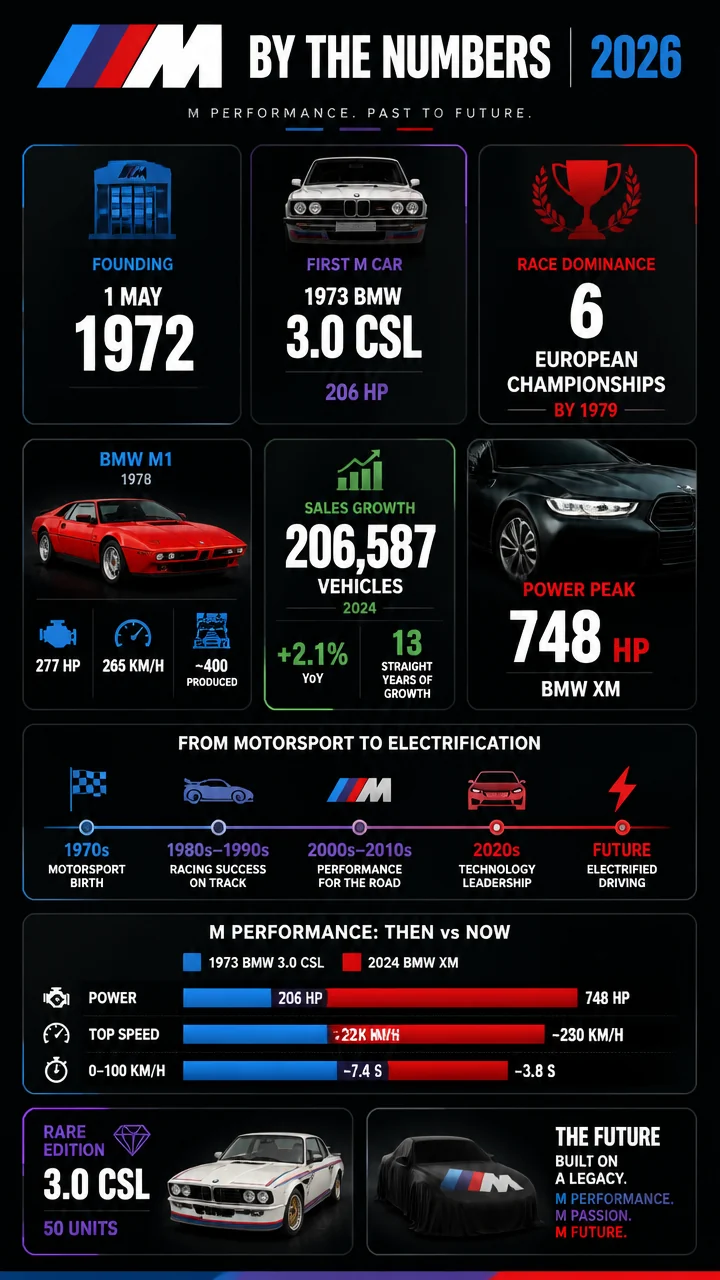
BMW M has evolved from a motorsport-focused subsidiary into one of the most recognizable performance brands in the world.
The numbers behind that transformation show a rare mix of racing dominance, sales growth, and a fast shift into electrification.
From the first BMW M road car in 1973 to a 748 hp hybrid flagship in 2023, these BMW M statistics reveal how the division has stayed relevant while changing almost everything else.
BMW M statistics at a glance
Fast facts:
- 1972 marked the founding of BMW Motorsport GmbH, the origin of BMW M.
- 206,587 performance and high-performance vehicles were sold in 2024.
- +2.1% was BMW M’s year-over-year sales growth in 2024.
- 13 consecutive years of sales growth were recorded in 2024.
- 748 hp is the peak output of the BMW XM.
- 50 units made up the limited 3.0 CSL comeback model in 2022.
Why it matters: BMW M is no longer just a racing badge.
The data shows a brand that has scaled globally, expanded into SUVs, hybrids, and EVs, and still keeps one foot firmly in motorsport.
Table of contents
- BMW M origin and history statistics
- BMW M performance car statistics
- BMW M sales and growth statistics
- BMW M motorsport statistics
- BMW M electric and hybrid statistics
- BMW M model comparison table
BMW M origin and history statistics
BMW M was founded on 1 May 1972 as BMW Motorsport GmbH, created to concentrate BMW AG’s motorsport activities.
That origin story still defines the division, and BMW M says it has been shaped by motorsport and automobiles from 1972 to the present day.
The early timeline is important because it explains why BMW M’s identity never settled on just one formula.
It began in racing, but very quickly turned into road cars that carried motorsport lessons onto public roads.
Key takeaways
- The first BMW M road car, the BMW 3.0 CSL, debuted in 1973.
- The first BMW M3 launched in 1986, and the first BMW M5 followed in 1987.
- BMW M’s expansion into SUVs came much later, with the X5 M and X6 M premiering in 2009.
- The first fully electric BMW M car arrived in 2021 with the i4 M50.
Big number: BMW M’s comeback 3.0 CSL in 2022 was limited to just 50 units, making it one of the most exclusive entries in the brand’s anniversary era.
The brand also built credibility through people as much as products.
Rauno Aaltonen became chief instructor for BMW driver safety training in 1977, and the first BMW Junior Team line-up included Manfred Winkelhock, Eddie Cheever, and Marc Surer.
Early BMW M milestones
- 1972: BMW Motorsport GmbH founded.
- 1973: BMW 3.0 CSL debuted.
- 1978: BMW M1 debuted.
- 1986: First BMW M3 launched.
- 1987: First BMW M5 launched.
BMW M performance car statistics
The first BMW 3.0 CSL produced 206 hp, a figure that was impressive for a road car in the early 1970s.
It also used lightweight construction, and BMW says it remained the most powerful road version of the series when it launched.
Its competition record is even more striking.
The 3.0 CSL won the European Championship title in its first season and then added five more European Touring Car Championship wins from 1974 to 1979.
BMW M says it was unbeatable in six European championships through 1979.
BMW M’s next defining statement came with the M1 in 1978.
The car weighed 1,300 kg, produced 277 hp, and reached a top speed of 265 km/h.
BMW says around 400 road cars were produced, which helps explain why the M1 became such a cult object.
Stat spotlight: The BMW M1’s 3.5-litre, 6-cylinder engine produced 330 Nm of torque, showing that the early M formula balanced power with serious engineering depth.
By the 1980s, BMW M had clearly learned how to make performance cars that could also become benchmarks.
The first M3 became, according to BMW M, the most successful touring car in history.
The first M5 then extended the formula to the executive-sedan segment with 286 hp, a 5-speed manual, and handcrafted assembly.
Why it matters: BMW M didn’t simply build faster versions of regular BMWs.
It repeatedly created new categories of performance cars, from the compact M1 to the sedan-based M5 and the SUV-based X5 M.
Notable BMW M road-car milestones
- 1973 BMW 3.0 CSL: 206 hp, lightweight construction, championship-winning debut.
- 1978 BMW M1: 277 hp, 265 km/h top speed, around 400 road units.
- 1986 BMW M3: first generation became the most successful touring car in history.
- 1987 BMW M5: 286 hp, 3.5-litre inline six, handcrafted build.
- 1997 BMW Z3 M Coupé: 321 hp and more than 100 hp per litre for the first time.
BMW M sales and growth statistics
BMW M is not just a motorsport story; it is also a sales story.
In 2024, BMW M sold 206,587 performance and high-performance vehicles, up from 202,431 in 2023.
That was +2.1% year over year and marked BMW M’s 13th consecutive year of sales growth.
In a premium performance market where many brands rely on niche volumes, that consistency stands out.
At a glance
- 2023 sales: 202,431 units
- 2024 sales: 206,587 units
- Growth: +4,156 units
- YoY change: +2.1%
- Growth streak: 13 straight years
BMW also reported that almost one in ten BMW brand vehicles delivered in 2024 was an M model.
That is a major signal that M has moved from being a niche halo badge to a deeply embedded part of BMW’s mainstream performance mix.
Another notable detail: BMW M’s best-selling model in 2024 was the all-electric BMW i4 M50.
That suggests the brand’s volume engine is now tied to electrification rather than traditional combustion alone.
BMW M sales snapshot
| Metric | 2023 | 2024 |
|---|---|---|
| BMW M sales | 202,431 | 206,587 |
| Year-over-year change | — | +2.1% |
| Growth streak | 12 years | 13 years |
Pull quote: BMW M sold 206,587 vehicles in 2024, its highest figure in the dataset and another sign that performance demand remains resilient.
BMW M motorsport statistics
BMW M’s racing record is one of the strongest in the performance-car world.
The division’s identity was shaped by victories first, and the data shows that pattern continuing across decades.
The 3.0 CSL is the clearest early example.
It won the European Championship title in its first season and then went on to dominate the European Touring Car Championship through the late 1970s.
Later, BMW M says BMW M teams, drivers, and vehicles dominated the DTM from 1984 to 1992.
BMW’s Formula 1 chapter also matters.
BMW announced its entry into Formula 1 on 24 April 1980, and its first Formula 1 victory came in June 1982 in Montreal with the Brabham BT50 Turbo and Nelson Piquet.
The turbo engine project had been led by Paul Rosche since 1969, highlighting how long-term engineering bets paid off.
Key motorsport numbers
- 6 European championships were won by the 3.0 CSL through 1979.
- 1984 to 1992: BMW M dominated the DTM era.
- 1983: BMW 635 CSi won the 24 Hours of Spa.
- 21st overall victory: BMW M’s 2025 Nürburgring 24 Hours win.
BMW M’s endurance record is especially notable.
The 2025 Nürburgring 24 Hours produced BMW M’s 21st overall victory in the race, and BMW says no other manufacturer has won the event overall as often.
That is the kind of statistic that turns a brand into an institution.
BMW M motorsport highlights by era
- 1970s: 3.0 CSL dominates European touring car racing.
- 1980s: Formula 1 breakthrough and DTM success.
- 2010s: DTM comeback delivers four victories before Bruno Spengler’s 2012 championship.
- 2020s: endurance racing returns with the hybrid M Hybrid V8.
BMW M electric and hybrid statistics
BMW M’s biggest strategic shift is clear in the numbers: the brand is now building high-performance cars around electric assistance, hybrid systems, and in one case, a fully electric platform.
The BMW i4 M50 launched in 2021 as BMW M’s first fully electric car.
In Sport Boost mode it delivered 544 hp, reached 100 km/h in 3.9 seconds, and offered a WLTP range of over 500 km.
That combination makes it one of the strongest “everyday performance” cases in the BMW M lineup.
Then came the BMW XM in 2023.
It became BMW M’s most powerful production model at up to 550 kW or 748 hp, was the brand’s first model with an electrified drivetrain, and introduced the M Lounge in the rear for the first time.
Big number: 748 hp puts the BMW XM at the top of the production-output hierarchy in this dataset.
BMW M also returned to endurance racing in early 2023 with the BMW M Hybrid V8.
It debuted at the 24 Hours of Daytona, later scored its first victory at the 6 Hours of Watkins Glen, and uses a 4.0-litre V8 turbo engine plus an electric motor.
BMW says it makes around 640 hp and weighs only around one tonne.
This is a useful summary of where BMW M is headed: more hybrid power, more usable range, and more performance models that are not defined solely by engine displacement.
Electric and hybrid BMW M milestones
- 2021: i4 M50 becomes BMW M’s first fully electric model.
- 2023: XM becomes the first electrified-drivetrain model.
- 2023: M Hybrid V8 returns BMW M to endurance racing.
- 2024: BMW M Hybrid V8 becomes the basis for the 22nd BMW Art Car.
BMW M model comparison table
The easiest way to see BMW M’s evolution is to compare its most important models side by side.
The table below shows how the division has moved from lightweight, compact, combustion-led performance to electrified powerhouses.
| Model | Debut | Power | Other standout figure |
|---|---|---|---|
| BMW 3.0 CSL | 1973 | 206 hp | Won the European Championship in its first season |
| BMW M1 | 1978 | 277 hp | Top speed of 265 km/h; around 400 road cars produced |
| BMW M5 | 1987 | 286 hp | Handcrafted; 5-speed manual |
| BMW X5 M / X6 M | 2009 | 555 hp | First all-wheel-drive and first turbo-engine M models |
| BMW 1 Series M Coupé | 2011 | 340 hp | 6,331 units; 0–100 km/h in 4.9 seconds |
| BMW i4 M50 | 2021 | 544 hp | Over 500 km WLTP range; 0–100 km/h in 3.9 seconds |
| BMW M3 Touring | 2022 | 510 hp initially | Later raised to 530 hp; standard M xDrive |
| BMW XM | 2023 | 748 hp | Most powerful production BMW M model in the dataset |
What stands out: BMW M has more than doubled its flagship output from the 277 hp M1 era to the 748 hp XM era, while also broadening its lineup into EVs, SUVs, and touring wagons.
BMW M benchmarks, records, and surprising figures
Some BMW M statistics are less about product launches and more about benchmarks that define the brand’s identity.
- The BMW Z3 M Coupé was the first BMW M car to exceed 100 hp per litre, thanks to its 3.2-litre inline six and 321 hp.
- The 1 Series M Coupé was built for just one year, yet still delivered 6,331 units.
- The X6 M matched the Nordschleife time of a BMW M3 E46, showing how quickly SUV performance had closed the gap to a legendary sports sedan.
- The M3 CS Touring set a Nürburgring best time with test driver Jörg Weidinger, reinforcing BMW M’s ongoing lap-time credibility.
- The M5 Sedan and M5 Touring pair hybrid performance with real-world efficiency, each offering roughly 60 km of electric range.
At a glance: BMW M’s story is not one of straight-line power alone.
It is a story of engineering firsts, racing titles, limited editions, and new segments turned into performance territory.
BMW M market data and future-facing takeaways
BMW M’s 2024 sales and model mix show a brand that has learned how to make performance scalable.
Traditional icons like the M3 and M5 still matter, but the volume leader is now the i4 M50, and the flagship status sits with the XM.
That combination suggests a simple but powerful trend in the BMW M statistics: the brand is growing by widening the definition of what “M” can be.
It now includes combustion, hybrid, and fully electric models; compact coupes and touring wagons; sedans, SUVs, and race cars.
Key takeaways
- BMW M started as a motorsport specialist in 1972 and still uses racing as its core brand engine.
- Sales reached a record-high level in this dataset at 206,587 units in 2024.
- The shift to electrification is already measurable through the i4 M50’s volume leadership.
- BMW M’s strongest products now span the full spectrum from race-track relevance to daily usability.
Pull quote: BMW M recorded 13 consecutive years of sales growth in 2024, a rare achievement for any performance division that has also remained active in elite motorsport.