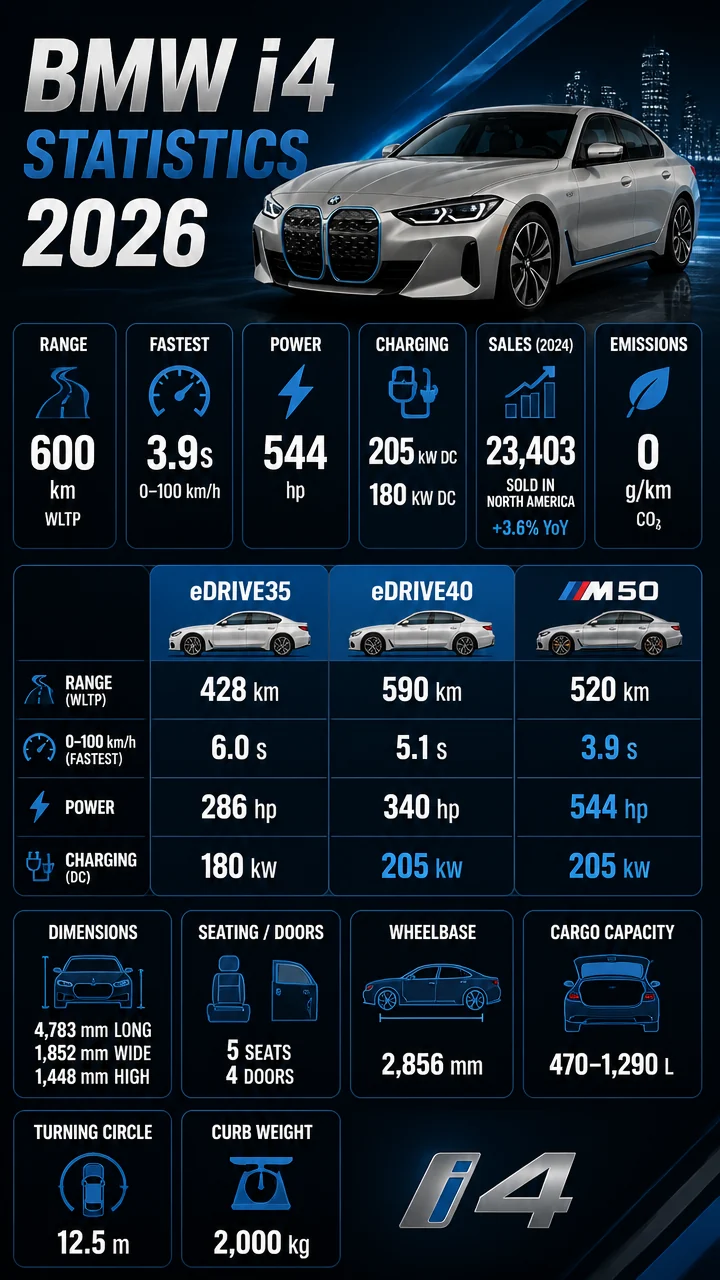
BMW i4 statistics at a glance
The BMW i4 sits in one of the most competitive EV segments, yet its numbers show a rare mix of long-range efficiency, strong performance, and everyday practicality.
From 0 g/km CO2 to 544 hp in the M50 xDrive, the BMW i4 lineup covers a remarkably wide spread.
- Range leader: The i4 eDrive40 reaches up to 600 km WLTP range.
- Fastest model: The i4 M50 xDrive hits 100 km/h in 3.9 seconds.
- Sales momentum: BMW of North America sold 23,403 i4s in 2024, up 3.6% year over year.
- High-voltage charging: The eDrive40 supports up to 205 kW DC charging, while the eDrive35 supports 180 kW DC.
- Plant shift: BMW says Munich will produce only electric vehicles from 2027.
BMW i4 statistics table of contents
- Size and space statistics
- Performance statistics
- Battery, range, and charging statistics
- Efficiency and emissions statistics
- Safety and chassis statistics
- Sales and market statistics
- Production and plant statistics
BMW i4 size and space statistics
Big number: the BMW i4 eDrive35 and eDrive40 both measure 4,783 mm long, 1,852 mm wide, and 1,448 mm high, making the sedan-like Gran Coupé footprint identical across these trims.
That shared body shape helps explain why BMW positions the i4 as a practical electric four-door rather than a niche performance EV.
The dimensions are consistent across the eDrive35 and eDrive40, while the room and utility numbers give it real family-car appeal.
| BMW i4 metric | eDrive35 | eDrive40 |
|---|---|---|
| Seats / doors | 5 / 4 | 5 / 4 |
| Length | 4,783 mm | 4,783 mm |
| Width | 1,852 mm | 1,852 mm |
| Height | 1,448 mm | 1,448 mm |
| Wheelbase | 2,856 mm | Not provided in the dataset |
| Turning circle | 12.5 m | Not provided in the dataset |
| Ground clearance | 125 mm | Not provided in the dataset |
- 5 seats and 4 doors give the i4 a conventional premium-sedan layout.
- 2,856 mm wheelbase suggests strong cabin packaging for a car this size.
- 12.5 m turning circle is useful for tight city maneuvering.
- 125 mm ground clearance keeps the i4 low and planted rather than SUV-like.
Why it matters: the i4’s size statistics show BMW did not chase crossover proportions to win EV buyers.
Instead, it optimized a low-slung body for efficiency, handling, and aerodynamics.
The i4 eDrive35 offers 470 to 1,290 liters of cargo volume, which is a major jump from everyday trunk usability to serious loading flexibility when the rear seats are folded.
- 470 liters in standard use
- 1,290 liters with the rear seats folded
- 75 kg roof load limit
- 75 kg towbar nose weight limit
BMW i4 performance statistics
The BMW i4 lineup splits cleanly into three performance tiers: efficient rear-drive versions, a more powerful dual-motor all-wheel-drive model, and the M-badged flagship.
The spread is wide enough to cover commuters, long-distance drivers, and performance shoppers in one body style.
| BMW i4 model | Power | Torque | 0-100 km/h | Top speed |
|---|---|---|---|---|
| i4 eDrive35 | 210 kW / 286 hp | 400 Nm | 6.0 s | 190 km/h |
| i4 eDrive40 | 250 kW / 340 hp | 430 Nm | 5.7 s | 190 km/h |
| i4 xDrive40 | 295 kW / 401 hp | 600 Nm | 5.1 s | 200 km/h |
| i4 M50 xDrive | 400 kW / 544 hp | 795 Nm | 3.9 s | 225 km/h |
Pull-quote stat: the jump from the eDrive35 to the M50 xDrive is enormous: 286 hp to 544 hp, plus a 0-100 km/h sprint cut from 6.0 seconds to 3.9 seconds.
- eDrive35: 210 kW and 400 Nm, aimed at balanced everyday use.
- eDrive40: 250 kW and 430 Nm, with a clear boost in power and range.
- xDrive40: 295 kW and 600 Nm, adding all-wheel-drive traction and stronger acceleration.
- M50 xDrive: 400 kW and 795 Nm, the performance outlier of the range.
The common thread across all versions is BMW’s single-speed automatic transmission with a fixed 11.115:1 ratio.
That simplicity is one of the quiet strengths of EV drivetrains: no shift interruptions, just immediate torque delivery.
The eDrive35 also shows how BMW tuned the motor for real-world usability.
It uses fifth-generation BMW eDrive technology, a separately excited synchronous motor, and a recuperation function.
Peak motor speed reaches 6,000 rpm, with the torque band running from 0 to 4,500 rpm.
The i4 range is not built around one headline figure.
Instead, BMW offers a clear ladder: more power, more traction, more speed, and, in some cases, more efficiency trade-offs as buyers move up the lineup.
BMW i4 battery, range, and charging statistics
Big number: the eDrive40 battery carries 83.9 kWh gross and 81.3 kWh net, while the eDrive35 uses a smaller 70.3 kWh gross and 67.1 kWh net pack.
That battery gap is one of the biggest reasons the eDrive40 delivers more range.
| BMW i4 model | Battery gross | Battery net | DC 10-80% | 10-min DC range | WLTP range |
|---|---|---|---|---|---|
| i4 eDrive35 | 70.3 kWh | 67.1 kWh | 32 min at 180 kW | 144 km | 406 to 500 km |
| i4 eDrive40 | 83.9 kWh | 81.3 kWh | 30 min at 205 kW | 154 km | 491 to 600 km |
| i4 xDrive40 | 83.9 kWh | 81.3 kWh | Not provided in the dataset | 149 km | 459 to 546 km |
| i4 M50 xDrive | Not provided in the dataset | Not provided in the dataset | Not provided in the dataset | 135 km | 416 to 520 km |
Stat highlight: the eDrive40’s 491 to 600 km WLTP range is the highest range figure in the dataset, making it the long-distance standout of the line-up.
- eDrive35: 0 to 100% AC charging in 7 hours at 11 kW.
- eDrive40: 0 to 100% AC charging in 8.5 hours at 11 kW.
- eDrive35: 10 to 80% DC charging in 32 minutes.
- eDrive40: 10 to 80% DC charging in 30 minutes at an initial 205 kW.
- xDrive40: 10 minutes of DC charging adds up to 149 km of range.
- M50 xDrive: 10 minutes of DC charging adds up to 135 km of range.
The charging figures make a useful comparison story.
The eDrive40 charges faster at DC than the eDrive35 despite having a larger battery, while the M50 xDrive sacrifices some efficiency for its performance mission.
The result is a lineup where buyers can choose between speed, range, and charging convenience without leaving the same model family.
Pull quote: a 10-minute DC session adds up to 154 km on the eDrive40, which is one of the clearest everyday-use statistics in the whole dataset.
BMW i4 efficiency and emissions statistics
The BMW i4’s efficiency numbers show how different power outputs affect consumption while keeping emissions at zero.
Even the performance-focused M50 xDrive remains an EV with 0 g/km CO2 and a CO2 class A rating.
| BMW i4 model | Combined WLTP consumption | 130 km/h consumption | CO2 |
|---|---|---|---|
| i4 eDrive35 | 18.6 to 15.1 kWh/100 km | 22.5 kWh/100 km | 0 g/km |
| i4 eDrive40 | 18.6 to 15.4 kWh/100 km | 22.4 kWh/100 km | Not provided in the dataset |
| i4 xDrive40 | 19.8 to 16.7 kWh/100 km | 23.3 kWh/100 km | Not provided in the dataset |
| i4 M50 xDrive | 21.9 to 17.6 kWh/100 km | 25.7 kWh/100 km | Not provided in the dataset |
Why it matters: the efficiency ladder is very clear.
As BMW moves from rear-wheel drive to dual-motor performance, consumption rises, and WLTP range falls accordingly.
- Lowest combined consumption: eDrive35 at 18.6 to 15.1 kWh/100 km.
- Best high-speed efficiency: eDrive40 at 22.4 kWh/100 km at 130 km/h.
- Highest consumption: M50 xDrive at 25.7 kWh/100 km at 130 km/h.
The dataset also shows a useful road-trip lesson: high-speed driving reduces efficiency across the board.
The jump from combined WLTP figures to the 130 km/h metric is notable on every variant, especially the M50 xDrive.
The eDrive35 combines 406 to 500 km of WLTP range with 18.6 to 15.1 kWh/100 km consumption, making it the most efficiency-focused trim in the supplied data.
BMW i4 safety, chassis, and utility statistics
BMW packed the i4 with a long list of driving aids and underbody hardware that make it feel more like a conventional premium BMW than a minimalist EV experiment.
- Front axle: double-joint strut design
- Rear axle: five-link layout
- Front brakes: ventilated four-piston disc brakes
- Rear brakes: ventilated single-piston disc brakes
- Steering ratio: 15.5:1 with EPS and Servotronic
- Optional feature: variable sport steering
- Tires: 225/55 R17 101Y XL on 7.5J x 17 LM wheels
Stat highlight: the standard equipment list includes DSC, ABS, ASC, DTC, ARB, CBC, DBC, hill-start assist, hill-descent control, trailer stability control, and performance control.
That collection of chassis and stability systems suggests the i4 is built to be usable in a wide range of conditions, not just optimized for quick straight-line acceleration.
The utility figures reinforce the same idea:
- 555 kg payload
- 2,555 kg gross vehicle weight rating
- 1,105 kg front axle load
- 1,530 kg rear axle load
- 1,600 kg braked towing capacity
- 750 kg unbraked towing capacity
Those numbers matter for buyers who need more than commuter range.
The i4 can carry real loads, tow a trailer, and still stay within a premium fastback profile.
Pull-quote: a 75 kg roof load limit and 75 kg towbar nose weight limit round out the i4’s practical-use credentials.
BMW i4 sales and market statistics
The market data shows that the BMW i4 is not just a specification-sheet success.
It is contributing meaningfully to BMW’s electric sales base in the U.S.
| Sales metric | 2023 | 2024 | Change |
|---|---|---|---|
| BMW i4 Q4 sales in North America | 5,402 | 5,737 | +6.2% |
| BMW i4 full-year sales in North America | 22,583 | 23,403 | +3.6% |
| BMW U.S. battery-electric vehicle sales | 45,417 | 50,981 | +12.3% |
- 23,403 i4s sold in the U.S. in 2024.
- 5,737 units were sold in Q4 2024 alone.
- BMW’s U.S.
BEV sales
crossed 50,000 units in 2024. - Four fully electric BMW BEV models were in market from the start of 2024.
Why it matters: the i4’s sales growth was modest compared with BMW’s broader U.S.
BEV growth, which indicates the brand’s EV portfolio is expanding beyond a single nameplate.
Stat highlight: BMW’s U.S.
BEV volume rose by 5,564 units year over year, while i4 volume rose by 820 units from 2023 to 2024.
BMW i4 production statistics and Plant Munich facts
The BMW i4 is deeply tied to BMW Group Plant Munich, where the brand has been reworking production for an electric future.
The plant story gives the i4 broader strategic importance beyond its retail numbers.
€650 million is the approximate investment BMW Group says it is making in Plant Munich’s rebuild.
- 2021: the first all-electric BMW i4 was built on the Munich production line.
- Almost half of output: BMW says electrified drivetrains now account for nearly half of Plant Munich production.
- Around 1,000 vehicles per day: leave Plant Munich during the rebuild.
- 2026: Munich begins producing Neue Klasse vehicles alongside current models.
- 2027: Munich is scheduled to produce only electric vehicles.
Why it matters: the i4 is not just an EV model in BMW’s lineup; it is part of the transition story for one of the company’s flagship plants.
The timeline shows how BMW is bridging current EV production with the next generation of electric vehicles.
The combination of the i4’s launch in 2021, the ongoing Munich rebuild, and the 2026-2027 production shift suggests BMW is treating electrification as a long-term manufacturing reset rather than a short-term product trend.
BMW i4 statistics summary: what stands out most
- Range and power span a wide spectrum: 286 hp to 544 hp, and 406 km to 600 km WLTP range.
- The eDrive40 is the sweet spot for range: it leads the lineup with up to 600 km WLTP range and 154 km added in 10 minutes of DC charging.
- The M50 xDrive is the performance benchmark: 3.9 seconds to 100 km/h and 225 km/h top speed.
- BMW kept the i4 practical: 5 seats, 4 doors, 470 to 1,290 liters of cargo space, and real towing capability.
- Sales are moving in the right direction: U.S. i4 sales rose to 23,403 in 2024, while BMW’s total U.S.
BEV sales surpassed 50,000.
- The manufacturing story is bigger than the car: Munich is on course to become an all-electric plant from 2027.
BMW i4 statistics show a car that is not defined by one number. It is defined by a rare combination of practicality, range, efficiency, performance, and production-scale significance.