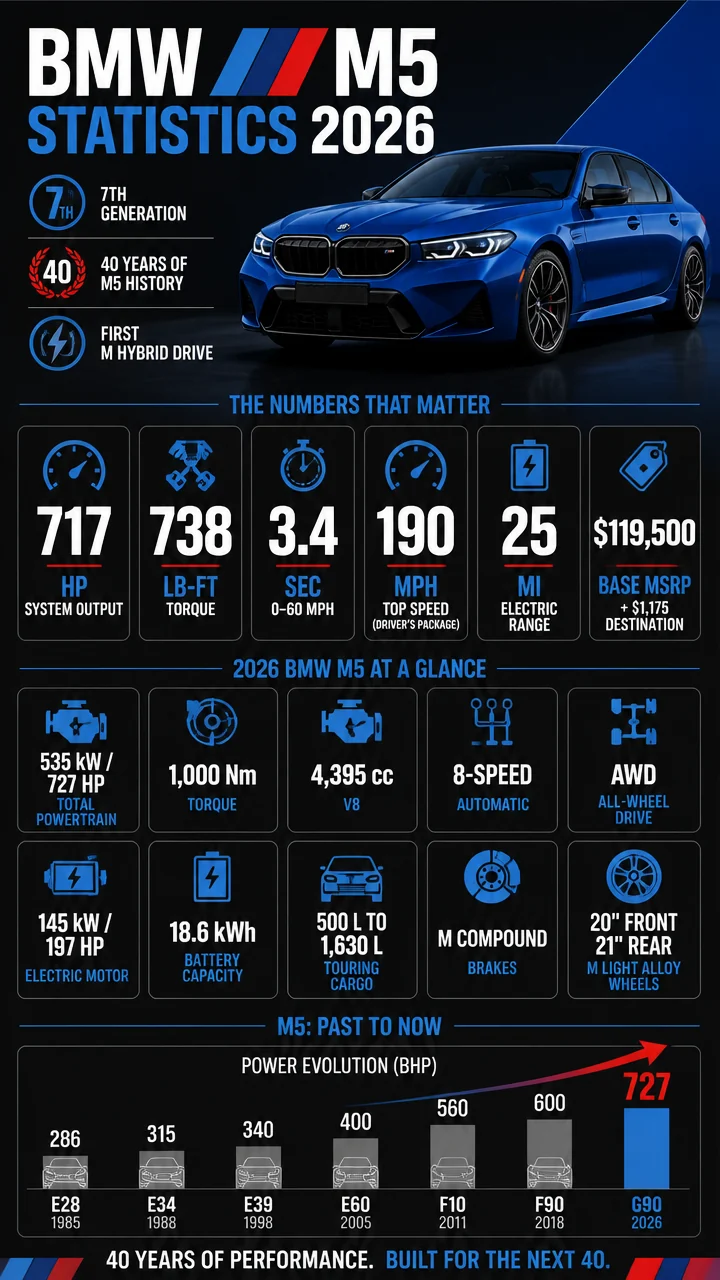
BMW M5 statistics at a glance
The BMW M5 has always been the benchmark for the fast executive sedan, but the latest numbers show just how dramatically the formula has changed.
The 2025 M5 adds hybrid power, more output, and real electric-only capability without giving up the model’s long-standing performance identity.
- 717 hp maximum system output in the 2025 BMW M5.
- 738 lb-ft peak system torque in the 2025 U.S.-spec M5.
- 3.4 seconds to 60 mph, according to BMW USA.
- 25 miles of estimated all-electric range in the U.S. press release.
- 18.6 kWh battery capacity in the Australian technical data.
Why it matters: the current M5 is no longer just about straight-line speed.
The data points to a heavier, electrified, all-wheel-drive flagship that still pushes into supercar territory while adding efficiency and usable EV range.
- The M5 now blends a twin-turbo V8 with hybrid assistance for the first time in the nameplate’s history.
- BMW’s figures vary slightly by market, with U.S. and Australian outputs listed in different testing and naming conventions.
- Across generations, the M5 has gone from 286 bhp to as much as 727 hp at the system level.
- Practicality remains part of the appeal, especially in the Touring, which expands cargo space from 500 l to 1,630 l.
BMW M5 statistics and the 2025 powertrain data
The 2025 BMW M5 is the 7th generation of the model and marks 40 years of M5 history, according to BMW USA.
It is also the first M5 to use BMW M Hybrid drive, a major shift for a nameplate historically associated with large gasoline engines and rear-biased dynamics.
Big number: BMW USA says the 2025 M5 produces 717 hp and 738 lb-ft of system output.
That puts the new car firmly in modern super-sedan territory.
- 0-60 mph: 3.4 seconds
- Top speed: 190 mph with the optional M Driver’s Package
- Electric range: about 25 miles
- Base MSRP: $119,500
- Destination and handling: $1,175
The U.S. release also says worldwide launch would begin in Q4 2024, which placed the car’s rollout squarely in the transition from traditional performance sedan to electrified flagship.
BMW Australia’s technical data gives a slightly different but compatible picture of the same car: 535 kW / 727 hp total powertrain output and 1,000 Nm total torque.
That same market listing shows the M5 using an 8-speed automatic transmission and all-wheel drive.
BMW M5 performance statistics by the numbers
The latest M5’s performance figures are striking not just on their own, but in the context of the car’s size and weight.
BMW Australia lists a curb weight of 2,510 kg, yet the sedan still reaches 0-100 km/h in 3.5 seconds and 0-100 km/h with 1-foot rollout in 3.2 seconds.
Additional performance figures from BMW Australia include:
- 305 km/h top speed
- 140 km/h electric top speed
- 3.2 l/100 km combined fuel use
- 72 g/km combined CO2 emissions
- 261 kWh/100 km combined WLTP energy consumption as listed on the technical page
The combination of a high-output V8, electric assist, and all-wheel drive explains how the M5 can deliver both explosive acceleration and low official emissions figures.
The car’s battery also enables short-range EV driving, with BMW Australia listing up to 65 km of electric range and an 18.6 kWh battery.
BMW M5 drivetrain and engine statistics
BMW Australia’s technical page breaks out the powertrain in detail.
The combustion engine is an 8-cylinder unit with a displacement of 4,395 cm3, outputting 430 kW / 585 hp at 5,600-6,500 rpm and 750 Nm at 1,800-5,400 rpm.
The electric motor is rated at 145 kW / 197 hp nominal power with 280 Nm nominal torque.
Together, those figures support the car’s combined output and explain why the M5 can launch so hard despite its size.
- The engine still does the heavy lifting for sustained performance.
- The electric motor adds instant torque and hybrid flexibility.
- AWD helps manage the combined 1,000 Nm total torque figure listed for the sedan.
BMW M5 Touring statistics: practicality without giving up the pace
The M5 Touring extends the formula into wagon territory without softening the core message.
BMW M5 Touring press kit figures show weighted combined CO2 of 46 g/km and weighted combined fuel use of 2.0 l/100 km, with weighted combined electric use of 30.7 kWh/100 km.
Fast fact: The Touring is rated at 3.6 seconds to 0-100 km/h, only a tenth slower than the sedan in the BMW Australia data.
That’s important because the Touring isn’t just a styling variation.
It adds real loading utility while staying within super-sedan acceleration territory.
| BMW M5 Touring statistic | Figure |
|---|---|
| 0-100 km/h | 3.6 seconds |
| Maximum electric-only driving speed | 140 km/h |
| Usable battery energy | 18.6 kWh |
| Load capacity | 500 l to 1,630 l |
| Maximum trailer load | 2,000 kg |
| M Driver’s Package top speed change | 250 km/h to 305 km/h |
The Touring’s cargo figures are especially notable: luggage space grows from 500 l to 1,630 l.
For buyers who want an M car that can carry more than weekend bags, that is one of the most compelling statistics in the range.
BMW M5 price, range, and efficiency statistics
Pricing gives the 2025 M5 another layer of context.
BMW USA lists a base MSRP of $119,500, with $1,175 added for destination and handling.
That positions the M5 as a premium flagship even before options such as the M Driver’s Package.
Efficiency figures are equally revealing.
BMW Australia lists a combined fuel consumption of 3.2 l/100 km and a combined CO2 figure of 72 g/km, while the U.S. release gives an estimated 25-mile zero-emissions range.
The Australian data goes further, naming up to 65 km of electric range.
- $119,500 base MSRP
- $1,175 destination and handling
- 18.6 kWh battery capacity
- 11 kW AC charging power
- 2 hours 15 minutes for AC 0-100% charging
The charging data matters because it shows the M5’s hybrid system is meant to be used, not just advertised.
With 11 kW AC charging and a 2 hour 15 minute full-charge time, owners can replenish the battery at home or at suitable charging points without extraordinary delays.
BMW M5 size, weight, and utility statistics
The 2025 M5’s size explains a lot about its character.
BMW Australia lists it at 5,096 mm long, 1,970 mm wide, and 1,510 mm high, with a 3,006 mm wheelbase.
Width including mirrors reaches 2,156 mm.
These dimensions make the M5 a large car, and the weight confirms it: 2,510 kg curb weight, 2,940 kg permissible gross weight, and 505 kg payload.
- Roof rack mount load: 75 kg
- Braked trailer load support: 2,000 kg
- Towbar download: 100 kg
- Luggage capacity: 466 l
- Tank capacity: 60 l
Why it matters: the M5 remains a genuine all-rounder.
The numbers show a performance car that can still tow, carry luggage, and handle long trips instead of being a single-purpose machine.
BMW M5 history statistics: how the car evolved across generations
The strongest story in the BMW M5 statistics dataset is the long-term rise in output.
The original M5 from 1984-1987 produced 210 kW / 286 bhp from a straight-six engine.
The modern 2025 model delivers more than double that at the system level, even before considering electric support.
| Generation | Power | 0-100 km/h | Top speed | Production note |
|---|---|---|---|---|
| 1984-1987 original M5 | 210 kW / 286 bhp | 6.5 seconds | 245 km/h / 152 mph | About 2,200 units in Munich |
| 1988-1995 second generation | 232 kW / 315 bhp to 250 kW / 340 bhp | 6.3 seconds | 250 km/h / 155 mph | About 12,000 units in Munich |
| 1998 third generation | 294 kW / 400 bhp | 5.3 seconds | 250 km/h / 155 mph | More than 20,000 units total |
| 2011 fifth generation | 560 hp / 412 kW | 4.4 seconds (0-62 mph) | Not stated in dataset | About 30% less fuel than predecessor |
| 2018 M5 | 600 hp and 553 lb-ft | 3.2 seconds (0-60 mph) | 189 mph with M Driver’s Package | First M xDrive on an M passenger car |
| 2025 M5 | 717 hp system output | 3.4 seconds (BMW USA) | 190 mph with M Driver’s Package | First M Hybrid drive in the M5 line |
The progression is clear: every generation added power, speed, and sophistication, while also increasing the model’s reach.
Production grew from about 2,200 units in the first generation to more than 20,000 units by the third generation, showing how the M5 moved from cult hero to established performance icon.
BMW’s own history data also shows the tension between pace and efficiency.
The original M5 used 11.3 l/100 km of premium fuel, while the 2011 fifth-generation model consumed roughly 30% less fuel than its predecessor.
By the 2025 model, hybridization pushed the conversation toward electric range, emissions, and charging as much as raw speed.
BMW M5 benchmark comparisons and standout stats
Looking at the dataset as a whole, a few benchmarks stand out immediately.
- Performance benchmark: the 2018 M5 hit 3.2 seconds to 0-60 mph, while the 2025 M5 counters with a broader hybrid system and more torque.
- Efficiency benchmark: the 2025 Australian data lists 3.2 l/100 km combined fuel use and 72 g/km CO2, which is a dramatic shift for a car in this class.
- Practicality benchmark: the Touring’s 500 l to 1,630 l load expansion gives the M5 family a genuine utility advantage.
- Heritage benchmark: the nameplate has now reached its 7th generation and 40th year of history.
Pull quote: The M5 has moved from a fast straight-six sedan with 286 bhp into a hybrid flagship with up to 727 hp and genuine electric-only driving capability.
One of the most interesting comparisons is speed versus usability.
The current car is heavier and more technologically complex than any early M5, but it still delivers:
- Supercar-like acceleration
- All-wheel traction
- Short-distance EV driving
- Real towing and cargo utility
- A top-speed ceiling of 305 km/h or 190 mph depending on market and package
That combination explains why BMW M5 statistics remain so closely watched: the badge is no longer just a horsepower story.
It is also about how far the company can push a luxury sedan or wagon while keeping it usable, compliant, and fast enough to stay in the conversation.
BMW M5 statistics that define the current generation
If you only remember a few numbers from the latest M5, these are the most important:
- 717 hp maximum system output
- 738 lb-ft peak system torque
- 3.4 seconds to 60 mph
- 190 mph top speed with the M Driver’s Package
- 25 miles estimated all-electric range in the U.S. release
- $119,500 base MSRP
- 18.6 kWh battery capacity
- 3,006 mm wheelbase
- 466 l luggage capacity in the sedan
Those numbers tell the story of a car that is no longer defined by one trait.
The modern M5 is fast, heavy, expensive, electrically assisted, and still unmistakably built around performance.