BMW repair cost statistics can look intimidating until you separate covered maintenance from true out-of-pocket repairs.
The difference between a 4-year warranty, a 36-month maintenance plan, and long-duration battery coverage explains a lot of the brand’s ownership cost story.
This article breaks down the most useful BMW repair cost statistics from U.S. and UK BMW service programs, with a focus on coverage limits, service intervals, excluded repairs, and price benchmarks.
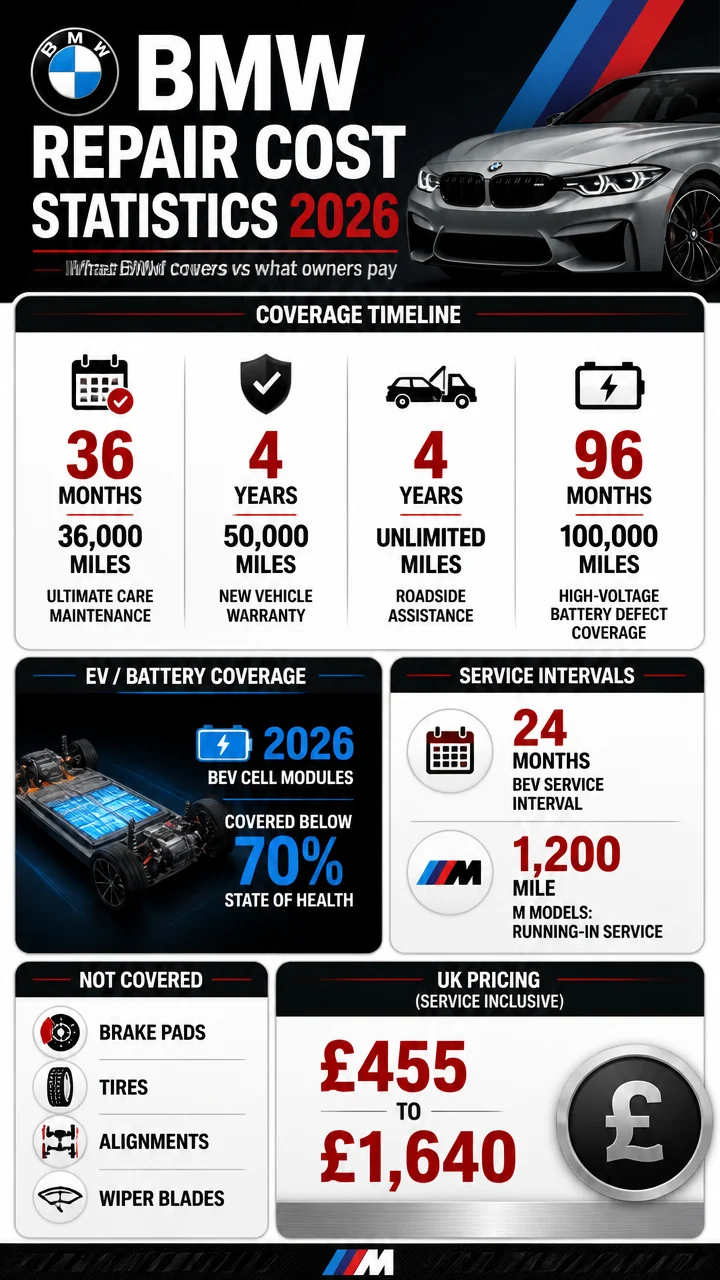
- 36 months or 36,000 miles is the standard BMW Ultimate Care maintenance window in the U.S.
- 4 years or 50,000 miles is BMW’s new vehicle warranty protection in the U.S.
- 96 months or 100,000 miles covers BMW high-voltage battery defects.
- £455 to £1,640 is the UK Service Inclusive range shown across select BMW model lines.
- BMW Ultimate Care excludes many wear items, including brake pads, tires, alignments, and wiper blades.
BMW repair cost statistics at a glance
BMW ownership costs are easier to understand when you look at the built-in protection first.
BMW’s programs cover several major maintenance items, but they stop well short of covering many everyday wear-and-tear expenses.
- BMW Ultimate Care covers scheduled maintenance for 36 months or 36,000 miles, whichever comes first.
- BMW roadside assistance is included for 4 years with unlimited miles.
- BMW new vehicle warranty lasts 4 years or 50,000 miles, whichever comes first.
- BMW high-voltage battery defect coverage lasts 96 months or 100,000 miles.
- BEV service warnings can appear within 3,000 miles or 3 months for a white indicator, and within 1,200 miles or 1 month for a yellow indicator.
Big number: BMW’s battery defect coverage stretches to 8 years in time terms, giving electric owners a much longer protection window than the brand’s standard maintenance plan.
BMW repair cost statistics: warranty and maintenance coverage
BMW’s coverage structure is split into three layers: scheduled maintenance, basic warranty protection, and longer battery-specific coverage.
That matters because the brand may cover the service itself, but not the wear parts that often trigger the biggest repair bills later.
| BMW coverage item | Duration / mileage | What it means |
|---|---|---|
| Ultimate Care scheduled maintenance | 36 months or 36,000 miles | Routine scheduled maintenance is covered during the qualifying period |
| New vehicle warranty | 4 years or 50,000 miles | General warranty protection outlasts maintenance coverage |
| Roadside assistance | 4 years, unlimited miles | Help continues even after maintenance coverage ends |
| High-voltage battery defect coverage | 96 months or 100,000 miles | Long-duration battery protection for electric models |
| 2026 BEV cell-module coverage | 96 months or 100,000 miles | Cell modules are separately covered below 70% state of health |
BMW’s maintenance window ends first.
That means many owners will start facing more out-of-pocket service expenses after 3 years, even though warranty and roadside support continue longer.
BMW repair cost statistics by service interval and maintenance timing
BMW’s maintenance display is built around mileage and date-based tracking, depending on the item.
That creates a service schedule that is relatively structured, but not always identical across components.
- Engine oil is tracked by both date and miles.
- Vehicle checks are tracked by both date and miles.
- Front brake pads and rear brake pads are tracked by miles.
- Brake fluid is tracked by date.
For battery-electric BMW models, the schedule is simpler on paper:
- Basic maintenance intervals use a 24-month time interval with no mileage influence.
- White service warnings appear within 3,000 miles or 3 months.
- Yellow service warnings appear within 1,200 miles or 1 month.
- BMW M models include a 1,200-mile running-in service.
- That break-in service is explicitly included at no expense during Ultimate Care eligibility.
- BMW’s service alerts aim to warn owners before intervals become urgent, especially on BEVs.
Oil-service milestones that matter
BMW’s engine oil service cadence becomes more revealing when the related items are grouped by approximate mileage.
These are the kinds of milestones that often shape repair cost expectations after coverage ends.
| Approximate interval | Related BMW maintenance items |
|---|---|
| 20,000 miles | Every 2nd engine oil service; coolant level check, ventilation microfilter replacement, remote control key battery replacement |
| 30,000 miles | Every 3rd engine oil service; air filter element replacement, spark plugs replacement |
| 40,000 miles | Every 4th engine oil service; air filter element replacement, remote control key battery replacement |
| 50,000 miles | Every 5th engine oil service; rear axle differential fluid, transfer case fluid on M3/M4 xDrive, M5, and M8; front axle differential fluid on BMW XM |
| 60,000 miles | Every 6th engine oil service; spark plugs replacement, remote control key battery replacement |
Pull-quote stat: BMW’s maintenance schedule clusters meaningful service items around 20,000, 30,000, 40,000, 50,000, and 60,000 miles, which makes long-term ownership planning easier, but also highlights how quickly service needs can stack up.
BMW repair cost statistics: what Ultimate Care covers
BMW Ultimate Care reduces scheduled maintenance costs significantly during the qualifying period, but its coverage is specific.
That specificity is good news for predictable service items and bad news for everything else.
- Engine oil service, including the oil filter
- Brake fluid replacement
- Vehicle inspection checks
- The 1,200-mile M-model break-in service
- Cabin microfilters when they qualify with an oil service
- Engine air filters when they qualify with an oil service
- Spark plugs when they qualify with an oil service
- Front differential or final drive oil for applicable M models when they qualify with an oil service
This matters because several expensive maintenance items are bundled into routine scheduled service, especially on performance models.
BMW drivers who stay inside the included period can avoid paying separately for some of the brand’s most common service tasks.
36 months or 36,000 miles is the line where BMW’s free scheduled maintenance typically ends in the U.S.
BMW repair cost statistics: what is not covered
The exclusions are where BMW repair cost statistics become most useful for estimating real-world ownership expense.
Many of the most common recurring costs are wear items that fall outside Ultimate Care.
| BMW Ultimate Care exclusions | Owner impact |
|---|---|
| Front and rear brake pads and discs | High-frequency wear components stay on the owner’s bill |
| Optional carbon ceramic brake pads and discs | Performance brake upgrades are excluded |
| Parking brake shoes or linings | Wear-related brake parts are not covered |
| Wiper blade assemblies and inserts | Routine visibility maintenance is excluded |
| Engine drive belt | A standard wear item remains outside the plan |
| Vehicle safety inspections | Inspection fees may still apply |
| Vehicle emissions tests | State or local testing costs are not included |
| Oxygen sensor replacements | Sensor-related repair expense is excluded |
| Wheel alignment, tire balancing, or tire rotation | Common tire-related service is not covered |
| Topping off low fluids | Only covered if done with a covered scheduled service |
Why it matters: BMW’s excluded items are exactly the kinds of repairs and maintenance tasks that can surprise owners after the complimentary maintenance period ends.
Brake wear, tires, alignments, and wipers are all routine, but none are included in the core plan.
BMW’s coverage is generous on scheduled items but deliberately narrow on wear-and-tear items, which means ownership costs can rise even when the car is still under warranty.
BMW repair cost statistics by model: UK Service Inclusive pricing
BMW’s UK Service Inclusive pricing provides a useful benchmark for how service costs scale by model class and term length.
Larger and more expensive vehicles tend to carry higher package prices, and longer coverage terms cost more across every line.
| BMW model group | 3 years | 4 years | 5 years |
|---|---|---|---|
| 1/2 Series | £455 | £750 | £1,000 |
| 3/4 Series | £470 | £835 | £1,044 |
| 5 Series | £570 | £950 | £1,300 |
| X5/X6 | £735 | £1,385 | £1,640 |
- Lowest-priced group: 1/2 Series at £455 for 3 years.
- Highest-priced group: X5/X6 at £1,640 for 5 years.
- Largest 5-year gap: £640 separates 1/2 Series (£1,000) from X5/X6 (£1,640).
- Steadiest pricing ladder: every model group becomes more expensive as the coverage term extends.
Big number: The UK price range spans £455 to £1,640 depending on model and term, showing that BMW service costs can more than triple between entry models and larger SUVs over longer coverage periods.
BMW repair cost statistics for EV owners and BEV maintenance
BMW’s electric-vehicle coverage is one of the most important parts of the repair-cost picture because battery-related claims can be expensive outside warranty.
The good news is that BMW gives BEV owners substantial battery protection.
- High-voltage battery defect coverage: 96 months or 100,000 miles
- 2026 BEV cell-module coverage: also 96 months or 100,000 miles
- Coverage threshold: separate cell-module protection applies below 70% state of health
- Maintenance interval: 24 months with no mileage influence
That combination suggests BMW is treating battery integrity as a long-term durability issue rather than a routine service event.
For BEV owners, the biggest maintenance surprise may be how simple the scheduled intervals are, while the biggest risk remains any repair outside the battery coverage window.
BMW BEVs have fewer mileage-driven service intervals than combustion models, but the long battery warranty is the real financial safety net.
BMW repair cost statistics: service planning benchmarks owners should know
If you want to forecast BMW maintenance expense more realistically, the most useful numbers are the ones that mark when coverage changes or major items tend to appear.
- 1,200 miles: M-model break-in service
- 20,000 miles: recurring bundled maintenance items begin to appear more visibly
- 30,000 miles: spark plugs and air filter elements become relevant
- 50,000 miles: fluids on performance and utility-focused drivetrains start to matter more
- 60,000 miles: additional spark plug and key-battery service cycles repeat
- 96 months / 100,000 miles: high-voltage battery protection remains in force
- 150,000 miles: oxygen sensor replacement is listed as a later-life service benchmark
Pull quote: BMW’s service schedule is front-loaded with covered maintenance, but many of the costs owners feel most acutely show up after the 36,000-mile maintenance window ends.
BMW repair cost statistics: quick owner takeaways
- BMW’s core scheduled maintenance support is relatively short at 36 months or 36,000 miles.
- The brand’s basic vehicle warranty lasts longer at 4 years or 50,000 miles.
- Battery protection is much more durable at 96 months or 100,000 miles.
- Many common costs are excluded, especially brakes, tires, alignments, wipers, belts, inspections, and emissions tests.
- UK Service Inclusive pricing rises consistently with model size and term length, topping out at £1,640 for X5/X6 over 5 years.
- BMW’s maintenance schedule is predictable, but that predictability does not automatically mean low repair costs.
For shoppers comparing BMW repair cost statistics, the most useful mindset is to treat BMW’s included maintenance as a short-term cushion, not a complete ownership-cost solution.
The most expensive surprises are often not the scheduled services themselves, but the excluded items that arrive after the complimentary window ends.