BMW tire statistics at a glance
BMW tire fitment is more than a spec-sheet detail: it shapes ride quality, handling, top speed, and even lease-end compliance.
Across sedans, coupes, SUVs, and performance models, BMW’s published data shows a steady expansion from 17- and 18-inch setups into 20-, 21-, and 22-inch wheel packages.
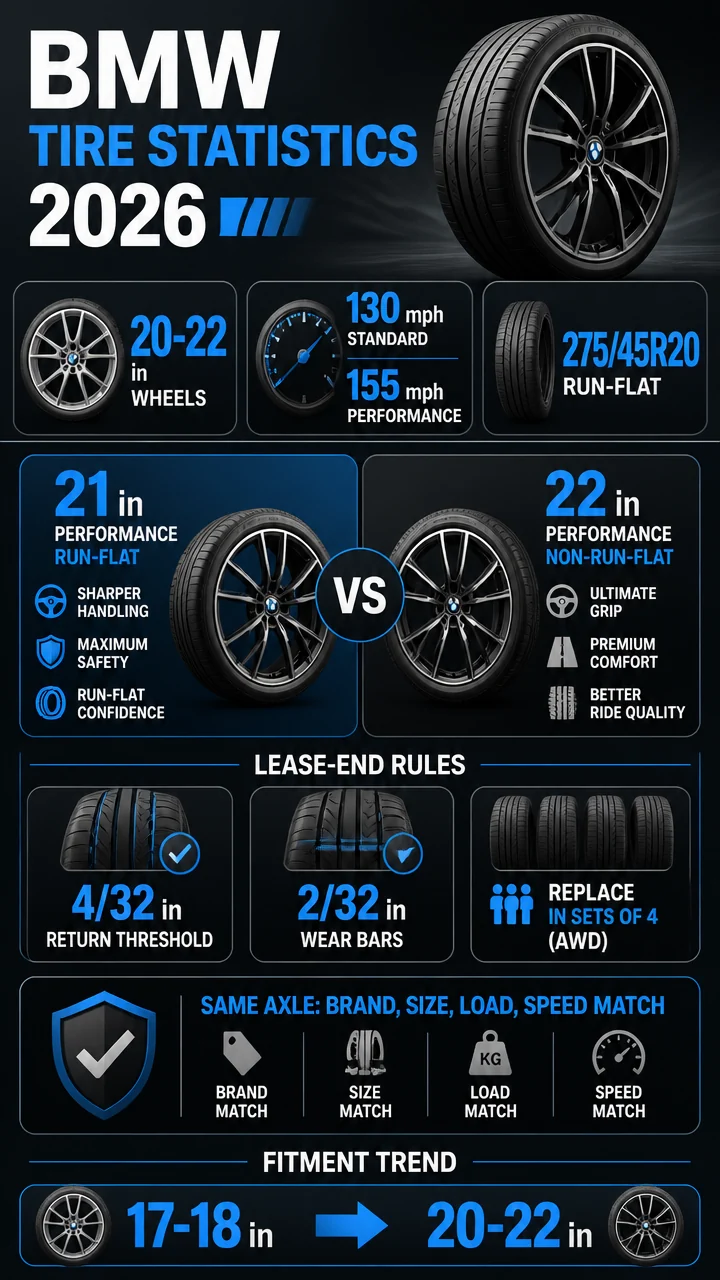
- BMW’s mainstream performance SUVs now commonly start on 20-inch wheels, with optional 21- and 22-inch packages.
- Several BMW models use run-flat tires by default, but larger performance packages may switch to non-run-flat tires.
- BMW’s top speed figures vary sharply by tire package: 130 mph on standard tires versus 155 mph with performance tires on the 2024 X5 and X6.
- BMW lease-end guidance requires replacement tires to match original equipment in size, speed rating, and run-flat specification when applicable.
- 4/32 inch is BMW’s lease-return tread-depth threshold.
- Tread wear indicator bars show wear down to 2/32 inch, which is below the return standard.
- BMW says all-wheel-drive or four-wheel-drive vehicles must have tires replaced in sets of four.
- BMW’s tire-manufacturer guide says tires on the same axle must match in manufacturer, brand, size, load index, speed rating, and Pirelli part number.
Table of contents
- BMW tire size trends by model
- BMW run-flat and non-run-flat tire data
- BMW SUV tire statistics: X3, X5, X6, X7
- BMW sedan and coupe tire benchmarks
- BMW performance tire statistics
- BMW lease-end and replacement tire rules
- What BMW tire statistics reveal about the brand
BMW tire size trends: bigger wheels are now the norm
One of the clearest patterns in the data is BMW’s movement toward larger wheel diameters and more specialized tire packages.
The brand’s recent releases show a premium vehicle lineup that regularly offers 20-inch, 21-inch, and 22-inch wheel-and-tire combinations, especially on SUVs and performance trims.
Larger wheels can sharpen appearance and handling, but they also narrow the margin for comfort, increase the importance of exact fitment, and can influence speed capability.
BMW’s 2024 X5 and X6 illustrate this shift especially well.
The standard setup is 275/45R20 all-season runflat on 20-inch wheels, with 21-inch performance runflat tires available and 22-inch performance non-runflat tires also offered.
BMW’s technical data also lists a standard rim size of 9.0 x 20 inches front and rear for the 2024 X5 and X6, reinforcing how the 20-inch package is now the baseline rather than an upgrade.
130 mph versus 155 mph: BMW lists the 2024 X5 and X6 top speed at 130 mph on standard tires and 155 mph with performance tires.
BMW tire statistics by model: comparison table
| Model / year | Standard tire or wheel setup | Optional or performance setup | Notable takeaway |
|---|---|---|---|
| 2024 X5 / X6 | 275/45R20 all-season runflat on 20-inch wheels | 21-inch performance runflat; 22-inch performance non-runflat | High-spec SUV lineup spans three wheel diameters |
| 2020 X5 M50i | 275/45R20 all-season run-flat | 21-inch 275/40R21 front and 315/35R21 rear; 22-inch 275/35R22 front and 315/30R22 rear | Mixed front/rear sizes appear in performance packages |
| 2020 X7 M50i | 21-inch 275/40R21 front and 315/35R21 rear performance run-flat | 22-inch 275/35R22 front and 315/30R22 rear performance non-run-flat | Even larger standard sizing than the X5 M50i |
| 2022 X7 | 21-inch wheels with 285/45R tires | 22-inch wheels with 275/40R front and 315/35R rear tires on M60i | Standard X7 spec already starts at 21 inches |
| 2019 X7 | 9.5J x 21 standard wheels; 275/40R22 and 315/35R22 listed | — | BMW’s first X7 launched with oversized wheel options |
| 2024 X3 sDrive30i / xDrive30i | 245/50R19 all-season runflat | 21-inch BMW Individual wheels with performance runflat tires | Compact SUV still gets premium wheel choices |
| 2024 5 Series | — | 20-inch and 21-inch light-alloy wheels with mixed-performance or all-season non-runflat tires | BMW broadens tire type choices on sedans |
BMW SUV tire statistics: X3, X5, X6, and X7
BMW SUV tire data is where the brand’s fitment strategy becomes most visible.
The X models show a layered approach: standard all-season run-flats for everyday use, performance run-flats for sharper dynamics, and non-run-flat packages for drivers prioritizing specific high-performance tire compounds.
- X3: standard 19-inch run-flat fitment on the 2024 sDrive30i and xDrive30i.
- X5 / X6: standard 20-inch run-flat tires, plus 21- and 22-inch options.
- X7: starts with 21-inch wheels in standard form and climbs to 22-inch performance packages.
The 2024 X3 and X4 continue the premium SUV trend with a standard 245/50R19 all-season runflat setup for the X3 sDrive30i and xDrive30i.
BMW also says the X3 and X4 offer 21-inch BMW Individual wheels with performance runflat tires.
BMW adds an aerodynamic detail worth noting: the 2024 X3 and X4 feature wheel-arch air curtains that reduce turbulence around the front wheel area.
That matters because wheel and tire size can affect airflow, drag, and noise as well as appearance.
The larger X5, X6, and X7 take the story further.
BMW’s 2022 X7 standard specification includes 21-inch wheels with 285/45R tires, while the X7 M60i standard setup moves to 22-inch wheels with 275/40R front and 315/35R rear tires.
That makes the X7 a clear example of BMW’s premium-SUV tire strategy: standard equipment that would have looked like an upgrade on many vehicles only a few years ago.
BMW SUV tire sizes by model
- 2024 X3 sDrive30i / xDrive30i: 245/50R19 all-season runflat.
- 2024 X3 and X4: available 21-inch BMW Individual wheels with performance runflat tires.
- 2024 X5 / X6: 275/45R20 all-season runflat standard.
- 2020 X5 M50i: 21-inch performance run-flat and 22-inch performance non-run-flat options.
- 2020 X7 M50i: same 21-inch performance run-flat package and 22-inch non-run-flat package.
- 2022 X7: 21-inch wheels with 285/45R tires.
- 2022 X7 M60i: 22-inch wheels with 275/40R front and 315/35R rear tires.
- 2019 X7: 21-inch standard wheels and 275/40R22 plus 315/35R22 tire listings.
BMW sedan and coupe tire statistics: smaller sizes still matter
Although the most dramatic fitment numbers appear on BMW’s SUVs, the brand’s sedans and coupes reveal a parallel trend: even lower and mid-range models often use specialized tire setups, with run-flat technology still prominent.
BMW’s 2020 2 Series Gran Coupe offers a useful size ladder.
The 228i xDrive standard tire is 225/45R17 all-season runflat, with 225/40R18 all-season runflat available on 18-inch wheels and 235/35R19 non-runflat performance tires on 19-inch wheels.
That progression shows how BMW uses the same model to support different driving priorities:
- 17-inch for standard all-season utility.
- 18-inch for a slightly more upscale run-flat setup.
- 19-inch for a performance-oriented non-run-flat configuration.
The 2022 2 Series Coupe follows a similar logic.
The 228i uses 225/45R18 front and rear all-season tires, while the M240i xDrive uses 225/40R19 all-season runflat.
BMW also lists 225/45R18 95H XL AS on the standard 18-inch setup and 225/40R19 93H XL AS on the standard 19-inch setup for the M240i xDrive variant.
BMW is not simply upsizing tires for appearance.
It is pairing tire size with trim level, load rating, and tire construction to support how each model is meant to drive.
BMW’s 2021 M3 and M4 sharpen that point even more.
Their standard performance tires are 275/40ZR18 front and 285/35ZR19 rear, on 18-inch front and 19-inch rear wheels.
That staggered layout is a classic performance strategy: wider rear rubber for traction, with a more aggressive rear wheel size for stance and grip.
BMW tire statistics for performance models and wheel packages
Performance-oriented BMWs show some of the clearest examples of staggered fitment and run-flat variation.
Across the dataset, BMW repeatedly pairs bigger wheels with more specialized tires and higher performance intent.
BMW’s published tire data shows a simple formula: as performance rises, wheel diameters expand and tire choices become more specialized.
The 2020 X5 M50i and 2020 X7 M50i both use a familiar high-performance layout on optional and performance packages:
- 21-inch package: 275/40R21 front and 315/35R21 rear performance run-flat tires.
- 22-inch package: 275/35R22 front and 315/30R22 rear performance non-run-flat tires.
BMW’s 2020 8 Series Gran Coupe applies the same logic in a lower-slung format.
The 840i and 840i xDrive use 245/45R18 front and 275/40R18 rear all-season runflat tires as standard, with an optional 19-inch setup of 245/40R19 front and 275/35R19 rear in all-season or performance run-flat form.
The M850i xDrive Gran Coupe starts at 245/35R20 front and 275/30R20 rear performance run-flat, with 19-inch all-season run-flat tires also available.
That means BMW’s Gran Coupe lineup shows three distinct tire philosophies in one model family:
- All-season run-flat for broad usability.
- Performance run-flat for sharper dynamics.
- Lower-profile 20-inch performance fitment for the M850i.
BMW tire pressure and safety statistics
Tire data is not just about size.
BMW includes tire monitoring and tire-pressure display equipment as part of its safety package in multiple model lines.
BMW’s 2024 X5 and X6 include a tire pressure indicator in safety equipment.
BMW’s 2025 3 Series also includes a tire pressure display in safety equipment, alongside six airbags and belt pretensioners.
The model is listed as a 4-door, 5-seat layout, showing how tire monitoring is treated as a standard safety feature rather than a premium extra.
For owners, this matters because tire pressure affects wear, safety, and compliance with BMW’s replacement rules.
It also reflects how modern BMW tire statistics cannot be separated from the brand’s broader safety and maintenance systems.
BMW lease-end and replacement tire rules
BMW’s tire statistics are especially important for lessees and owners of all-wheel-drive models, because replacement requirements are strict.
BMW Financial Services says lease-end vehicles must have at least 4/32 inch tread depth at return time.
That threshold is important because BMW’s own guide says tread wear indicator bars only show wear down to 2/32 inch, which is already below the return requirement.
In other words, a tire can still be legally worn to the indicator bars and yet fail BMW lease-end standards.
- Minimum tread depth at return: 4/32 inch.
- Tread wear indicator bars: 2/32 inch.
- Replacement match requirements: size, speed rating, and run-flat specification when applicable.
- AWD/4WD replacement rule: replace in sets of four.
BMW’s tire-manufacturer guide is even more specific.
Tires on the same axle must match in:
- Manufacturer
- Brand
- Tire size
- Load index
- Speed rating
- Pirelli part number
That level of detail makes clear that BMW tire replacement is not just about “close enough.” Exact specification matching is part of the ownership equation, especially when run-flat technology or staggered sizing is involved.
BMW’s replacement standards can affect cost, convenience, and timing.
A tire that looks fine to a casual driver may still be out of spec for lease return or axle matching.
BMW tire statistics by construction type: run-flat vs non-run-flat
Run-flat tires are a recurring theme across BMW’s published fitments, but they are not universal.
The dataset shows BMW using run-flats in many standard and performance applications, while larger or more aggressive packages sometimes move to non-run-flat construction.
| BMW tire construction | Where it appears | Examples from the dataset | Key insight |
|---|---|---|---|
| All-season runflat | Standard SUVs, sedans, and coupes | 2024 X5/X6 275/45R20; 2024 X3 245/50R19; 2020 2 Series Gran Coupe 225/45R17 | Common baseline across many BMW models |
| Performance run-flat | Higher trims and optional packages | 2024 X5/X6 21-inch package; 2020 X5 M50i 21-inch; 2021 M3/M4 standard performance tires | Used when BMW wants both performance and run-flat convenience |
| Non-run-flat performance | Largest sport and SUV packages | 2024 X5/X6 22-inch package; 2020 X5 M50i 22-inch; 2020 X7 M50i 22-inch | Often paired with the largest wheel diameters |
| All-season non-run-flat | Some 5 Series wheel options | 2024 5 Series optional 20-inch and 21-inch light-alloy wheels | BMW broadens fitment choices outside run-flat-only setups |
A notable pattern emerges: BMW often reserves non-run-flat tires for its largest wheels and more performance-focused packages.
That suggests a deliberate compromise between ultimate wheel size, tire sidewall flexibility, and driving character.
BMW tire benchmarks across years and model ranges
BMW’s published tire statistics also reveal how quickly wheel sizes have grown across model generations.
The 2019 X7 already launched with 21-inch standard wheels and tire listings for 22-inch fitment, while the 2020 and 2024 updates continue that trajectory across more models.
Compare that with BMW’s more mainstream offerings:
- 2020 2 Series Gran Coupe: starts at 17 inches.
- 2022 2 Series Coupe: starts at 18 inches for the 228i and 19 inches for the M240i xDrive.
- 2025 3 Series: emphasizes safety tech, including tire-pressure display, rather than larger wheel sizes in the supplied data.
- 2024 5 Series: offers 20- and 21-inch light-alloy wheel options with non-run-flat tire choices.
BMW’s 2024 5 Series is especially useful context for the brand’s tire strategy.
BMW says the car is 199.2 inches long, 74.8 inches wide, and 59.6 inches high, and notes that it has the longest wheelbase in its segment.
That packaging helps explain why larger wheel and tire options fit naturally into the car’s design.
199.2 inches long, 74.8 inches wide, and 59.6 inches high: BMW’s 2024 5 Series has the proportions to support larger wheel/tire combinations.
What BMW tire statistics say about the brand’s strategy
BMW tire statistics point to a brand that treats wheels and tires as an integral part of the vehicle’s identity.
The data repeatedly shows three priorities:
- Performance tuning through tire size. Larger wheels and staggered fitments are common on SUVs, Gran Coupes, and M cars.
- Practicality through run-flats. Standard fitments often favor all-season or performance run-flat tires.
- Specification discipline. BMW’s lease-end and tire-manufacturer rules are unusually strict about exact matching.
The result is a tire ecosystem that is highly segmented by model, trim, and use case.
A BMW driver might see 17-inch all-season run-flats on one model, 19-inch staggered performance tires on another, and 22-inch non-run-flat packages on a third—all within the same brand family.
- BMW’s largest tire packages are concentrated in SUVs like the X5, X6, and X7.
- Staggered front/rear sizing is common in higher-performance BMW applications.
- Run-flat tires remain a core BMW theme, but not every performance package uses them.
- BMW’s maintenance and lease rules make tire choice a compliance issue, not just a preference.
BMW tire statistics also show how the brand balances luxury, performance, and ownership rules in the same spec sheet.
For shoppers, that means checking size, construction, and speed rating is essential before ordering wheels or replacing tires.
For lessees, it means tread depth and exact match requirements can matter long before the mileage limit does.