BMW reliability statistics are more nuanced than a simple “good” or “bad” label.
The latest numbers show a premium brand that performs well in dependability studies, backs cars with long warranty and corrosion coverage, and still faces a few high-profile recall and quality challenges.
Below, we break down the most relevant BMW reliability data for 2026, including dependability rankings, warranty coverage, supplier oversight, recycling durability, and the recall figures that shape the brand’s real-world reputation.
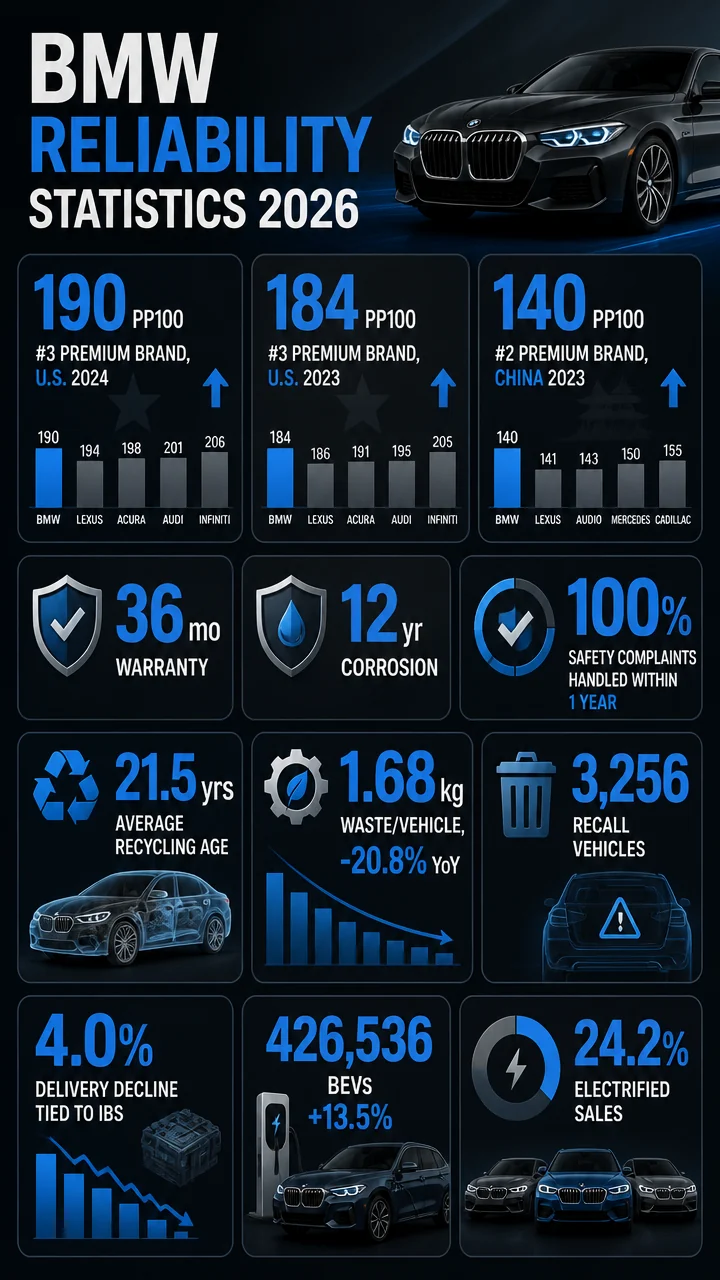
BMW reliability statistics at a glance
Key takeaways:
- BMW ranked third among premium brands in the 2024 U.S.
Vehicle Dependability Study with 190 PP100.
- BMW also ranked third among premium brands in the 2023 U.S. study with 184 PP100.
- BMW ranked second among premium brands in China in 2023 with 140 PP100.
- BMW Group says it addresses 100% of safety-related complaints within one year.
- BMW Group’s 2024 report says delivery stops linked to the Integrated Brake System (IBS) contributed to a 4.0% decline in total deliveries.
Fast facts:
- 36 months — BMW Group’s 2+1 warranty term
- 12 years — corrosion repair right from the start of the quality period
- 21.5 years — average age of BMW Group automobiles voluntarily returned to recycling centres
- 1.68 kg — waste for disposal per vehicle produced in 2024, down 20.8% year over year
- 3,256 vehicles — size of one U.S. recall tied to BMW of North America
BMW reliability trends: what the latest data suggests
BMW’s reliability story is mixed, but not weak. The brand’s dependability rankings place it near the top of the premium field, while the company’s ownership support, supplier controls, and long-term durability measures point to a large-scale quality system built around prevention and correction.
At the same time, BMW Group’s 2024 deliveries fell 4.0% year over year, with the company saying delivery stops linked to the IBS contributed to the decline.
That matters for reliability readers because it shows how a quality issue can affect production, delivery timing, and perception even when the broader brand remains strong in dependability surveys.
Why it matters: Dependability studies measure how often owners report problems, while recalls and quality stops show how manufacturers respond when issues are found.
BMW’s numbers suggest the brand is competitive on both fronts, though not immune to disruptions.
BMW dependability statistics in the U.S. and China
BMW’s best reliability-related signal comes from J.D.
Power dependability rankings.
In both the U.S. and China, the brand finished near the top of premium competitors.
| Study | BMW ranking | PP100 | Notable detail |
|---|---|---|---|
| 2024 U.S. Vehicle Dependability Study |
3rd among premium brands | 190 | BMW AG received 2 segment awards |
| 2023 U.S. Vehicle Dependability Study |
3rd among premium brands | 184 | BMW AG received 4 segment awards |
| 2023 China Vehicle Dependability Study | 2nd among premium brands | 140 | BMW models led segments including 5 Series, 7 Series, and X1 |
Big number: BMW’s U.S. dependability score moved from 184 PP100 in 2023 to 190 PP100 in 2024.
Higher PP100 means more reported problems per 100 vehicles, so this reflects a modest decline in dependability year over year.
Even with that increase in PP100, BMW still held a top-three premium ranking in the U.S.
The brand’s China result is also notable: 140 PP100 and second place among premium brands suggest BMW can remain highly competitive across markets with different ownership patterns and model mixes.
BMW segment winners in dependability studies
BMW’s dependability performance is easier to appreciate when broken into segment-level wins.
- 2024 U.S.
VDS:
BMW X1 and BMW X6 were segment winners. - 2023 U.S.
VDS:
BMW 4 Series, BMW X2, BMW X5, and MINI Cooper were segment winners. - 2023 China VDS: BMW 5 Series, BMW 7 Series, and BMW X1 ranked highest in their segments.
That spread matters because it suggests reliability strengths are not limited to one body style or price tier.
BMW’s awards span compact luxury, midsize performance, and SUV segments.
BMW warranty and ownership support statistics
Reliability is not just about breakage rates; it is also about how long the brand stands behind the car. BMW Group’s warranty and repair promises are important context for buyers comparing ownership risk.
Warranty snapshot:
- 36 months of BMW Group 2+1 warranty coverage
- 12 years of corrosion repair rights from the start of the quality period
- 100% of complaints regarding safety-related deficiencies addressed within one year
BMW Group also says it offers several hundred thousand different spare parts for automobiles and motorbikes, and that Condition Based Services monitor the condition of every BMW Group car.
For reliability-conscious shoppers, that combination signals a large aftersales infrastructure designed to identify issues early and support repairs quickly.
BMW recall statistics and defect data
The recall picture is where BMW reliability statistics become more visible to everyday owners.
The data does not suggest widespread failure across the entire fleet, but it does show recurring quality control events across different models and equipment types.
| Recall / report | Vehicles or items affected | What stands out |
|---|---|---|
| 24V-345 | 3,256 vehicles | Estimated 1% defect rate; included X5, X6, and X7 variants |
| 24V-739 | 11,579 vehicles | 5,696 remedied by the quarterly snapshot |
| 24V-302 | 145 vehicles | 64 repaired by the quarterly snapshot |
| 24V-139 | 267 vehicles | Smaller targeted recall |
| 24V-138 | 8 vehicles | Tiny population, highly specific issue |
| 24V-772 | 7 vehicles | Very small recall population |
| 24E-029 | 1,600 dealer accessory side cases | Equipment recall rather than vehicle recall |
The largest recall figure in the dataset is 11,579 vehicles for 24V-739, while the smallest vehicle recall listed is just 7 vehicles under 24V-772.
That range shows BMW’s issue profile includes both broad actions and tiny, highly targeted campaigns.
Pull-quote highlight: BMW of North America’s 24V-345 recall covered 3,256 vehicles with an estimated 1% defect rate, including the BMW X5, X6, and X7.
Another useful detail is the 24V-611 report, which referenced supplier-quality checks that found a suspect part on July 30, 2024 and expanded the containment range after further analysis.
That suggests BMW’s quality process is not only reactive, but also containment-driven once a part issue is identified.
BMW supply chain and quality-control statistics
BMW’s reliability performance is supported by a large upstream inspection system.
The company says it audited more than 500 supplier and sub-supplier production sites in 2024 and assessed 12,078 supplier sites overall.
- 79% of suppliers of production-related material had implemented preventive measures at awarding in 2024.
- 17% had agreed preventive measures at awarding in 2024.
- 22 notifications of potential sustainability principle violations came through reporting channels.
- 16 of those notifications were clarified during 2024.
That supplier data matters because many reliability issues begin before a car reaches the customer.
BMW’s preventive-measure figures suggest the brand is pushing quality controls upstream rather than relying solely on post-sale repairs.
Why it matters: A premium brand’s reliability score is often a supply-chain story as much as a product story.
BMW’s audit volume indicates a system built to catch defects earlier, even if some issues still require recalls or delivery interruptions.
BMW durability and long-life ownership data
Some of the strongest evidence in BMW reliability statistics comes from how long vehicles stay in use before end-of-life recycling.
BMW Group says the average age of automobiles voluntarily returned to recycling centres is around 21.5 years.
That is especially notable because the German Federal Environment Agency analysis cited by BMW puts the industry average return age at around 18 years.
In other words, BMW’s vehicles in this measure are remaining in service roughly 3.5 years longer than the referenced industry average.
At a glance: Long return age is not a perfect measure of reliability, but it is a strong durability signal.
Vehicles that remain in use for two decades or more usually have owners willing to maintain, repair, and keep them on the road.
BMW sustainability and recycling data tied to reliability
BMW’s recycling figures are not direct reliability metrics, but they do reveal how the brand manages material life cycles and production waste.
Those systems can indirectly support product durability, parts availability, and long-term ownership confidence.
| Metric | 2024 figure | What it shows |
|---|---|---|
| Recycled or recovered production waste | 868,084 tonnes | Large-scale material recovery |
| Material recovery share | 91.7% | Most production waste was recovered |
| Thermal recovery share | 7.7% | Minority route for waste processing |
| Waste for disposal | 4,892 tonnes | Only 0.6% of production waste |
| Waste for disposal per vehicle produced | 1.68 kg | Down 20.8% year over year |
Big number: BMW Group’s waste for disposal per vehicle produced fell to 1.68 kg in 2024, a 20.8% year-over-year drop.
For readers tracking BMW reliability through the lens of manufacturing discipline, the waste data suggests an operation that is tightening process efficiency.
Lower disposal waste can be a sign of better production control, even if it is not a direct warranty metric.
BMW delivery and electrification statistics that shape reliability perception
Reliability conversations increasingly overlap with electrification, especially when buyers want to know whether newer technology is changing the brand’s quality profile.
BMW’s 2024 delivery numbers show that electrified vehicles are now a major part of the business.
- 2,450,854 BMW Group deliveries in 2024.
- 2,200,217 BMW brand automobile deliveries in 2024.
- 244,925 MINI deliveries in 2024.
- 5,712 Rolls-Royce deliveries in 2024.
- 426,536 BMW Group BEV deliveries in 2024.
- 593,150 BMW Group electrified deliveries in 2024.
At a glance: BEVs represented 17.4% of BMW Group automobile deliveries in 2024, while electrified vehicles represented 24.2% of sales.
The brand’s BEV momentum is still positive: BMW Group BEV deliveries rose 13.5% year over year in 2024, even as total Group deliveries fell.
That contrast is important because it shows BMW’s newer powertrain mix is growing faster than the overall business.
Brand-level electrification mix
| Brand / category | 2024 deliveries | 2023 comparison |
|---|---|---|
| BMW Group BEVs | 426,536 | 375,716 in 2023 |
| BMW brand BEVs | 368,475 | 330,197 in 2023 |
| MINI BEVs | 56,171 | 45,193 in 2023 |
| Rolls-Royce BEVs | 1,890 | 326 in 2023 |
| BMW Group PHEVs | 166,614 | 190,159 in 2023 |
| BMW brand PHEVs | 164,172 | 173,878 in 2023 |
| MINI PHEVs | 2,442 | 16,281 in 2023 |
The standout shift is that BMW Group BEVs increased while PHEVs declined.
BMW Group PHEV deliveries fell from 190,159 in 2023 to 166,614 in 2024, while MINI PHEVs dropped sharply from 16,281 to 2,442.
That shift may reflect a product-cycle change as the brand leans further into BEVs.
BMW reliability by model family: what stands out
Several BMW models appear repeatedly in the dataset, and that repetition is useful.
It shows where BMW is earning dependability recognition, where recalls cluster, and which nameplates matter most to the brand’s quality profile.
- BMW X1 appears as a segment winner in both the U.S. and China dependability studies.
- BMW X5 appears as a 2023 U.S. dependability winner and also shows up in the 24V-345 recall population.
- BMW X6 appears as a 2024 U.S. dependability winner and is also included in the 24V-345 recall population.
- BMW 5 Series and BMW 7 Series both ranked highest in their China VDS segments.
- BMW X7 is included in the 24V-345 recall population.
That combination is revealing: BMW’s bestselling and most visible premium nameplates are also the ones most likely to be tracked closely in both dependability and recall reporting.
For shoppers, the result is a clearer picture of model-by-model ownership risk rather than a single brand-wide label.
BMW reliability benchmarks compared with ownership support systems
BMW’s reliability statistics are strongest when viewed alongside the company’s broader ownership and support infrastructure.
The brand’s figures point to a premium manufacturer that relies on scale, monitoring, and process control to protect durability.
Notable benchmark points:
- BMW Group operates in more than 140 countries.
- The global production network comprises over 30 production sites.
- BMW Group says Condition Based Services monitor the condition of every BMW Group car.
- BMW Group carries several hundred thousand spare parts for automobiles and motorbikes.
Scale matters because larger networks usually mean more complex quality challenges.
BMW’s challenge is not simply to build reliable vehicles, but to maintain consistent reliability across multiple brands, powertrains, markets, and production sites.
BMW reliability statistics: the most quotable figures
Pull quotes worth remembering:
- 190 PP100 placed BMW third among premium brands in the 2024 U.S.
VDS.
- 184 PP100 placed BMW third among premium brands in the 2023 U.S.
VDS.
- 140 PP100 placed BMW second among premium brands in the 2023 China VDS.
- 100% of safety-related complaints are addressed within one year, according to BMW Group.
- 21.5 years is the average age of BMW Group automobiles voluntarily returned to recycling centres.
- 1.68 kg of waste for disposal per vehicle produced marks a 20.8% improvement year over year.
- 3,256 vehicles were covered by the 24V-345 recall, with an estimated 1% defect rate.
If you are researching BMW reliability statistics for a purchase decision, the takeaway is straightforward: BMW scores well in dependability studies, backs ownership with substantial service coverage, and shows a mature quality-control system.
The caution is that recalls and delivery interruptions still occur, so model-specific research remains important.
For buyers comparing premium brands, the most useful BMW data points are not just the rankings themselves, but the balance between strong dependability results, extensive warranty support, and a clearly documented quality-control pipeline.