BMW maintenance looks simple on the surface, but the details tell a more interesting story: coverage windows, model-specific service schedules, and a surprisingly long list of items that are either included, excluded, or tracked only when the car says so.
These BMW maintenance statistics break down how Ultimate Care works in 2026, what the Maintenance System monitors, and where BEV and combustion-engine schedules diverge.
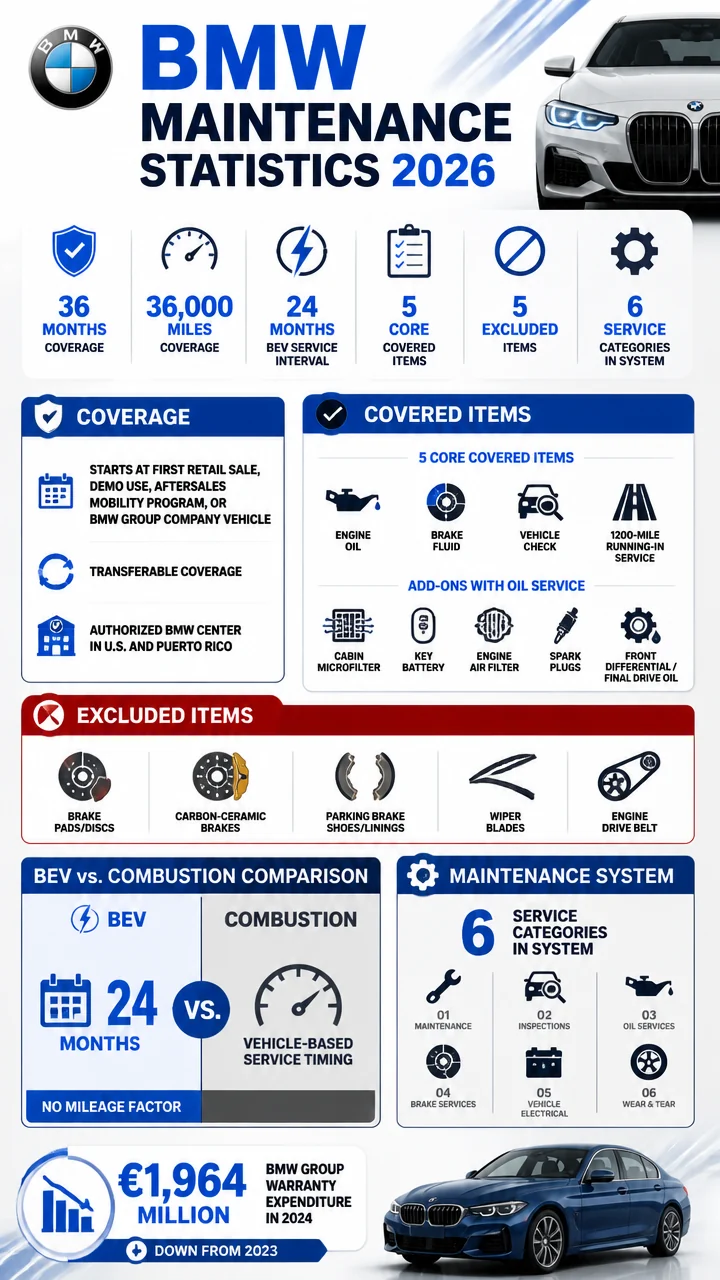
- 36 months or 36,000 miles is the standard new-vehicle maintenance coverage window in the U.S.
- 24 months is BMW’s basic time interval for BEV maintenance, with no mileage influence.
- 5 core maintenance items are excluded from Ultimate Care coverage.
- €1,964 million was BMW Group’s warranty expenditure in 2024, down sharply from 2023.
BMW maintenance coverage statistics: what Ultimate Care includes, excludes, and transfers
- New BMW vehicles sold through an authorized BMW center in the U.S. are covered for 36 months or 36,000 miles, whichever comes first.
- Coverage begins at the earliest of first retail sale, demonstrator use, Aftersales Mobility Program use, or BMW Group company vehicle placement.
- Remaining maintenance coverage is transferable to subsequent owners.
- Eligible maintenance can be performed at any authorized BMW center in the U.S. or Puerto Rico at no expense while the vehicle qualifies.
36 months or 36,000 miles is the headline figure most buyers will want to remember, because that is BMW’s standard new-vehicle maintenance coverage window for eligible U.S. purchases.
The start date is also broader than many shoppers expect.
BMW says the coverage begins at the earliest of four events: first retail sale, first placement into service as a sales demonstrator, first placement into service as an Aftersales Mobility Program vehicle, or first placement into service as a BMW Group company vehicle.
Big number: BMW says remaining maintenance coverage is transferable to subsequent owners, which adds value for used-car buyers and helps preserve resale confidence.
Another important ownership detail: BMW says eligible maintenance services can be performed at any authorized BMW center in the United States or Puerto Rico while the vehicle qualifies, with no expense to the owner.
What BMW covers under Ultimate Care
BMW’s factory-recommended maintenance coverage centers on a narrow set of items, with expansion only when specific services qualify together.
| Coverage category | BMW maintenance items | Count |
|---|---|---|
| Core covered services | Engine oil, brake fluid, vehicle check, 1200-mile running-in service for applicable M vehicles | 4 |
| Add-on items when linked to engine-oil service | Cabin microfilter(s), remote control key battery, engine air filter, spark plugs, front differential and/or final drive oil for applicable M vehicles | 5 |
| Excluded items | Standard brake pads/discs, optional carbon-ceramic brake pads/discs, parking brake shoes/linings, wiper blade assemblies/inserts, engine drive belt | 5 |
5 maintenance items are explicitly excluded from BMW Ultimate Care coverage, including wear items like brake pads/discs and wiper blades.
- 4 core items are covered under BMW’s factory-recommended maintenance list.
- 5 add-on items can be covered when they qualify with an engine-oil service.
- 5 exclusions are called out in BMW’s maintenance booklet.
That structure matters because it shows BMW’s approach is not “everything is free,” but rather a tightly defined service package centered on scheduled upkeep and condition-based needs.
BMW service interval statistics: how the Maintenance System predicts service needs
- All BMW vehicles use sensors and algorithms.
- The system factors in elapsed time, driving distance, and driving profile.
- Every BMW has an integrated Maintenance System reminder.
- Service-task status is continually updated and stored in the remote control key.
BMW says all vehicles in the lineup use sensors plus algorithms to forecast maintenance intervals, combining elapsed time with driving distance and driving profile.
That means the schedule is not just calendar-based and not just mileage-based.
It is a condition-based system designed to adapt to how the car is actually used.
Why it matters: BMW’s service model is built around prediction, not fixed intervals alone, which can change when and how owners see maintenance reminders.
BMW also says the service-task status is continually updated and stored in the remote control key, and the integrated reminder system is standard across BMW vehicles.
BMW Condition Based Service display: 4 service states
- No service required
- Approaching deadline
- Deadline passed
- Customized checklist at the BMW center
That four-status structure makes the display useful for both routine planning and workshop visits.
BMW even notes that, in certain vehicles, front and rear brake pad status may appear only when about 2,000 miles or less remain before service is required.
There is also an important caveat for owners who store their cars long-term: BMW says long-term storage with the battery disconnected interrupts calculation of time-dependent maintenance services.
BMW combustion-engine maintenance statistics: model families, checks, and service patterns
- BMW groups combustion models into 5 model families.
- Standard-scope checks include core safety, tire, lighting, and fluid inspections.
- Brake service is organized into front and rear sections, each with the same 3 actions.
- Several long-life components are pushed far out on the mileage horizon.
BMW’s combustion-engine maintenance summary organizes vehicles into 5 model families, which helps explain why the maintenance tables look broad but still structured:
- 3/5/7 Series
- 2/4/8 Series and Z4 Roadster
- M2/M3/M4/M5
- X5 M/X6 M/BMW XM
- X1/X2/X3/X4/X5/X6/X7
Across those families, BMW lists a set of universal standard-scope checks that apply to every model family on the page.
The maintenance summary alone includes 5 universal checks:
- Verify check control messages
- Check indicator and warning lights
- Reset CBS display
- Inspect tires, adjust tire pressures, reset TPMS
- Check parking brake functionality
BMW then adds 4 more universal checks on the next maintenance page:
- Check sunroof guide rails
- Check for open service actions or recalls
- Check parking brake while entering workshop
- Inspect parking brake function while driving into the workshop
BMW combustion standard-scope checks by category
| Category | Checks listed | Count |
|---|---|---|
| Lighting and visibility | Lighting system, safety belts, windshield wipers, washer jets, rear-view mirrors/camera, SRS airbag units | 6 |
| Tires | Tread depth, wear pattern, outer condition, inflation pressure | 4 |
| Fluids and body | Engine coolant level, coolant concentration, brake system lines, underbody condition | 4 |
6 lighting and visibility checks are built into the combustion model standard-scope table, showing how broadly BMW frames routine inspection.
The brake section is equally structured.
BMW’s front-brake maintenance applies to 5 model families and includes 3 actions: replace pads, clean pad contact points, and check discs for surface/thickness.
The rear-brake section mirrors that same pattern for the same 5 model families.
Pull quote: BMW’s maintenance tables are less about “one car, one schedule” and more about a repeating logic: family grouping, universal checks, and long-interval component replacement.
BMW also explicitly references optional M Carbon Ceramic Brakes for the M4 in the combustion-engine table, while parking brake shoes/linings remain excluded from maintenance coverage when fitted.
BMW combustion maintenance milestones: long-interval service items
Some maintenance items are pushed far beyond routine service visits, which gives the schedule a long-tail shape rather than a purely short-cycle one.
| Service item | BMW interval or milestone | Notes |
|---|---|---|
| Transmission fluid replacement | Approximately 60,000 to 78,000 miles | Applies to the 2 Series Gran Coupe and selected X1/X2 models |
| Oxygen-sensor replacement | 150,000 miles | Listed combustion model families |
| Particulate-filter replacement | 150,000 miles | Listed gasoline and turbo models in the booklet |
BMW also maps extra service actions to every second, third, fourth, fifth, and sixth engine-oil service.
These intervals create a useful benchmark for owners who want to anticipate what may be added during each major oil-service cycle.
- Every 2nd engine-oil service: approximately 20,000 miles; may include ventilation microfilter, remote-control key battery, and transfer-case oil for specified models
- Every 3rd engine-oil service: approximately 30,000 miles; may include air filter element and spark plugs
- Every 4th engine-oil service: approximately 40,000 miles; may include air filter element and remote-control key battery
- Every 5th engine-oil service: approximately 50,000 miles; may include rear axle differential fluid and transfer-case fluid for specified models
- Every 6th engine-oil service: approximately 60,000 miles; may include spark plugs and remote-control key battery
BMW’s standard operator checks also stay consistent across ownership.
The company recommends 4 regular checks for drivers:
- Washer fluid
- Coolant level
- Brake fluid level
- Tire pressure, condition, and wear
BMW BEV maintenance statistics: i5 and iX service intervals, warnings, and checks
- BMW’s BEV maintenance summary covers 2 model lines: i5 Sedan and iX Sports Activity Vehicle.
- Basic maintenance timing is 24 months with no mileage influence.
- Warnings can appear at 3,000 miles or 3 months, then again at 1,200 miles or 1 month.
- BEV maintenance includes 11 checks in the standard-scope table.
BMW’s BEV maintenance schedule is noticeably different from the combustion-engine version.
The basic interval is 24 months, and BMW says mileage does not influence that core schedule.
At the same time, BMW still uses advance reminders.
BEV next-service warnings can appear as a white indicator within 3,000 miles or 3 months, and a yellow indicator within 1,200 miles or 1 month.
Why it matters: BEV owners are guided by time-first maintenance planning, but BMW still layers in distance-based warning thresholds for visibility and convenience.
BMW says the BEV maintenance summary applies to only 2 model lines: the i5 Sedan and iX Sports Activity Vehicle.
BMW BEV maintenance table: what’s included
| BEV maintenance area | Included items | Count |
|---|---|---|
| Standard-scope maintenance | Charge-setting review, inflation pressure setting, tire-size check, HV charge-port inspection, Flexible Fast Charger inspection, and more | 11 |
| Vehicle-check lighting/visibility | Horn/headlight flasher/hazard lights, instrument and control lighting and heater-A/C blower, lighting system, windshield wiper/washer jet positions | 4 |
| Brake-service actions | Front pads, rear pads, disc checks, light greasing of wheel hub contact points, wear-sensor replacement for pads | 5 |
| Supplemental vehicle-check items | Tie rods, steering gear boots, steering gear boot clamps, light-switch cluster illumination | 4 |
| Mobility-kit expiration checks | i5 Seal & Drive tire kit, Tire Repair Kit Plus | 2 |
BMW also says the BEV maintenance table includes a supplemental vehicle-check every 2nd vehicle check, which is every 4 years.
That supplemental inspection adds four steering, lighting, and mobility-kit-related checks.
One of the more overlooked BEV details is how much BMW still watches tires and charge-related equipment.
The standard-scope list includes charge-setting review, inflation pressure setting, tire-size check, HV charge-port inspection, and Flexible Fast Charger inspection.
Brake-fluid replacement applies to both BEV models in the table, and BMW includes a full 5-step brake-service package: front pads, rear pads, disc checks, light greasing of wheel hub contact points, and wear-sensor replacement for pads.
BMW maintenance comparisons and benchmarks: ICE vs BEV
- ICE coverage is organized around mileage and condition-based service cycles.
- BEV coverage leans more heavily on time-based intervals.
- Combustion families are spread across 5 model groups; BEV coverage is concentrated in 2 lines.
- BMW’s service logic is consistent, but the triggers differ by powertrain.
BMW’s service strategy changes depending on the vehicle type, and that contrast is one of the clearest takeaways from the 2026 maintenance data.
| Category | Combustion-engine vehicles | BEV vehicles |
|---|---|---|
| Model coverage scope | 5 model families | 2 model lines |
| Basic maintenance timing | Condition-based, using sensors, algorithms, time, distance, and driving profile | 24 months, with no mileage influence |
| Advance reminder windows | Brake-pad warnings may appear when about 2,000 miles or less remain | 3,000 miles or 3 months and 1,200 miles or 1 month |
| Standard-scope maintenance focus | Safety, lights, tires, fluids, brakes, and workshop checks | Charge settings, tire setup, charge port, flexible charger, safety, and brake items |
The pattern is clear: combustion cars are managed through a flexible, condition-based service network, while BEVs are anchored more explicitly to calendar time.
BMW still uses reminders for both, but the maintenance triggers are not identical.
- 2,000 miles remaining: brake pad status may begin appearing on certain vehicles.
- 20,000 miles: every 2nd engine-oil service.
- 30,000 miles: every 3rd engine-oil service.
- 40,000 miles: every 4th engine-oil service.
- 50,000 miles: every 5th engine-oil service.
- 60,000 miles: every 6th engine-oil service.
- 150,000 miles: oxygen sensors and particulate filters.
BMW also says the service reminder system can store 2 state-specific mandatory inspections: vehicle safety inspection and emissions test.
That detail reinforces that the reminder system is not just for internal maintenance—it can also track compliance items in the right jurisdictions.
BMW warranty and service expense statistics: what the financial data says
BMW Group’s financial statements give a useful ownership-cost backdrop to the maintenance rules.
In 2024, BMW Group reported €1,964 million in warranty expenditure, down from €3,782 million in 2023.
| BMW Group expense category | 2023 | 2024 | Change |
|---|---|---|---|
| Warranty expenditure | €3,782 million | €1,964 million | Down |
| Service contracts, telematics and roadside assistance | €2,780 million | €2,885 million | Up |
That is a striking split.
Warranty expenditure fell sharply year over year, while expenses for service contracts, telematics and roadside assistance rose to €2,885 million in 2024 from €2,780 million in 2023.
Pull quote: BMW’s financial data suggests a business still heavily invested in aftersales support, even as warranty spending dropped significantly year over year.
For owners and shoppers, the combination of transferable maintenance coverage, structured service intervals, and broad service-center access helps explain why BMW’s aftersales system remains a major part of the ownership experience.
BMW maintenance statistics: quick answers
- How long is BMW maintenance coverage? New BMW vehicles bought from an authorized BMW center in the U.S. are covered for 36 months or 36,000 miles, whichever comes first.
- Does BMW maintenance transfer to a second owner? Yes, BMW says the remaining maintenance coverage is transferable.
- How often do BMW BEVs need maintenance? BMW says the BEV schedule uses a basic 24-month interval with no mileage influence.
- What does BMW exclude from Ultimate Care? BMW excludes brake pads/discs, carbon-ceramic brake pads/discs, parking brake shoes/linings, wiper blades, and the engine drive belt.
- What is BMW’s biggest maintenance pattern difference by powertrain? Combustion models use condition-based service logic, while BEVs are primarily time-based.