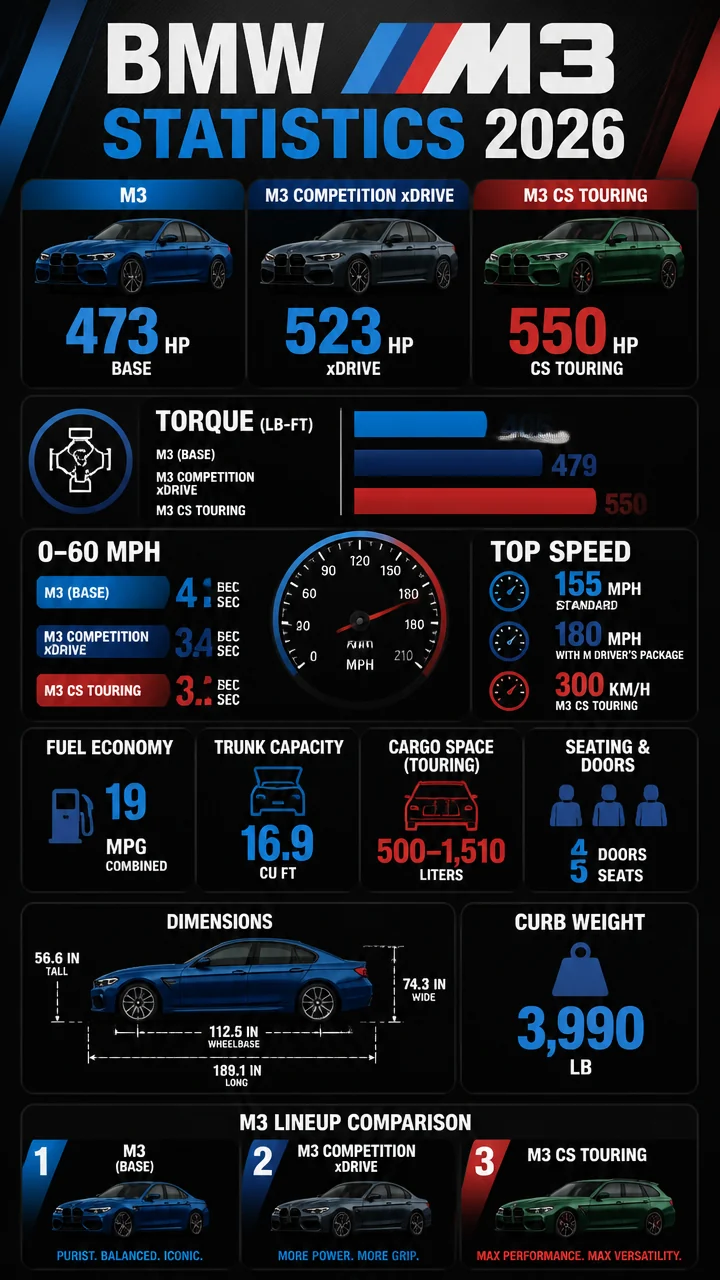
The BMW M3 remains one of the most data-rich performance cars on sale, and the latest figures show just how wide the lineup has become.
From a 473-hp base sedan to a 550-hp M3 CS Touring, the numbers tell a story of escalating speed, grip, and practicality.
BMW M3 statistics at a glance
Big number: The current M3 range stretches from 473 hp in the base sedan to 550 hp in the first-ever M3 CS Touring.
Fast facts: BMW quotes as little as 3.2 seconds for 0-60 mph in the 2024 M3 CS and 3.4 seconds for the 2025 M3 Competition xDrive.
Why it matters: The M3 is no longer just a sport sedan benchmark; it now spans sedan, Competition, xDrive, Touring, and CS variants with clearly different priorities.
- Base 2025 M3: 473 hp, 406 lb-ft, 4.1 seconds to 60 mph, 19 mpg combined.
- 2025 M3 Competition xDrive: 523 hp, 479 lb-ft, 3.4 seconds to 60 mph, 155 mph limited top speed.
- 2024 M3 Competition xDrive: 530 hp, 650 Nm, 3.5-3.6 seconds to 62 mph, 27.2-28.0 mpg fuel consumption.
- M3 CS Touring: 550 hp, 3.5 seconds to 100 km/h, 300 km/h top speed, 500-1,510 liters of cargo space.
BMW M3 statistics: performance and speed
The performance spread is broad, but the headline is simple: every M3 variant is quick, and the xDrive cars turn the model into a true launch-control weapon.
The 2025 BMW M3 Competition Sedan with M xDrive produces 523 hp at 6,250 rpm and 479 lb-ft of torque across a wide 2,750 to 5,730 rpm band.
BMW says that setup gets the sedan from 0 to 60 mph in 3.4 seconds.
By comparison, the base 2025 M3 makes 473 hp and 406 lb-ft, reaching 60 mph in 4.1 seconds.
That’s still extremely fast, but the gap shows how much the Competition and xDrive hardware changes the car’s character.
The rear-wheel-drive 2025 M3 Competition sits in the middle of the range with 503 hp, 479 lb-ft, and a 3.8-second 0-60 mph time.
It uses an 8-speed M Steptronic transmission with Drivelogic instead of the base car’s 6-speed manual.
Pull quote: BMW’s M3 lineup now spans a full performance ladder: 4.1 seconds to 3.4 seconds from the least to the quickest current sedan.
| Model | Horsepower | Torque | 0-60 mph | Top speed |
|---|---|---|---|---|
| 2025 M3 base | 473 hp | 406 lb-ft | 4.1 sec | 155 mph |
| 2025 M3 Competition RWD | 503 hp | 479 lb-ft | 3.8 sec | 155 mph |
| 2025 M3 Competition xDrive | 523 hp | 479 lb-ft | 3.4 sec | 155 mph, or 180 mph with M Driver’s Package |
Key takeaway: BMW maintains the same electronically limited 155 mph ceiling across the 2025 sedan lineup unless the optional M Driver’s Package is added.
Historically, BMW has kept nudging the xDrive cars faster.
In 2022, the M3 Competition xDrive was already quoted at 3.4 seconds to 60 mph, and BMW said it was 0.4 seconds quicker than rear-wheel-drive models.
For model year 2025, BMW raised M3 Competition xDrive output by 20 hp.
The numbers show how BMW uses power increases to preserve the M3’s relevance as competitors chase ever-stronger launch times.
Even the older 2024 xDrive sedan and Touring variants were quoted at 530 hp and 650 Nm, placing them above the 2025 xDrive sedan in raw output.
BMW M3 statistics: dimensions and packaging
The M3 is compact by modern performance-car standards, but it is not small. The 2025 sedan measures 189.1 inches long, 74.3 inches wide, and 56.6 inches tall, with a 112.5-inch wheelbase.
That footprint supports a usable cabin with 4 doors and 5 seats, plus 16.9 cubic feet of luggage space.
The car’s 4.8 inches of ground clearance and 41.3-foot turning circle reinforce the fact that this is a track-capable sedan with real-world practicality.
At a glance: The M3 balances low-slung proportions with everyday usability, especially in five-seat sedan and Touring forms.
| Dimension | 2025 BMW M3 Sedan | BMW M3 Touring |
|---|---|---|
| Length | 189.1 in | 4,801 mm |
| Width | 74.3 in | 1,903 mm |
| Height | 56.6 in | 1,446 mm |
| Wheelbase | 112.5 in | 2,857 mm |
| Turning circle | 41.3 ft | 12.6 m |
| Ground clearance | 4.8 in | 123 mm |
| Cargo capacity | 16.9 cu ft | 500-1,510 liters |
The Touring body style makes the packaging story more interesting.
BMW lists 500 to 1,510 liters of cargo space for the M3 Touring, turning the M3 into a performance wagon with a genuinely versatile load area.
That cargo range matters because the Touring isn’t just a niche enthusiast item; it is a practical body style wrapped around the same high-output S58 engine and M chassis hardware.
BMW M3 statistics: trims, rankings, and model-by-model comparison
One of the biggest takeaways from the dataset is how clearly BMW separates each M3 derivative. The base sedan, Competition, Competition xDrive, CS, Touring, and CS Touring each occupy a distinct role in the lineup.
| Variant | Power | Torque | Transmission | Drivetrain | Acceleration |
|---|---|---|---|---|---|
| 2025 M3 base | 473 hp | 406 lb-ft | 6-speed manual | Rear-wheel drive | 0-60 mph in 4.1 sec |
| 2025 M3 Competition | 503 hp | 479 lb-ft | 8-speed M Steptronic | Rear-wheel drive | 0-60 mph in 3.8 sec |
| 2025 M3 Competition xDrive | 523 hp | 479 lb-ft | 8-speed M Steptronic | M xDrive | 0-60 mph in 3.4 sec |
| 2024 M3 CS | 543 hp | 479 lb-ft | 8-speed M Steptronic | M xDrive | 0-60 mph in 3.2 sec |
| M3 CS Touring | 550 hp | 650 Nm | 8-speed M Steptronic | M xDrive | 0-100 km/h in 3.5 sec |
Why it matters: BMW uses the same core engine family but changes output, traction, and body style to create sharply different ownership experiences.
- Base M3: appeals to purists with a manual gearbox and rear-drive layout.
- Competition RWD: keeps rear-drive character while adding 30 hp over the base car.
- Competition xDrive: prioritizes launch traction and all-weather speed.
- M3 CS: pushes power and weight savings for maximum performance.
- Touring and CS Touring: add practicality without abandoning M-car pace.
BMW’s published figures also show how acceleration improves in steps.
The 2024 M3 Competition Saloon with M xDrive was quoted at 3.5 seconds to 0-62 mph, while the Touring version took 3.6 seconds.
That 0.1-second difference is small, but it underscores how body style and mass still matter.
BMW M3 statistics: fuel economy and emissions
Efficiency is not the M3’s main selling point, but the figures are still useful for comparison shopping. The 2025 base sedan is rated at 19 mpg combined, with 16 mpg city and 23 mpg highway.
The rear-wheel-drive 2025 Competition also returns 19 mpg combined, showing that the move from manual base car to automatic Competition doesn’t create a major fuel-economy penalty in BMW’s published numbers.
The 2024 Competition xDrive body styles are listed in Europe with 27.7-28.0 mpg for the saloon and 27.2-27.4 mpg for the Touring.
In WLTP terms, the 2024 M3 Touring is rated at 10.4-10.3 l/100 km and 235-233 g/km of CO2.
| Model | Fuel economy | Emissions | Notes |
|---|---|---|---|
| 2025 M3 base | 19 mpg combined | Not listed in dataset | 16 city / 23 highway |
| 2025 M3 Competition RWD | 19 mpg combined | Not listed in dataset | Same combined rating as base |
| 2024 M3 Competition Saloon xDrive | 27.7-28.0 mpg | Not listed in dataset | European test figure |
| 2024 M3 Competition Touring xDrive | 27.2-27.4 mpg | Not listed in dataset | European test figure |
| 2024 M3 Touring | 10.4-10.3 l/100 km | 235-233 g/km | WLTP combined |
| M3 CS Touring | 10.5 l/100 km | 238 g/km | Euro 6e, CO2 class G |
Fast fact: The CS Touring’s official 10.5 l/100 km combined figure comes alongside a top speed of 300 km/h, showing BMW’s prioritization of performance first.
BMW M3 statistics: engine and chassis data
Under the hood, the M3’s numbers center on the 3.0-liter twin-turbo S58 family. BMW lists the current engine at 6 cylinders, 24 valves, and 2,993 cc.
Additional engine data includes a 90.0/84.0 mm stroke/bore, a 9.3:1 compression ratio, and a fuel tank capacity of 15.6 gallons for the 2025 sedan.
BMW also specifies Adaptive M suspension with a double-joint spring strut axle at the front and a five-link axle at the rear.
- Front suspension: Adaptive M suspension with double-joint spring strut axle.
- Rear suspension: Adaptive M suspension with five-link axle.
- Standard drivetrain on base M3: Rear-wheel drive.
- Standard transmission on base M3: 6-speed manual.
The 2025 M3 Competition Sedan with M xDrive weighs 3,990 pounds, with a GVWR of 4,982 pounds.
For a car with this pace, that curb weight is part of what makes the acceleration figures meaningful: BMW is moving nearly two tons of sedan with supercar-adjacent launch performance.
Pull quote: BMW’s current M3 formula pairs a 2,993 cc six-cylinder engine with adaptive suspension and a chassis tuned for both grip and everyday use.
The turning circle of 41.3 feet and low 4.8-inch ground clearance are also notable.
One helps the car fit into real-world spaces; the other reminds you this is still an M car built close to the pavement.
BMW M3 statistics: Touring and M3 CS Touring highlights
The Touring body styles are where the M3 becomes unexpectedly practical. The standard 2024 M3 Touring has 5 doors, 5 seats, and a cargo range from 500 to 1,510 liters.
BMW’s first-ever M3 CS Touring pushes the formula even further.
It makes 550 hp, gets to 100 km/h in 3.5 seconds, and can reach 300 km/h or 186 mph.
Big number: The CS Touring’s cargo capacity expands to 1,510 liters, proving that a high-performance wagon can still carry serious luggage.
BMW also says the CS Touring is about 15 kg lighter than the M3 Competition Touring with M xDrive, thanks to weight-saving measures.
The company revealed the car on 30 January 2025 at Bathurst 12 Hour and said deliveries begin in March 2025.
Production is set to happen alongside other M3 Sedan and Touring variants at Plant Munich, and BMW described Germany as the model’s most important sales region.
| Touring variant | Power | 0-100 km/h | Top speed | Cargo space |
|---|---|---|---|---|
| 2024 M3 Touring | 530 hp | 3.6 sec | 250 km/h, or 280 km/h with M Driver’s Package | 500-1,510 liters |
| M3 CS Touring | 550 hp | 3.5 sec | 300 km/h, or 186 mph | 500-1,510 liters |
BMW also gives the CS Touring a detailed hardware list: 275/35 ZR19 front tires, 285/30 ZR20 rear tires, 9.5J x 19 front wheels, and 10.5J x 20 rear wheels.
Those figures reinforce the car’s track-first intent even in wagon form.
BMW M3 statistics: key facts, extremes, and notable findings
At a glance: The M3 is now a family of performance cars, not a single sedan trim.
- Most powerful figure in the dataset: 550 hp for the M3 CS Touring.
- Quickest quoted sprint: 3.2 seconds to 60 mph for the 2024 M3 CS.
- Highest top speed: 300 km/h or 186 mph for the M3 CS Touring.
- Best practicality: 500 to 1,510 liters of cargo space in Touring models.
- Heaviest current sedan figure provided: 3,990 pounds for the 2025 M3 Competition Sedan with M xDrive.
- Longest listed sedan dimension: 189.1 inches in length.
- Most driver-focused manual setup: the base 2025 M3 with a 6-speed manual and rear-wheel drive.
Stat highlight: BMW says the 2025 M3 Competition xDrive gained 20 hp, but the biggest headline in the lineup is still the CS Touring’s blend of 550 hp and wagon practicality.
For shoppers, the numbers suggest three broad M3 personalities.
The base car is the enthusiast’s choice, the Competition models are the fastest mainstream variants, and the CS and CS Touring are the headline-grabbers built for buyers who want BMW M at its most extreme.
The important part is that BMW has preserved a clear hierarchy while stretching the badge into new body styles.
The result is an M3 lineup that can be read as a single model family, yet still offers distinct data points for speed, utility, and driver engagement.