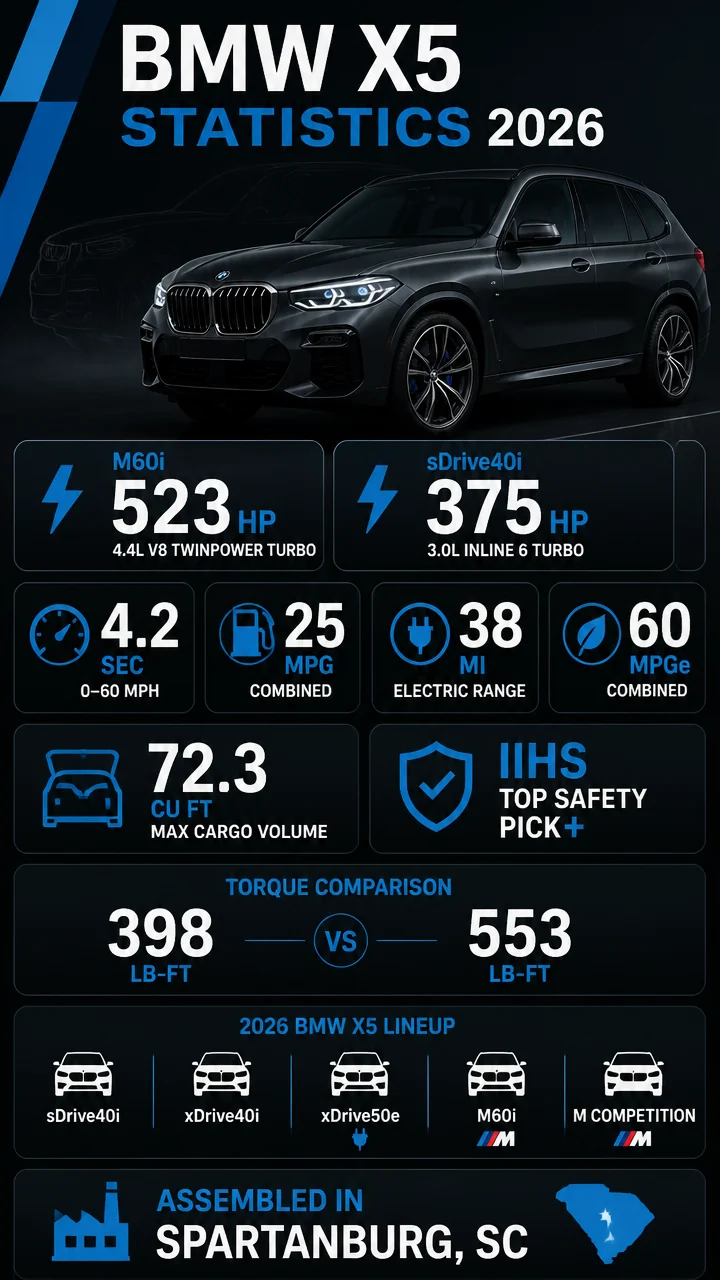
BMW X5 statistics at a glance
The 2026 BMW X5 lineup is a study in balance: performance, efficiency, size, and safety all show up in the numbers.
Across the range, the SUV stretches from a 375-horsepower sDrive40i to a 523-horsepower M60i, while the xDrive50e adds plug-in hybrid efficiency with up to 60 MPGe combined.
Key takeaways
- Fastest acceleration: the M60i reaches 0-60 mph in 4.2 seconds.
- Best efficiency: the xDrive50e is rated at 60 MPGe combined and up to 38 miles of electric range.
- Best combined gasoline mpg: the sDrive40i returns 25 mpg combined.
- Largest cargo capacity: 72.3 cubic feet with the second row folded in the sDrive40i and xDrive40i.
- Safety highlight: IIHS awarded the 2025-26 BMW X5 Top Safety Pick+.
BMW X5 performance statistics: horsepower, torque, and acceleration
The 2026 BMW X5 performance range is wide enough to cover efficient daily driving and serious straight-line speed.
The entry sDrive40i delivers 375 horsepower and 398 lb-ft of torque, while the M60i raises the ceiling to 523 horsepower and 553 lb-ft of torque.
Even the plug-in hybrid xDrive50e posts standout outputs, with 483 horsepower and 516 lb-ft of torque.
That makes it more powerful than the sDrive40i and not far off the M60i in real-world output claims.
| 2026 BMW X5 variant | Powertrain | Horsepower | Torque | 0-60 mph | Top speed |
|---|---|---|---|---|---|
| sDrive40i | Gasoline 48-volt mild-hybrid | 375 hp | 398 lb-ft | 5.3 seconds | 130 mph |
| xDrive50e | Plug-in hybrid | 483 hp | 516 lb-ft | 4.6 seconds | 130 mph |
| M60i | Gasoline 48-volt mild-hybrid | 523 hp | 553 lb-ft | 4.2 seconds | 130 mph |
That shared 130 mph maximum across all three trims is an important clue: BMW is tuning the X5 family for broad performance spread, not just a single top-speed story.
Performance benchmarks by variant
- sDrive40i: 375 hp, 398 lb-ft, 5.3-second 0-60 mph sprint.
- xDrive50e: 483 hp, 516 lb-ft, 4.6-second 0-60 mph sprint.
- M60i: 523 hp, 553 lb-ft, 4.2-second 0-60 mph sprint.
BMW X5 fuel economy statistics: mpg, MPGe, and electric range
BMW X5 statistics on efficiency are especially interesting because the lineup spans three distinct strategies: mild-hybrid gasoline, plug-in hybrid, and performance-oriented gasoline.
The fuel-economy spread is clear.
The sDrive40i returns 23 mpg city and 27 mpg highway, for 25 mpg combined.
The M60i drops to 19 mpg combined, with 17 mpg city and 22 mpg highway.
The xDrive50e is in a different league, rated at 60 MPGe combined.
| 2026 BMW X5 variant | Combined rating | City | Highway | Electric range |
|---|---|---|---|---|
| sDrive40i | 25 mpg | 23 mpg | 27 mpg | Not listed |
| xDrive50e | 60 MPGe | Not listed | Not listed | Up to 38 miles |
| M60i | 19 mpg | 17 mpg | 22 mpg | Not listed |
The plug-in hybrid also offers up to 38 miles of electric range, giving the X5 family a practical EV commuting option without leaving the SUV segment.
Efficiency takeaways
- The xDrive50e has the strongest efficiency credentials in the dataset.
- The sDrive40i delivers the best gasoline mpg figures.
- The M60i trades fuel economy for the strongest performance numbers.
- All three versions reflect BMW’s effort to keep the X5 premium and versatile rather than narrowly specialized.
BMW X5 dimensions statistics: length, width, height, and wheelbase
The 2026 BMW X5 is a large two-row luxury SUV by any practical measure.
BMW’s overview lists the model at 194.3 inches long, 78.9 inches wide, and 69.1 inches high.
Technical data for several trims shows a nearly identical footprint, with the sDrive40i and M60i measuring 194.2 inches long, 78.9 inches wide, and 69.5 inches high, while the xDrive50e is 69.1 inches high.
| Dimension | BMW overview | sDrive40i | xDrive50e | M60i |
|---|---|---|---|---|
| Length | 194.3 in | 194.2 in | 194.2 in | 194.2 in |
| Width | 78.9 in | 78.9 in | 78.9 in | 78.9 in |
| Height | 69.1 in | 69.5 in | 69.1 in | 69.5 in |
| Width incl. mirrors | 87.3 in | 87.3 in | 87.3 in | 87.3 in |
| Wheelbase | 117.1 in | 117.1 in | 117.1 in | 117.1 in |
That consistency matters for shoppers comparing variants.
Choosing the xDrive50e or M60i does not appear to change the X5’s fundamental footprint, which makes garage fit, visibility, and parking considerations easier to compare across the lineup.
BMW X5 cargo space and practicality statistics
Practicality remains one of the BMW X5’s biggest strengths.
The sDrive40i and xDrive40i provide 33.9 cubic feet of cargo space with the second row up, and 72.3 cubic feet with the second row folded.
The xDrive50e gives up a small amount of space to its electrified hardware, but still posts strong numbers at 33.0 cubic feet with the seats up and 71.2 cubic feet folded.
| Variant | Cargo space, seats up | Cargo space, seats folded |
|---|---|---|
| sDrive40i / xDrive40i | 33.9 cu ft | 72.3 cu ft |
| xDrive50e | 33.0 cu ft | 71.2 cu ft |
- The xDrive50e sacrifices just 0.9 cubic feet with the second row up versus the gasoline models listed.
- With the second row folded, it trails by only 1.1 cubic feet.
- The X5 remains a strong choice for shoppers who want performance without abandoning utility.
BMW X5 drivetrain and engineering statistics
The engineering story behind the 2026 BMW X5 is more varied than the exterior might suggest.
The sDrive40i uses a gasoline 48-volt mild-hybrid powertrain with rear-wheel drive, while the xDrive50e uses a plug-in hybrid powertrain with all-wheel drive.
The M60i stays in the gasoline mild-hybrid camp, but moves to an 8-cylinder layout and all-wheel drive.
- sDrive40i: 6 cylinders, 2,998 cc, 8-speed automatic, rear-wheel drive.
- xDrive50e: 6 cylinders, 2,998 cc, 8-speed automatic, all-wheel drive.
- M60i: 8 cylinders, 4,395 cc, 8-speed automatic, all-wheel drive.
The common 8-speed automatic transmission across all three trims is another notable consistency point.
It suggests BMW is emphasizing seamless power delivery regardless of whether the buyer chooses efficiency or performance.
BMW X5 safety statistics and IIHS ratings
Safety is one of the strongest parts of the BMW X5’s 2026 statistics profile.
The SUV achieved IIHS Top Safety Pick+ status for 2025-26, with a string of strong results across key crash tests and active safety evaluations.
| IIHS category | Rating |
|---|---|
| Small overlap front | Good |
| Updated moderate overlap front | Good |
| Updated side | Good |
| Standard headlights | Acceptable |
| Front crash prevention vehicle-to-vehicle | Good |
| Pedestrian front crash prevention | Good |
| LATCH ease of use | Good |
BMW also lists several standard driver-assistance and crash-avoidance features tied to the X5’s safety profile:
- Blind spot detection comes standard.
- Lane departure warning comes standard.
- Rear automatic braking comes standard.
- Lane departure prevention is optional.
Those ratings and standard features help explain why the X5 remains such a strong luxury SUV benchmark: it pairs premium performance with a safety package that scores well in independent testing.
BMW X5 production and sales statistics
The BMW X5 is not just a flagship SUV in the showroom; it is also a major product for BMW’s manufacturing and global sales footprint.
The 2026 X5 is assembled in the United States at BMW’s Spartanburg Plant in South Carolina.
BMW Group also identifies Spartanburg as the global center of competence for the X3, X4, X5, X6, X7, and XM, which helps underscore how central the X5 is to BMW’s SUV strategy.
X5/X6 delivery snapshot
| Year | X5/X6 deliveries | Change vs. prior year | Share of BMW brand deliveries |
|---|---|---|---|
| 2023 | 280,684 | Not provided | Not provided |
| 2024 | 275,318 | -1.9% | 12.5% |
Two details stand out in the sales data.
First, deliveries remained extremely high even after a modest decline of 1.9% in 2024 versus 2023.
Second, the X5/X6 pair accounted for 12.5% of BMW brand deliveries in 2024, which is a meaningful contribution for any single model family.
- 2023 deliveries: 280,684 units
- 2024 deliveries: 275,318 units
- Year-over-year change: -1.9%
- BMW brand delivery share: 12.5% in 2024
BMW X5 model range statistics and trim comparisons
The 2026 BMW X5 range is intentionally broad.
The overview confirms the model family includes sDrive40i, xDrive40i, xDrive50e, M60i, and M Competition variants, giving shoppers a wide spread of powertrains and performance levels.
- sDrive40i: Rear-wheel drive, 375 hp, 25 mpg combined.
- xDrive40i: Mentioned in overview as part of the range, with shared cargo figures alongside the sDrive40i.
- xDrive50e: Plug-in hybrid, 483 hp, 60 MPGe combined, up to 38 miles electric range.
- M60i: 523 hp, 553 lb-ft, 4.2-second 0-60 mph time.
- M Competition: Listed in the range overview, reinforcing the lineup’s upper-end breadth.
What the BMW X5 statistics say about the SUV’s place in the market
The numbers paint a clear picture: the BMW X5 is sized like a mainstream luxury family SUV, but engineered like a premium performance platform.
Its stats combine a 117.1-inch wheelbase, cargo space exceeding 71 cubic feet with the rear seats folded, a Top Safety Pick+ rating, and power outputs that climb above 500 horsepower in the M60i.
That breadth is exactly why BMW X5 statistics remain so searchable.
Shoppers compare the 375-horsepower sDrive40i, the 483-horsepower xDrive50e, and the 523-horsepower M60i, then weigh mpg, electric range, cargo room, and safety scores in the same decision.
- Strong performance spread across three distinct powertrain approaches.
- Competitive cargo figures for a luxury SUV in this size class.
- Independent safety results that support premium-family positioning.
- High-volume production and sales that make the X5 strategically important to BMW.
For buyers and researchers alike, the 2026 BMW X5 stands out because the data is unusually complete: power, torque, efficiency, dimensions, safety, and sales all point to a model that remains one of BMW’s most important SUVs.