BMW’s battery story is no longer just about range.
It is about where cells are made, how fast plants are ramping, and how aggressively the company is tying production, recycling, and carbon reduction into one system.
This statistics-led breakdown pulls together the clearest BMW battery figures available, from sixth-generation round cells to factory footprints, launch timelines, and circular-economy benchmarks.
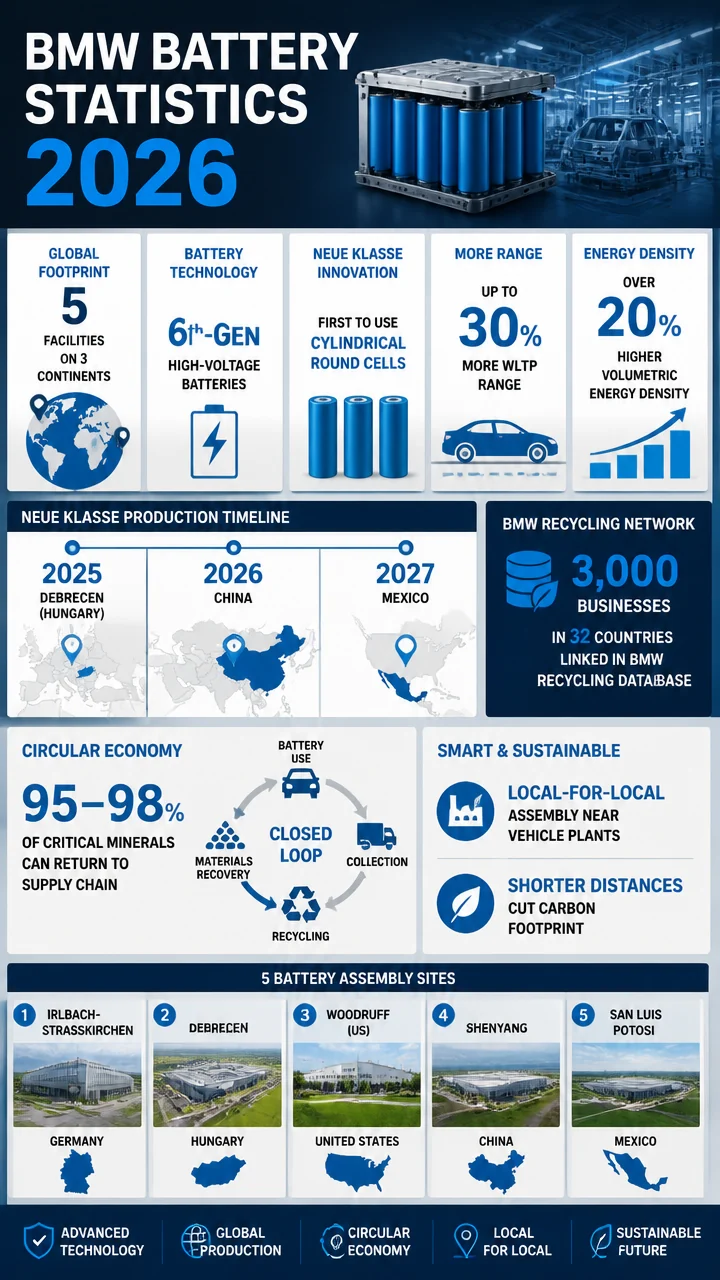
At a glance: BMW Group is building sixth-generation battery capability across five facilities on three continents, with Neue Klasse launches starting in 2025 in Debrecen, 2026 in China, and 2027 in Mexico.
BMW battery statistics: key takeaways
- Five facilities on three continents are being set up for BMW’s sixth-generation high-voltage batteries.
- The Neue Klasse will be the first BMW lineup to use the brand’s all-new cylindrical cells.
- BMW says the new round cells can improve range by up to 30 percent WLTP.
- The cells improve volumetric energy density by more than 20 percent.
- BMW’s local-for-local strategy places battery assembly close to vehicle plants to improve resilience and reduce carbon footprint.
- BMW’s circular-economy systems already link around 3,000 businesses in 32 countries through its common recycling database.
Big number: BMW says its Redwood partnership can return 95 to 98 percent of critical minerals to the battery supply chain.
BMW battery statistics at a glance
| Metric | BMW battery figure | Why it stands out |
|---|---|---|
| Battery plants | Five facilities | Signals global scale for sixth-generation batteries |
| Continents | Three | Production footprint spans Europe, North America, and Asia |
| Cell format | 46 mm diameter round cells | Core design change for the Neue Klasse era |
| Range gain | Up to 30% WLTP | One of the strongest quoted performance claims in the dataset |
| Energy density improvement | More than 20% | Supports better packaging efficiency |
| Redwood recovery rate | 95% to 98% | High-return recycling loop for critical minerals |
| Common recycling database users | 3,000 businesses in 32 countries | Shows breadth of BMW’s recycling ecosystem |
BMW battery trends: what the company is building
BMW’s battery strategy is increasingly local, modular, and vertically connected. The company says new battery cells are being assembled as closely as possible to vehicle plants under a local-for-local model, with battery and vehicle production tightly linked to improve resilience.
That matters because BMW also says the short distance between battery and vehicle plants will help reduce the carbon footprint of car production.
In other words, the company is using geography as a manufacturing advantage.
Why it matters: BMW is not treating batteries as a standalone component.
It is designing production networks where the battery plant, vehicle plant, and logistics chain operate as one system.
- Local-for-local manufacturing is central to the strategy.
- Resilience is improved when production is distributed and closely connected.
- Carbon reduction is tied to shorter transport distances.
- Series production is being staged region by region rather than launched all at once.
BMW battery production sites and launch timeline
BMW has named five sixth-generation battery assembly sites across its global footprint: Irlbach-Strasskirchen in Germany, Debrecen in Hungary, Woodruff near Spartanburg in the United States, Shenyang in China, and San Luis Potosi in Mexico.
The timeline is just as telling as the geography.
BMW says Debrecen will lead the Neue Klasse rollout, China will follow in 2026, and Mexico is planned for 2027.
| Location | BMW battery or vehicle milestone | Timing |
|---|---|---|
| Debrecen, Hungary | First Neue Klasse vehicles; battery and vehicle manufacturing in parallel | 2025, series launch in the second half |
| China | Neue Klasse vehicles made in China | 2026 |
| San Luis Potosi, Mexico | Neue Klasse production planned to start | 2027 |
| Irlbach-Strasskirchen, Germany | High-voltage battery plant permission and build-out | April 2024 permission; pillars erected in late June 2024 |
| Woodruff, U.S. | Plant completion | 2026 |
Fast fact: BMW says the first Chinese-made pre-series batteries for the Neue Klasse were due to roll off the line at the end of 2024.
BMW battery statistics by region: where the buildout is happening
BMW’s battery footprint is truly global, but the buildout is not evenly distributed. Europe is the launch pad, North America is the scale-up market, and China remains a major manufacturing pillar.
- Europe: Irlbach-Strasskirchen and Debrecen anchor the early sixth-generation rollout.
- North America: Woodruff and San Luis Potosi extend BMW’s local production strategy across the Americas.
- Asia: Shenyang keeps China embedded in the next-gen battery network.
| Region | Site(s) in dataset | Notable BMW battery data point |
|---|---|---|
| Europe | Irlbach-Strasskirchen, Debrecen | Debrecen launches vehicle and battery manufacturing in parallel in 2025 |
| North America | Woodruff, San Luis Potosi | Woodruff covers about 93 hectares and creates more than 300 jobs |
| Asia | Shenyang | China-made Neue Klasse vehicles arrive in 2026 |
BMW battery plant benchmarks: size, jobs, and build pace
The numbers behind BMW’s factories show how much physical capacity is being added to support battery and electric vehicle production.
Stat highlight: BMW says the San Luis Potosi battery assembly plant will include more than 80,000 square metres of production space.
- San Luis Potosi: The body shop will grow to more than 90,000 square metres in total.
- San Luis Potosi: Vehicle assembly and logistics will expand by nearly 10,000 square metres.
- Woodruff: The plant will cover about 93 hectares.
- Woodruff: BMW says it will create more than 300 new jobs.
- Woodruff: Completion is scheduled for 2026.
- Irlbach-Strasskirchen: The German plant received permission in April 2024.
- Irlbach-Strasskirchen: BMW erected the first of more than 1,000 concrete pillars in late June 2024.
One of the most striking comparisons is speed. BMW says the former BMW i3 hall in Leipzig was converted for e-component manufacturing in less than six months, which underlines how quickly the company can repurpose industrial space when it wants to scale.
BMW battery statistics in Leipzig: the manufacturing engine
Leipzig is one of the clearest examples in the dataset of BMW’s battery production maturity.
It is where the company’s e-component production structure is already up and running at industrial scale.
Key stat: Leipzig’s first cell coating line entered series operation in February 2023.
BMW says the Leipzig process follows three stages: cell coating, module production, and assembly.
That structure matters because it shows the full battery manufacturing chain rather than a single-step operation.
| Leipzig battery metric | BMW figure |
|---|---|
| First cell coating line | Series operation in February 2023 |
| Total coating lines planned | Five by 2024 |
| Module assembly lines | Three by 2024 |
| High-voltage battery assembly lines | Two by 2024 |
| Line capacity | More than 10 million cells per year |
| Throughput | Over 2,300 cells an hour |
| Coating system footprint | 2,300 square metres |
| Future e-component production area | Some 150,000 square metres |
| Workers in e-component production at time of release | More than 800 |
| Expected workers by 2024 | More than 1,000 |
- Capacity: more than 10 million cells annually
- Speed: over 2,300 cells per hour
- Scale: future e-component area of some 150,000 square metres
- Workforce growth: from more than 800 to more than 1,000 workers
BMW battery statistics on cell design and performance
The Neue Klasse battery package is built around a standardized round-cell format. BMW says the new cells have a 46-millimetre diameter and come in two heights: 95 millimetres and 120 millimetres.
The performance claims are strong enough to define the product story: BMW says the sixth-generation round cells can raise the range of the highest-range model by up to 30 percent WLTP while improving volumetric energy density by more than 20 percent.
Pull quote: “Up to 30 percent WLTP” is the headline number BMW attaches to its sixth-generation round-cell technology.
- 46 mm diameter standardizes the new round-cell format.
- Two heights create flexibility within the same cell architecture.
- More than 20 percent better volumetric energy density supports better packaging.
- Up to 30 percent WLTP range gain is the most attention-grabbing consumer-facing figure in the dataset.
BMW battery statistics and the circular economy
BMW’s battery strategy does not end when a battery is used up.
The company’s circular-economy dataset suggests that materials recovery is now a core operating principle rather than an afterthought.
Why it matters: BMW says the closed loop in battery production, established since late 2024, recovers cobalt, nickel, and lithium from used high-voltage batteries.
BMW also says its common recycling database is used by around 3,000 businesses in 32 countries, showing that the company’s recycling infrastructure extends well beyond a single plant or supplier relationship.
| BMW circular-economy metric | Figure | Interpretation |
|---|---|---|
| Closed-loop recovery | Cobalt, nickel, lithium | Targets key battery materials for reuse |
| Common recycling database reach | 3,000 businesses in 32 countries | Shows international adoption |
| Recycling and Dismantling Centre experience | More than 30 years | Long-running process development base |
| Average end-of-life return time | About 21 years | Vehicles stay in circulation for a long time before recovery |
| Legal recyclable share | 85 percent | Baseline vehicle recyclability requirement |
| Legal recoverable share | 95 percent | Includes thermal recycling in recovery target |
- 85 percent of a vehicle must be recyclable by law.
- 95 percent must be recoverable, including thermal recycling.
- BMW says end-of-life vehicles are generally returned after about 21 years on average.
- The company’s Recycling and Dismantling Centre has more than 30 years of process development experience.
BMW battery statistics vs. recycling partner Redwood
One of the most notable parts of the dataset is BMW’s Redwood partnership, which directly links battery supply-chain resilience with materials recovery.
Stat highlight: BMW says Redwood’s processes can reduce energy use by 80 percent, CO2 emissions by 70 percent, and water use by 80 percent versus conventional mining or recycling.
| Redwood partnership metric | BMW figure |
|---|---|
| BMW Group locations covered | Close to 700 in the U.S. |
| Critical minerals recovery | 95% to 98% |
| Energy use reduction | 80% |
| CO2 emissions reduction | 70% |
| Water use reduction | 80% |
Those figures make the partnership stand out in three ways:
- Scale: it reaches close to 700 BMW Group locations across the U.S.
- Efficiency: energy and water use are both cut by 80 percent.
- Supply-chain value: 95 to 98 percent recovery of critical minerals is unusually high for a battery ecosystem claim.
BMW battery statistics by competence center: Munich and Parsdorf
Before full-scale battery production, BMW has been building the technical backbone in competence centers near Munich.
Fast fact: BMW says prototype battery cells for the Neue Klasse are already being made at CMCC Parsdorf, just east of Munich.
- CMCC Parsdorf employs around 80 people.
- The CMCC covers 15,000 square metres.
- BMW says the centre has received around 170 million euros of investment.
- The CMCC was built to complement the Battery Cell Competence Centre in northern Munich.
- Together, the centres support the ramp-up of sixth-generation e-drivetrains.
These numbers show a relatively compact but highly capitalized R&D and prototype operation.
With around 80 employees and 15,000 square metres, the site is smaller than the industrial plants in Leipzig or San Luis Potosi, but it plays a crucial role in preparing the next generation of battery hardware.
BMW battery statistics: the most quotable numbers
For editors, analysts, and anyone scanning for headline stats, these are the figures most likely to stick:
- Five facilities on three continents for sixth-generation battery production.
- Up to 30 percent WLTP range gain from the new round cells.
- More than 20 percent improvement in volumetric energy density.
- 95 to 98 percent critical mineral recovery in the Redwood loop.
- More than 10 million cells per year from Leipzig’s coating line.
- More than 1,000 concrete pillars planned for the Irlbach-Strasskirchen hall.
- More than 300 new jobs at Woodruff.
- 3,000 businesses in 32 countries using BMW’s recycling database.
Bottom-line insight: BMW’s battery statistics point to a company that is pairing next-gen cell technology with a geographically distributed, recycling-aware production model.