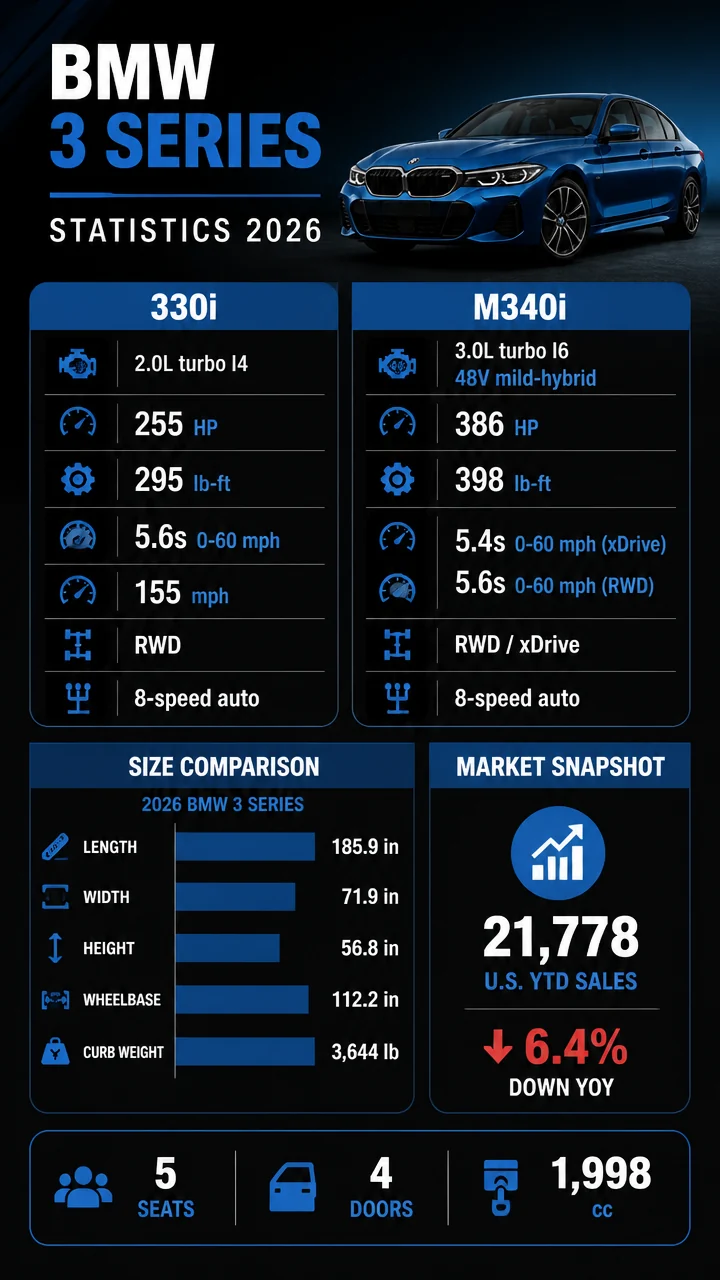
The BMW 3 Series still wins on a rare mix of everyday usability and real performance.
These BMW 3 Series statistics show exactly how the 2026 lineup balances compact dimensions, turbocharged power, and market relevance.
Here’s the data-backed snapshot: the 330i delivers 255 horsepower and 295 lb-ft of torque, the M340i climbs to 386 horsepower and 398 lb-ft, and U.S. sales totaled 21,778 units year to date in 2024.
BMW 3 Series statistics at a glance
Big number: The 2026 BMW 330i reaches 60 mph in 5.6 seconds and can hit 155 mph with optional performance tires.
Fast facts: The 330i uses a 2.0-liter turbocharged inline 4-cylinder, while the M340i uses a 3.0-liter turbocharged inline 6-cylinder with 48V mild-hybrid technology.
Why it matters: BMW’s 3 Series remains a benchmark because its specs cover both efficiency-minded entry luxury and near-sport-sedan territory.
- 330i power: 255 horsepower and 295 lb-ft of torque
- M340i power: 386 horsepower and 398 lb-ft of torque
- 330i 0-60 mph: 5.6 seconds
- M340i 0-60 mph: 5.4 seconds in xDrive form, 5.6 seconds in rear-wheel-drive form
- 3 Series U.S. sales: 21,778 YTD units in 2024
- Sales trend: U.S.
3 Series sales fell 6.4% year over year in YTD 2024
BMW 3 Series engine statistics and powertrain specs
The 2026 BMW 3 Series lineup splits neatly into two power stories: the 330i’s 2.0-liter turbo four and the M340i’s 3.0-liter turbo inline six.
Both use BMW’s TwinPower Turbo branding, but their output profiles are very different in character and intent.
Pull quote: The 330i makes 255 horsepower from just 1,998 cc, while the M340i produces 386 horsepower from 2,998 cc.
| Model | Engine | Displacement | Horsepower | Torque | Transmission | Drive |
|---|---|---|---|---|---|---|
| 330i | 2.0-liter BMW TwinPower Turbo inline 4-cylinder | 1,998 cc | 255 hp | 295 lb-ft | 8-speed automatic | Rear-wheel drive |
| M340i | 3.0-liter M TwinPower Turbo inline 6-cylinder with 48V mild-hybrid technology | 2,998 cc | 386 hp | 398 lb-ft | 8-speed Steptronic | xDrive available |
The difference in displacement is exactly 1,000 cc, and that gap helps explain the jump in output.
The 330i’s 2.0-liter engine is optimized for accessible performance, while the M340i’s inline six adds a stronger torque plateau and higher ceiling.
- 330i cylinder count: 4 cylinders
- M340i cylinder count: 6 cylinders and 24 valves
- 330i compression ratio: 10.5:1
- M340i compression ratio: 10.2:1
- 330i bore and stroke: 82.0 mm bore, 94.6 mm stroke
- 330i mild-hybrid tech: 48V mild-hybrid technology appears in the 2025 BMW 3 Series press release specification set
BMW 3 Series acceleration and top speed statistics
If you want the headline performance figures, this is where the 3 Series gets attention.
The 330i is quick for a luxury sedan, and the M340i trims a little more time off the sprint even while remaining practical enough for daily use.
Big number: The 330i hits 0-60 mph in 5.6 seconds, while the M340i xDrive does it in 5.4 seconds.
- 330i 0-60 mph: 5.6 seconds
- 330i top speed: 130 mph electronically limited
- 330i top speed with performance tires: 155 mph
- M340i xDrive 0-60 mph: 5.4 seconds
- M340i rear-wheel-drive 0-60 mph: 5.6 seconds
- M340i top speed: 130 mph, or 155 mph with performance tires
BMW also publishes the speed bands where each model makes its peak output.
That detail matters because it shows how broad the usable power range is.
| Model | Horsepower peak rpm | Torque peak rpm | Top speed |
|---|---|---|---|
| 330i | 4,700-6,500 rpm | 1,600-4,500 rpm | 130 mph, or 155 mph with performance tires |
| M340i | 5,200-6,250 rpm | 1,900-4,800 rpm | 130 mph, or 155 mph with performance tires |
The 330i’s torque arrives earlier, starting at 1,600 rpm, which helps it feel responsive in city and freeway driving.
The M340i shifts its torque band slightly higher, but extends the performance ceiling with far more output overall.
BMW 3 Series transmission and drivetrain data
BMW keeps the 3 Series formula focused: rear-drive balance in the base 330i, with xDrive available on the M340i for buyers who want traction variety.
Both cars use modern 8-speed automatics, which is part of the brand’s consistency across the lineup.
Key takeaway: The 330i uses an 8-speed automatic and standard rear-wheel drive, while the M340i uses an 8-speed Steptronic and can be ordered with xDrive.
- 330i transmission: 8-speed automatic
- M340i transmission: 8-speed Steptronic
- 330i drive layout: Rear-wheel drive
- M340i drive layout: Rear-wheel drive or xDrive all-wheel drive
- 330i final drive ratio: 2.81:1
- M340i steering ratio: 13.6:1
The 330i’s gear spread is wide, starting with a 5.25:1 first gear and ending at a 0.64:1 eighth gear.
That range supports both launch feel and highway efficiency.
| 330i gear | Ratio | 330i gear | Ratio |
|---|---|---|---|
| 1st | 5.25:1 | 5th | 1.32:1 |
| 2nd | 3.36:1 | 6th | 1.00:1 |
| 3rd | 2.17:1 | 7th | 0.82:1 |
| 4th | 1.72:1 | 8th | 0.64:1 |
Reverse is also unusually tall at 3.71:1, while the 2.81:1 final drive helps translate the turbo four’s torque into usable everyday acceleration.
BMW 3 Series dimensions and size statistics
One reason the 3 Series remains a standard-setter is that it stays relatively compact outside while still offering a usable cabin inside.
The 330i and M340i share very similar proportions, which keeps the design language and packaging consistent across the range.
At a glance: The 330i is 185.9 inches long, 71.9 inches wide, and 56.8 inches tall, with a 112.2-inch wheelbase.
| Measurement | 330i Sedan | M340i Sedan |
|---|---|---|
| Length | 185.9 in | 185.9 in |
| Width | 71.9 in | 71.9 in |
| Height | 56.8 in | 56.4 in RWD / 56.7 in xDrive |
| Wheelbase | 112.2 in | 112.5 in |
| Width with mirrors | 81.4 in | Not provided |
| Front track | Not provided | 62.3 in |
| Rear track | Not provided | 61.7 in |
The 330i’s footprint is particularly useful for shoppers who want a premium sedan without stepping into full-size territory.
It seats 5 passengers and has 4 doors, which keeps it aligned with family and commuting use cases.
- 330i curb weight: 3,644 pounds
- 330i fuel capacity: 15.6 gallons
- 330i width with mirrors: 81.4 inches
- 330i seating: 5 passengers
- 330i doors: 4
BMW 3 Series chassis, brakes, and handling benchmarks
BMW’s reputation is built on chassis tuning as much as engine power, and the 3 Series technical data backs that up.
Both models use lightweight aluminum-steel suspension construction, but the M340i adds a more aggressive brake package and a quicker steering ratio.
Why it matters: The M340i’s 13.6:1 steering ratio is quicker than the 330i’s 14.9:1 setup, signaling a sharper performance focus.
- 330i front suspension: Double-joint spring strut axle in lightweight aluminum-steel construction
- 330i rear suspension: Five-link axle in lightweight aluminum-steel construction
- 330i front brakes: Vented with single-piston floating calipers
- 330i steering: EPS with Servotronic
- 330i steering ratio: 14.9:1
- 330i standard tires: 225/45 R18 front and rear
- 330i standard rims: 7.5J x 18 front and rear
- M340i front suspension: Double-joint spring strut axle in lightweight aluminum-steel construction
- M340i rear suspension: Five-link axle in lightweight aluminum-steel construction
- M340i front brakes: Vented with four-piston fixed calipers
- M340i rear brakes: Vented with single-piston floating calipers
- M340i standard tires: 225/40 R19 front and rear
The brake hardware difference is especially notable.
The 330i uses single-piston floating calipers up front, while the M340i steps up to four-piston fixed calipers, reinforcing its higher-performance positioning.
BMW 3 Series M340i statistics versus 330i statistics
Looking at the two main trims side by side makes the hierarchy obvious.
The 330i focuses on balanced performance, while the M340i adds more power, heavier curb weight, available all-wheel drive, and more aggressive hardware.
| Category | 330i | M340i | What stands out |
|---|---|---|---|
| Horsepower | 255 hp | 386 hp | M340i adds 131 hp |
| Torque | 295 lb-ft | 398 lb-ft | M340i adds 103 lb-ft |
| 0-60 mph | 5.6 seconds | 5.4 seconds xDrive / 5.6 seconds RWD | xDrive gives the quickest sprint |
| Curb weight | 3,644 lb | 3,896 lb RWD / 4,008 lb xDrive | M340i is heavier, especially with xDrive |
| Steering ratio | 14.9:1 | 13.6:1 | M340i turns in quicker |
| Brakes | Single-piston floating front calipers | Four-piston fixed front calipers | M340i gets a stronger front brake setup |
Stat highlight: The M340i delivers 131 more horsepower than the 330i, but only a 0.2-second advantage to 60 mph in xDrive form.
That contrast is telling.
BMW’s performance sedan tuning is not just about raw horsepower; traction, gearing, and weight also shape the final number.
BMW 3 Series market data and U.S. sales statistics
The 3 Series remains one of BMW’s most important mainstream luxury nameplates in the U.S., even as sales trends softened in 2024.
The figures below show a model that still moves in significant volume, but at a lower pace than the prior year.
Fast facts: BMW of North America sold 7,641 3 Series vehicles in Q3 2024 and 21,778 year to date in 2024.
| Sales metric | 2024 | 2023 | Change |
|---|---|---|---|
| Q3 sales | 7,641 | 8,852 | -13.7% |
| YTD sales | 21,778 | 23,268 | -6.4% |
Sales fell year over year in both the quarter and the year-to-date view, but the 3 Series still remained a high-volume premium sedan.
The gap between 2023 and 2024 is meaningful, yet the nameplate continues to post five-digit totals.
- Q3 2024 sales: 7,641 units
- Q3 2023 sales: 8,852 units
- YTD 2024 sales: 21,778 units
- YTD 2023 sales: 23,268 units
- Q3 year-over-year change: -13.7%
- YTD year-over-year change: -6.4%
BMW 3 Series key numbers that define the lineup
Several numbers explain why the 3 Series continues to matter in the luxury sedan segment.
It is compact enough to feel manageable, powerful enough to feel special, and refined enough to support both daily use and enthusiast interest.
Key takeaways: 255 hp, 295 lb-ft, 5.6 seconds to 60, 185.9 inches long, and 21,778 U.S. sales YTD in 2024 are the figures that best summarize the 3 Series story.
- The 330i is the efficiency-and-balance play, with a 2.0-liter turbo four and rear-wheel drive as standard.
- The M340i is the performance choice, with 386 horsepower, 398 lb-ft, and available xDrive.
- Both variants keep the same basic 3 Series dimensions, preserving the sedan’s recognizable footprint.
- The 3 Series still sells in meaningful volume, even with 2024 declines.
- BMW’s tuning emphasis shows up in the details: suspension construction, steering ratios, brake hardware, and torque delivery windows.
One more notable figure: the 330i’s torque peak spans 1,600 to 4,500 rpm, which is a wide band for real-world drivability and an important reason the car feels stronger than its displacement suggests.
Another standout: the M340i’s 2,998 cc inline six, 48V mild-hybrid system, and 398 lb-ft of torque make it the clear upper-performance anchor in the range.