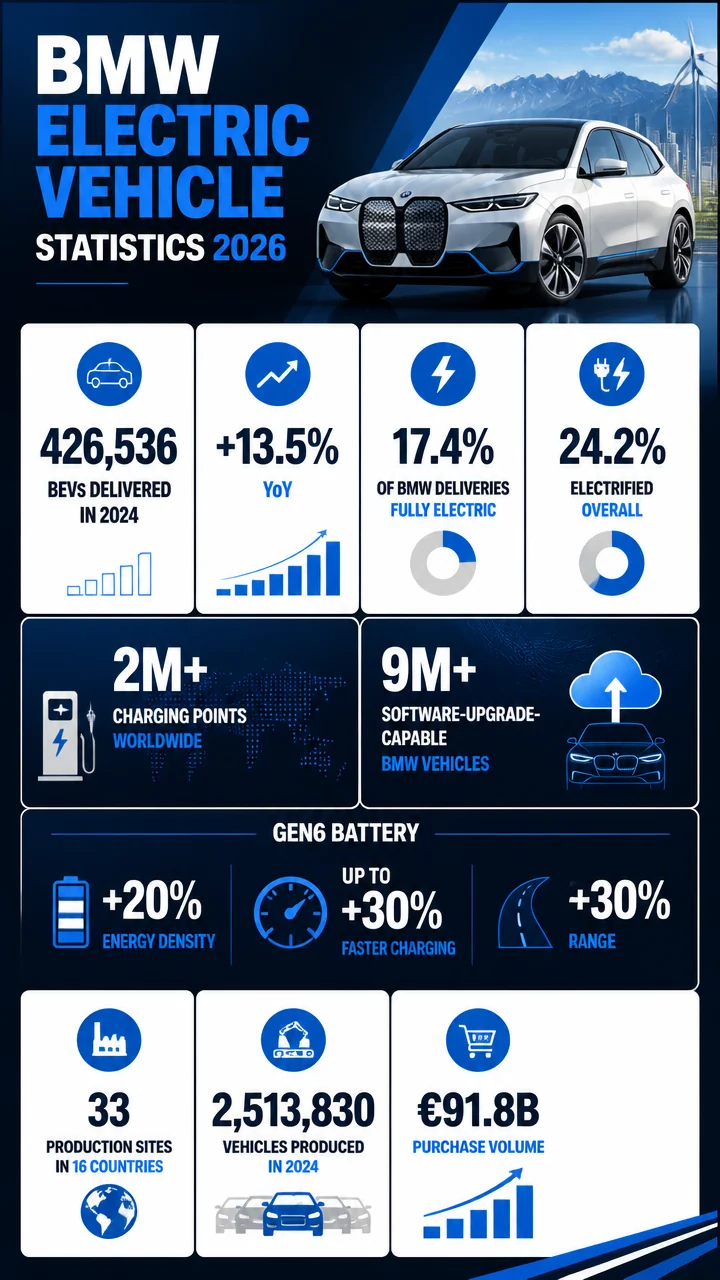
BMW electric vehicle statistics at a glance
BMW’s electric story is no longer about early adoption alone.
The latest numbers show a company scaling BEV deliveries, expanding charging access, and pushing toward a future where electrified cars become the majority of sales.
Big number: BMW Group delivered 426,536 all-electric vehicles in 2024, a 13.5% year-over-year increase.
Fast fact: Fully electric vehicles made up 17.4% of BMW Group automobile deliveries in 2024, while electrified vehicles overall reached 24.2% of total deliveries.
Why it matters: BMW is pairing EV growth with serious infrastructure and software capability, including access to more than 2 million charging points and more than 9 million remote software-upgrade-capable vehicles.
Table of contents
- BMW electric vehicle delivery trends
- BMW EV share and electrification benchmarks
- BMW U.S. electric vehicle sales statistics
- BMW model-by-model BEV performance
- BMW charging, software, and battery statistics
- BMW global production and business scale
- BMW 2030 EV target and what the data suggests
BMW electric vehicle delivery trends: the global picture
The clearest signal in BMW electric vehicle statistics is momentum.
BMW Group is growing fully electric deliveries even while total automotive deliveries remain essentially flat year over year, which suggests EVs are doing more of the heavy lifting inside the portfolio.
BMW Group delivered 426,536 all-electric vehicles in 2024, up 13.5% from the prior year.
That growth sits alongside a broader electrification story.
BMW Group delivered 593,215 electrified vehicles worldwide in 2024, up 4.8%.
In other words, the company is scaling both pure battery-electric vehicles and plug-in hybrids, even as it works toward a more electric product mix.
Electrified vehicles represented 24.2% of BMW Group deliveries in 2024, while fully electric vehicles accounted for 17.4%.
Those percentages tell an important story:
- BMW’s electrified base is already substantial.
- BEVs are the main growth engine inside that base.
- The gap between electrified share and BEV share shows plug-in hybrids still matter in the transition.
Global BMW EV and electrification snapshot
| Metric | 2024 result | Change |
|---|---|---|
| All-electric vehicles delivered | 426,536 | +13.5% |
| Electrified vehicles delivered | 593,215 | +4.8% |
| Fully electric share of BMW Group deliveries | 17.4% | of total deliveries |
| Electrified share of BMW Group deliveries | 24.2% | of total deliveries |
| Total BMW Group vehicle deliveries | 2,450,804 | Target met |
BMW electric vehicle statistics and the 2030 target
BMW’s long-term target makes the current numbers even more interesting.
The company says its 2030 goal is for fully electrified cars to exceed 50% of deliveries.
That puts today’s 17.4% BEV share in context: BMW still has a long runway ahead.
Key takeaway: To get from 17.4% BEV share in 2024 to more than 50% by 2030, BMW will need a sustained acceleration in product mix, battery rollout, and market penetration.
At the same time, BMW has a broad enough global platform to support the shift.
The company operated 33 production locations across 16 countries in 2024 and manufactured 2,513,830 BMW, MINI, and Rolls-Royce automobiles across its global production network.
That manufacturing footprint matters because EV transitions are not just about consumer demand.
They also depend on:
- production flexibility,
- platform integration,
- supply chain capacity, and
- regional delivery balancing.
BMW U.S. electric vehicle sales statistics
The U.S. is one of the most revealing markets in BMW electric vehicle statistics because it shows how EV demand can coexist with a premium brand record.
BMW of North America set a second consecutive annual U.S. sales record in 2024, while also establishing a new BEV benchmark.
BMW U.S.
BEV sales totaled 50,981 units in full-year 2024, up 12.3% year over year.
That happened in a year when BMW sold 371,346 BMW vehicles in the U.S., up 2.5%.
Electrified sales were not a side story; they were a major contributor to the brand’s U.S. performance.
BMW’s total electrified vehicle sales in the U.S. reached 70,379 units in 2024, equal to 19% of total U.S. sales.
BMW also had four fully electric BEV models in market in the U.S. from the start of 2024, which helps explain how the brand could generate volume across multiple nameplates instead of leaning on a single model.
BMW U.S. electric sales by period
| Period | BEV sales | YoY change | Share of U.S. sales |
|---|---|---|---|
| Q2 2024 | 14,081 | +23.8% | About 15.4% |
| Q3 2024 | 12,311 | -5.9% | About 15.8% |
| Q4 2024 | 13,876 | -3.5% | Not stated |
| Full-year 2024 | 50,981 | +12.3% | Not stated |
A few patterns stand out:
- BMW’s U.S.
BEV volume stayed above 12,000 units in both Q3 and Q4.
- Q2 was the strongest quarter in the dataset at 14,081 BEVs.
- Even with some quarterly softening, full-year growth remained solid at 12.3%.
Pull quote: BMW’s U.S.
EV business is not just growing; it is becoming a durable part of the brand’s premium volume engine.
BMW model-level BEV sales statistics in the U.S.
BMW’s U.S.
EV mix is also visible at the model level.
The line-up is broad enough to spread demand across core electric nameplates, with the i4 leading the pack and the iX close behind.
Full-year 2024 U.S. model ranking
| Model | Q4 2024 sales | Full-year 2024 sales |
|---|---|---|
| BMW i4 | 5,737 | 23,403 |
| BMW iX | 4,214 | 15,383 |
| BMW i5 | 2,987 | 8,763 |
| BMW i7 | 938 | 3,431 |
From these figures, the ranking is clear:
- BMW i4 is BMW’s top U.S.
BEV volume model in the dataset.
- BMW iX is the second-largest BEV contributor.
- BMW i5 is building volume, but still trails the i4 and iX.
- BMW i7 remains a smaller-volume flagship EV.
There is also an important quarter-to-quarter signal inside the model data:
- i4 delivered 7,066 units in Q2 and 6,063 in Q3, then 5,737 in Q4.
- i5 moved from 2,541 in Q2 to 996 in Q3 and 2,987 in Q4.
- iX climbed from 3,545 in Q2 to 4,679 in Q3 and 4,214 in Q4.
- i7 stayed niche at 929 in Q2, 573 in Q3, and 938 in Q4.
Notable pattern: BMW’s U.S.
BEV mix is not dependent on a single winner.
The i4 leads, but the iX and i5 also contribute meaningful volume.
BMW electric vehicle statistics by half-year and quarter
BMW’s corporate delivery data shows how quickly the brand can accelerate inside a half-year window.
In the first half of 2024, BMW Group delivered 1,213,359 vehicles worldwide and 190,622 BEVs, up 24.6%.
BMW brand delivered 179,557 fully electric vehicles in the first half of 2024, up 34.1% year over year.
That figure is especially strong because BMW brand sales overall were up only 2.3% to 1,096,486 units in the same period.
In plain English: EVs grew much faster than the brand itself.
Half-year and quarterly electrification metrics
| Metric | Result | Change |
|---|---|---|
| BMW Group BEV deliveries, H1 2024 | 190,622 | +24.6% |
| BMW Group electrified deliveries, H1 2024 | 269,065 | +9.6% |
| BMW Group BEV deliveries, Q2 2024 | 107,933 | +22.2% |
| BMW Group electrified deliveries, Q2 2024 | 146,483 | +8.5% |
These numbers show a consistent theme: BEVs are outperforming the broader electrified category in growth rate, which indicates BMW’s transition is becoming more battery-electric over time.
BMW charging, software, and battery statistics
BMW’s EV story is not only about vehicles sold.
It is also about the ecosystem built around them.
The company says customers had access to more than 2 million charging points worldwide via BMW and MINI Charging Cards in 2024.
Fast fact: BMW had more than 9 million remote software-upgrade-capable vehicles in 2024.
That software scale matters because EV ownership increasingly depends on connected features, battery optimization, and over-the-air improvement.
BMW’s digital base gives the company a strong support layer beyond the showroom.
BMW Gen6 battery cell highlights
BMW’s Gen6 battery cell generation was described as offering about 20% higher energy density, up to 30% faster charging, and about 30% greater range.
Those are the kinds of technical gains that can support both market expansion and consumer adoption.
Faster charging, higher density, and longer range are three of the most quoted variables in EV decision-making, and BMW’s stated Gen6 improvements address all three at once.
- Higher energy density helps pack more usable energy into the battery.
- Faster charging reduces downtime for drivers.
- Greater range improves the overall ownership proposition.
Why it matters: BMW’s EV performance depends not just on sales momentum, but on whether the product and ownership experience keep improving at the same pace.
BMW production, jobs, and supplier scale behind the EV push
BMW electric vehicle statistics make more sense when viewed inside the company’s broader industrial footprint.
The BMW Group employed 159,104 people at the end of 2024 and invested €415 million in vocational and further training.
That level of training spend suggests BMW is preparing its workforce for a more complex future that includes EV manufacturing, software, battery systems, and digital services.
Big number: BMW Group purchase volume reached €91.8 billion in 2024.
That supplier spend underscores the scale of BMW’s industrial network.
It also reflects how much of the EV transition depends on procurement, component sourcing, and execution across the supply chain.
BMW business scale at a glance
- 33 production locations across 16 countries
- 2,513,830 vehicles manufactured in the global production network
- 159,104 employees worldwide
- €91.8 billion purchase volume
- €415 million invested in employee training
BMW electric vehicle statistics and corporate performance
BMW’s EV expansion is happening inside a company that is still financially strong.
In 2024, the BMW Group posted group profit before tax of €10,971 million.
That matters because electrification programs require capital discipline, product investment, and long-term confidence.
Core profitability benchmarks in 2024: Automotive segment EBIT margin was 6.3%, Motorcycles segment EBIT margin was 6.1%, and Financial Services segment return on equity was 15.1%.
Those numbers show BMW can continue funding transformation while maintaining a profitable core.
In practical terms, that supports EV development, battery rollout, and charging ecosystem investment without relying on a weak balance sheet.
BMW also shows a notable leadership and inclusion data point: women held 21.7% of BMW Group management positions at the end of 2024.
While not an EV metric directly, it helps frame the organization behind the electrification push.
BMW electric vehicle growth by region and market
Regional delivery patterns reveal where BMW’s growth is strongest and where it faces the most pressure.
In the first half of 2024, BMW & MINI deliveries were up in Europe and the Americas, but down in Germany, Asia, and China.
| Region | BMW & MINI deliveries, H1 2024 | Change |
|---|---|---|
| Europe | 460,144 | +2.6% |
| Germany | 130,451 | -3.3% |
| Asia | 493,364 | -3.6% |
| China | 375,947 | -4.2% |
| Americas | 229,302 | +2.1% |
| USA | 187,979 | +1.5% |
These regional figures suggest a mixed global picture:
- Europe remains a stable growth market.
- The Americas are contributing modest gains.
- China and broader Asia are softer in the first half of 2024.
Key takeaway: BMW’s EV growth is global, but the regional demand backdrop is uneven, which makes execution in each market more important.
BMW electric vehicle statistics in context: what stands out most
A few figures do the most work in telling BMW’s EV story:
- 426,536 all-electric vehicles delivered globally in 2024.
- 17.4% of BMW Group deliveries were fully electric.
- 24.2% of deliveries were electrified overall.
- 50,981 U.S.
BEV sales
in 2024. - 70,379 electrified U.S. sales in 2024, equal to 19% of BMW’s U.S. volume.
- More than 2 million charging points available worldwide via BMW and MINI Charging Cards.
- More than 9 million software-upgrade-capable BMW vehicles.
- Gen6 battery cells with about 20% higher energy density and up to 30% faster charging.
Put together, these numbers show a company that is not merely participating in the EV transition.
BMW is building scale, software reach, charging access, and battery improvements simultaneously.
Pull quote: BMW’s EV strategy looks less like a one-year sales spike and more like a multi-layered transformation of product, platform, and customer experience.
BMW electric vehicle statistics: the most important takeaway points
- BMW Group’s BEV volume is growing faster than its overall vehicle deliveries.
- The U.S. remains a critical market, with 50,981 BEV sales and 19% electrified share in 2024.
- The i4 leads BMW’s U.S.
BEV lineup, with 23,403 units in full-year 2024.
- BMW’s charging and software infrastructure gives it a deeper EV support base than sales data alone shows.
- The 2030 target of more than 50% fully electrified deliveries implies the current 2024 mix still has significant room to grow.
At a glance: BMW’s electric vehicle statistics point to a brand that is scaling up from strength rather than trying to recover from weakness.
The numbers show growth, but they also show the infrastructure and industrial depth needed to sustain it.