The latest BMW 5 Series statistics show a sedan that has grown more tech-forward, more electrified, and still deeply focused on performance.
From 0 to 60 mph times to range, cargo space, safety ratings, and sales trends, the numbers tell a detailed story.
BMW 5 Series statistics at a glance
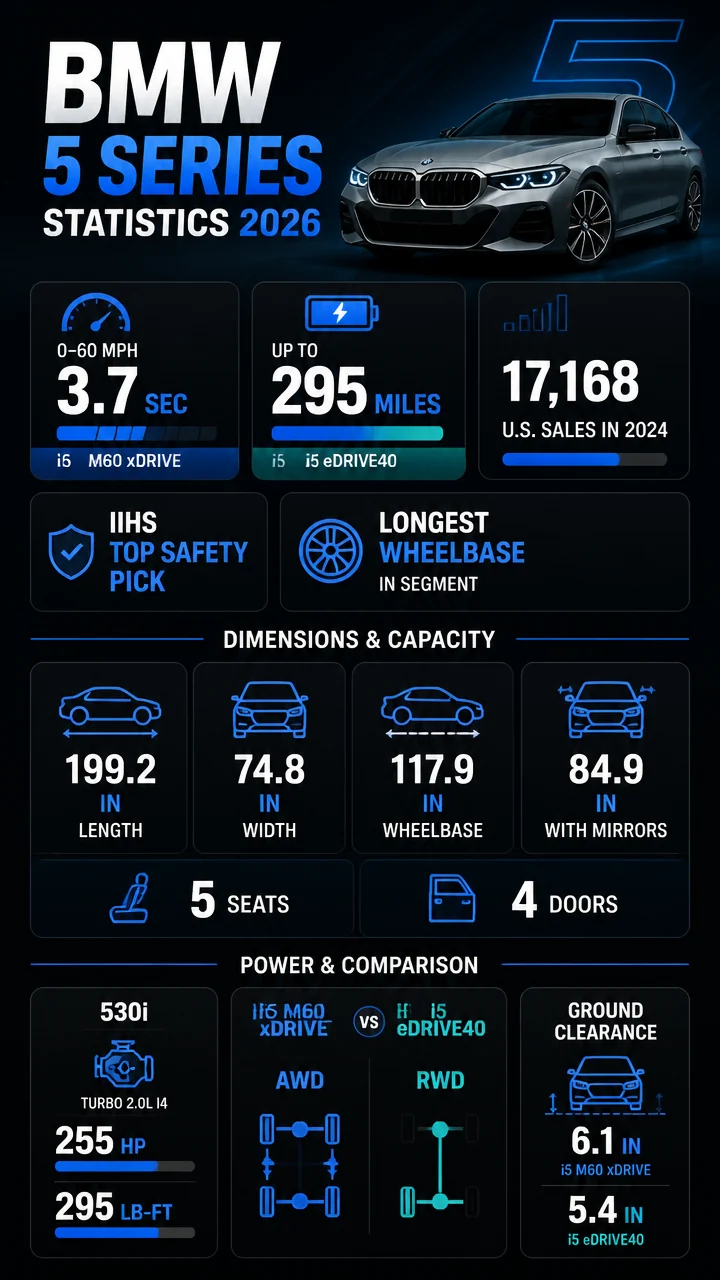
Big number: The i5 M60 xDrive hits 0 to 60 mph in just 3.7 seconds.
Longest claim: BMW says the 5 Series has the longest wheelbase in its segment.
Range leader: The i5 eDrive40 is estimated at up to 295 miles on standard 19-inch wheels.
Safety highlight: The redesigned 2024 BMW 5 Series earned an IIHS Top Safety Pick award.
Sales snapshot: BMW of North America sold 17,168 BMW 5 Series vehicles in full-year 2024 U.S. sales.
Why it matters: The 5 Series is no longer just a mid-size luxury sedan.
The current generation blends traditional gasoline power, all-electric drivetrains, advanced cabin tech, and a measurable EV push—all while keeping the core executive-sedan proportions buyers expect.
BMW 5 Series dimensions and size statistics
The 2024 BMW 5 Series (G60) keeps a consistent footprint across its U.S. lineup, with every listed trim sharing the same basic body size.
That consistency is useful for shoppers comparing gasoline and electric versions because the packaging is remarkably similar even when the powertrains differ.
| Specification | 530i / 530i xDrive | i5 eDrive40 | i5 M60 xDrive |
|---|---|---|---|
| Seating | 5 | 5 | 5 |
| Doors | 4 | 4 | 4 |
| Length | 199.2 in | 199.2 in | 199.2 in |
| Width | 74.8 in | 74.8 in | 74.8 in |
| Width with mirrors | 84.9 in | 84.9 in | 84.9 in |
| Wheelbase | 117.9 in | 117.9 in | 117.9 in |
117.9 inches of wheelbase is a standout number here.
BMW says the 5 Series has the longest wheelbase in its segment, and that long stance helps explain the sedan’s executive-car packaging and interior room.
At a glance: Every listed U.S. variant seats five, has four doors, and shares the same 199.2-inch length.
That means trim choice affects powertrain and equipment more than overall footprint.
Key size and cabin measurements
- Front shoulder width: 59.2 inches
- Second-row shoulder room: 56.9 inches
- Front track: 63.9 inches on the 530i and 530i xDrive
- Rear track: 65.2 inches on the 530i and 63.9 inches on the 530i xDrive
The rear track difference between the rear-drive 530i and the xDrive model is a small but telling packaging detail.
The 5 Series is engineered for stability and stance, not just cabin space.
Ground clearance and height differences
BMW keeps the car low and planted, but the exact stance changes slightly by trim.
- Height: 59.6 inches for the 530i and 530i xDrive
- Height: 59.3 inches for the i5 M60 xDrive
- Ground clearance: 6.1 inches for the 530i
- Ground clearance: 5.7 inches for the 530i xDrive
- Ground clearance: 5.4 inches for the i5 M60 xDrive
Why it matters: The lower ground clearance on the i5 M60 xDrive supports its performance-first setup, while the 530i offers a slightly more forgiving ride height.
BMW 5 Series engine, EV, and performance statistics
The BMW 5 Series statistics split neatly into two worlds: the 530i’s turbocharged gasoline power and the i5 lineup’s electric performance.
Across both, BMW keeps the emphasis on strong torque delivery and brisk real-world acceleration.
Fast facts: The 530i produces 255 hp, the i5 eDrive40 makes 335 hp from its rear motor, and the i5 M60 xDrive peaks at 593 hp system output.
| Powertrain | Output | Torque | 0-60 mph | Top speed |
|---|---|---|---|---|
| 530i | 255 hp | 295 lb-ft | 5.9 seconds | 130 mph |
| 530i xDrive | 255 hp | 295 lb-ft | 5.8 seconds | 130 mph |
| i5 eDrive40 | 335 hp | 295 lb-ft / 317 lb-ft with Sport Boost | 5.7 seconds | 120 mph |
| i5 M60 xDrive | 593 hp system | 586 lb-ft system | 3.7 seconds | 143 mph with performance tires |
530i gasoline statistics
The 530i is powered by a 1,998 cm3 engine with a 10.5:1 compression ratio.
BMW rates it at 255 hp at 4,700 to 6,500 rpm and 295 lb-ft at 1,600 to 4,500 rpm.
One of the most quotable efficiency-performance figures is the output-per-liter number: 127.5 hp/liter.
That makes the 530i’s powertrain a compact but effective performance package rather than a big-displacement statement.
- Transmission: 8-speed STEPTRONIC
- First gear: 5.25:1
- Second gear: 3.36:1
- Third gear: 2.17:1
- Fourth gear: 1.72:1
- Fifth gear: 1.32:1
- Sixth gear: 1.00:1
- Seventh gear: 0.82:1
- Eighth gear: 0.64:1
- Reverse: 3.71:1
- Final drive: 3.15:1
Launch takeaway: BMW says the 530i’s output rose by 7 hp and torque increased by 38 lb-ft over the previous generation.
Those are the kinds of gains that matter most in a luxury sedan: easier passing, smoother merges, and more relaxed daily driving.
i5 electric statistics
The i5 models use a lithium-ion battery with 84.3 kWh of usable energy content and a 399 V electrical system.
BMW says the i5 uses fifth-generation BMW eDrive technology, which helps explain the model’s strong efficiency and charging capability.
- i5 eDrive40 rear motor: 335 hp
- i5 eDrive40 torque: 295 lb-ft, or 317 lb-ft with Sport Boost/Launch Control
- i5 M60 xDrive front motor: 257 hp and 269 lb-ft
- i5 M60 xDrive rear motor: 335 hp and 317 lb-ft
- i5 M60 xDrive system output: 593 hp
- i5 M60 xDrive system torque: 586 lb-ft
Pull quote: The i5 M60 xDrive’s 593 hp and 3.7-second sprint to 60 mph put the executive sedan into serious performance territory.
The i5 eDrive40 and i5 M60 xDrive both use single-speed transmissions.
That simplicity is part of the electric-car advantage: torque arrives instantly, and the gearing does not need the multi-speed complexity of the gasoline 530i.
BMW also lists final-drive differences that show how each EV variant is tuned:
- i5 eDrive40: 11.12:1 front and 8.78:1 rear
- i5 M60 xDrive: 9.37:1 rear
Acceleration comparison: The i5 eDrive40 reaches 60 mph in 5.7 seconds, slightly quicker than the 530i xDrive at 5.8 seconds.
The M60 then makes the leap to 3.7 seconds, creating a very wide performance spread within the same body shell.
BMW 5 Series range, charging, and EV usage statistics
For shoppers cross-shopping electric luxury sedans, the i5’s range and charging numbers are the key story.
BMW positioned the car to work as a daily driver first, with enough DC fast-charging capability to make longer trips more realistic.
| EV metric | i5 eDrive40 | i5 M60 xDrive |
|---|---|---|
| Estimated range | Up to 295 miles | Up to 256 miles |
| AC charging | Up to 11 kW | |
| DC fast charging | Up to 205 kW | |
| 10% to 80% charge | About 30 minutes at a 205 kW DC charger | |
295 miles is the headline range figure to know for the i5 eDrive40.
The i5 M60 xDrive still posts a respectable 256 miles, especially considering its much higher output and all-wheel-drive hardware.
Why it matters: BMW’s range split shows the trade-off clearly: choose the eDrive40 for efficiency and distance, or the M60 xDrive for maximum performance with still-usable everyday range.
The battery itself is packaged in a modular format, made of four modules with 72 cells each and three modules with 12 cells each.
That detail underscores the engineering behind the i5 rather than treating it as a simple battery swap into a familiar sedan platform.
Charging and cabin convenience highlights
- AC charging max: 11 kW
- DC charging max: 205 kW
- Charge window: 10% to 80% in about 30 minutes
- Battery chemistry: Lithium-ion
BMW 5 Series technology and interior statistics
Inside, the 5 Series leans into BMW’s current digital cockpit strategy.
The visual centerpiece is the BMW Curved Display, which pairs a 12.3-inch information display with a 14.9-inch control display.
At a glance: BMW Operating System 8.5 powers the graphic display and QuickSelect interface, while the BMW Interaction Bar is standard in i5 models and optional on the 530i and 530i xDrive.
- BMW Curved Display: 12.3-inch information display + 14.9-inch control display
- Operating system: BMW Operating System 8.5
- Interaction Bar: standard in i5 models, optional on 530i and 530i xDrive
- Rear seat backrest split: 40:20:40
The rear seat split adds useful flexibility for cargo and passenger combinations, and it pairs well with the sedan’s respectable luggage space.
Cargo volume is 18.4 cubic feet for the 530i and 530i xDrive, and 17.3 cubic feet for the i5.
Big number: The panoramic Sky Lounge roof measures 33 inches long and 32 inches wide, with a view area that is almost 90 percent larger than the standard tilt-and-slide moonroof.
Why it matters: BMW is clearly using technology and premium atmosphere as part of the 5 Series pitch.
The cabin is not just about screens; it is also about light, rear-seat versatility, and a premium presentation that supports the sedan’s executive-car mission.
BMW 5 Series safety statistics and IIHS ratings
The redesigned 2024 BMW 5 Series earned an IIHS Top Safety Pick award, and the individual test results are strong across the board.
For buyers, that combination of awards and component scores is one of the most reassuring parts of the dataset.
| IIHS category | Rating / status |
|---|---|
| Driver-side small overlap front | Good |
| Passenger-side small overlap front | Good |
| Moderate overlap front original test | Good |
| Updated side test | Good |
| Headlights | Good |
| Front crash prevention for pedestrian detection | Good |
| Blind spot detection | Standard |
| Lane departure warning | Standard |
| Lane departure prevention | Optional |
| Rear automatic braking | Standard |
Pull quote: In IIHS testing, the 2024 BMW 5 Series posted Good ratings across the major crash categories and lighting, reinforcing its safety-first redesign.
Key safety takeaway: This is a sedan that combines performance and tech with real-world crashworthiness.
The standard presence of blind spot detection, lane departure warning, and rear automatic braking adds to its value proposition.
BMW 5 Series sales statistics and market trends
The sales data paints a more volatile picture than the product specs.
BMW 5 Series sales moved sharply from quarter to quarter, showing how launch timing, model changeovers, and luxury-sedan demand can all affect results.
| Sales period | BMW 5 Series sales | Change vs. prior comparable period |
|---|---|---|
| Q3 2024 | 2,508 | Up 44.7% vs. Q3 2023 |
| First three quarters of 2024 | 10,373 | Not provided |
| Full-year 2024 U.S. sales | 17,168 | Not provided |
| Q2 2024 | 7,788 | Baseline |
| Q2 2025 | 5,953 | Down 23.6% vs. Q2 2024 |
| First half 2024 | 14,660 | Baseline |
| First half 2025 | 13,432 | Down 8.4% vs. first half 2024 |
What the sales numbers suggest
- Q3 2024 rebounded hard: sales rose 44.7% versus Q3 2023.
- Full-year 2024 ended at 17,168 units: a solid benchmark for the redesigned model year.
- 2025 started softer: Q2 2025 fell 23.6% year over year.
- First-half 2025 remained below 2024: down 8.4% year to date.
The quarter-to-quarter movement matters because it shows the 5 Series is not riding a perfectly smooth sales curve.
Instead, it is experiencing the usual luxury-car pattern: launch momentum, then normalization, then a fresh comparison against a strong prior-year base.
Fast facts: BMW of North America sold 5,953 BMW 5 Series vehicles in Q2 2025 and 13,432 in the first half of 2025.
BMW’s broader U.S. business also provides helpful context.
In full-year 2024, BMW of North America sold 371,346 BMW vehicles, up 2.5 percent versus 2023.
Passenger-car sales totaled 163,752, while electrified vehicles reached 70,379, equal to 19 percent of total BMW sales.
BMW BEV sales alone totaled 50,981.
That backdrop helps explain why the 5 Series matters: it sits inside a brand portfolio that is increasingly electrified, yet still relies on core premium sedans to maintain visibility and volume.
Key takeaways from the BMW 5 Series statistics
1. The 5 Series keeps a consistent physical footprint across trims: 199.2 inches long, 74.8 inches wide, and 117.9 inches on the wheelbase.
2. Powertrain choice creates the real separation, from the 530i’s 255 hp to the i5 M60 xDrive’s 593 hp system output.
3. The electric i5 eDrive40 is the range leader at up to 295 miles, while the M60 xDrive trades some range for much stronger performance.
4. BMW pairs digital cabin tech with practical features like a 40:20:40 rear seat split and competitive cargo volume.
5. The redesigned 2024 model earned strong IIHS results, including a Top Safety Pick award.
6. U.S. sales have been uneven but meaningful, with 17,168 units sold in full-year 2024 and a softer first half of 2025.
Why this dataset stands out: BMW 5 Series statistics show a sedan that is nearly equal parts traditional luxury car and modern electric technology showcase.
The numbers point to a model line designed to appeal to both longtime 5 Series buyers and new EV shoppers.
More BMW 5 Series numbers worth remembering
- 530i xDrive 0-60 mph: 5.8 seconds
- i5 eDrive40 0-60 mph: 5.7 seconds
- i5 M60 xDrive 0-60 mph: 3.7 seconds
- 530i top speed: 130 mph
- 530i top speed with performance tires: 155 mph
- i5 eDrive40 top speed: 120 mph
- i5 M60 xDrive top speed with performance tires: 143 mph
- Steering ratio on 530i xDrive and i5 eDrive40: 15.2:1
- Turning radius: 38.4 feet for the 530i and 530i xDrive
- Turning radius: 39.0 feet for the i5 M60 xDrive