BMW Group’s 2024 numbers reveal a company balancing scale, electrification, and profitability at once.
The headline is not just what fell — it’s what kept growing.
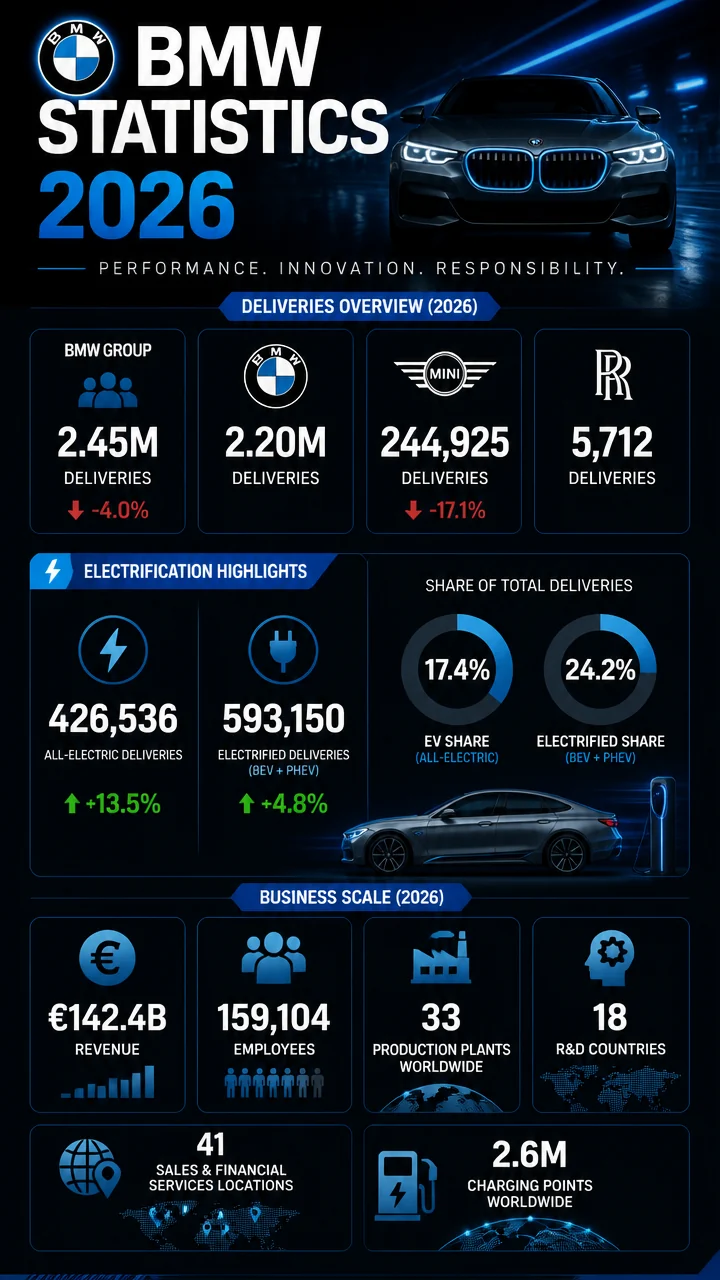
From 2.45 million deliveries to 426,536 all-electric vehicles and €142.4 billion in revenue, these BMW statistics show where the brand is gaining momentum and where pressure remains.
BMW statistics at a glance
Big number: BMW Group delivered 2,450,854 vehicles in 2024, down 4.0% from 2023.
Fast facts: The company sold 426,536 all-electric vehicles, had 2.6 million charging points worldwide, and generated €142.4 billion in revenue.
Why it matters: BMW’s total volume softened, but electrification and earnings remained strong enough to keep the company firmly in the premium auto race.
- 159,104 people worked for BMW Group at year-end 2024.
- 33 production and assembly plants supported global output.
- 18 countries hosted BMW Group research and development locations.
- 24.2% of deliveries were electrified vehicles.
- 17.4% of deliveries were all-electric vehicles.
BMW delivery statistics and brand performance
BMW Group’s total deliveries declined in 2024, but the weakness was uneven across brands.
BMW itself remained the core volume engine, while MINI saw a much sharper drop.
Pull quote: BMW brand deliveries totaled 2,200,217 in 2024 — more than 89% of the group’s total deliveries.
| Brand | 2024 deliveries | Change vs. 2023 |
|---|---|---|
| BMW Group | 2,450,854 | -4.0% |
| BMW brand | 2,200,217 | -2.3% |
| MINI | 244,925 | -17.1% |
| Rolls-Royce | 5,712 | -5.3% |
- BMW brand deliveries fell to 2,200,217 from 2,252,793.
- MINI deliveries dropped to 244,925 from 295,358, making MINI the steepest decline among the three brands.
- Rolls-Royce deliveries were 5,712, down from 6,032.
Key takeaway: BMW’s overall brand mix stayed heavily anchored by the BMW marque, while MINI’s drop had an outsized effect on group-level totals.
Compared with 2023, BMW Group’s total deliveries declined by 103,329 vehicles.
BMW brand volumes fell by 52,576, MINI lost 50,433, and Rolls-Royce declined by 320.
BMW electric vehicle statistics and electrification trends
Electrification was the clearest growth story in the BMW statistics dataset.
Even as total deliveries slipped, BMW Group expanded battery-electric volume and increased the electrified share of deliveries.
Big number: BMW Group sold 426,536 all-electric vehicles in 2024, up 13.5% year over year.
- All-electric deliveries rose from 375,716 in 2023 to 426,536 in 2024.
- Electrified deliveries — including BEVs and PHEVs — increased to 593,150 from 565,875.
- All-electric vehicles represented 17.4% of BMW Group deliveries, up from 14.7%.
- Electrified vehicles represented 24.2% of deliveries, up from 22.2%.
| Metric | 2024 | 2023 | Change |
|---|---|---|---|
| All-electric vehicles | 426,536 | 375,716 | +13.5% |
| Electrified vehicles | 593,150 | 565,875 | +4.8% |
| All-electric share of deliveries | 17.4% | 14.7% | +2.7 pts |
| Electrified share of deliveries | 24.2% | 22.2% | +2.0 pts |
Within the group, BMW brand led the EV effort in raw numbers:
- BMW brand BEV deliveries: 368,475, up 11.6% from 330,197.
- MINI BEV deliveries: 56,171, up 24.3% from 45,193.
- Rolls-Royce BEV deliveries: 1,890, up sharply from 326.
PHEV volume moved in the opposite direction.
BMW Group delivered 166,614 PHEVs in 2024, down 12.4% from 190,159.
- BMW brand PHEVs: 164,172, down 5.6%.
- MINI PHEVs: 2,442, down 85.0%.
Why it matters: BMW’s electric growth is being driven more by BEVs than plug-in hybrids, and MINI’s PHEV collapse makes that shift even more visible.
Notable pattern: The group’s all-electric share climbed faster than its total electrified share, signaling that BEVs are gaining importance faster than hybrids are.
BMW regional delivery statistics by market
BMW’s geographic performance in 2024 was a tale of two regions: Europe and the Americas held steady or improved slightly, while Asia — especially China — contracted noticeably.
Fast facts: Asia remained BMW Group’s largest regional market by volume, but it also posted the biggest absolute decline.
| Region / market | 2024 deliveries | 2023 deliveries | Direction |
|---|---|---|---|
| Asia | 963.6 thousand | 1,073.1 thousand | Down |
| Europe | 948.5 thousand | 943.0 thousand | Up |
| China | 715.2 thousand | 826.3 thousand | Down |
| Americas | 482.7 thousand | 482.0 thousand | Up |
| USA | 399.3 thousand | 397.3 thousand | Up |
| Germany | 265.7 thousand | 272.6 thousand | Down |
| UK | 168.8 thousand | 159.2 thousand | Up |
| Other markets | 56.1 thousand | 56.1 thousand | Flat |
- Asia fell by 109.5 thousand units year over year.
- China fell by 111.1 thousand units, closely mirroring the broader Asia decline.
- Europe edged up by 5.5 thousand units.
- Americas rose by just 0.7 thousand units, essentially flat.
- UK was one of the brighter spots, gaining 9.6 thousand units.
Pull quote: BMW Group delivered 715.2 thousand vehicles in China in 2024, making it one of the most important — and most challenged — markets in the data.
Regional insight: BMW’s 2024 geography suggests that growth in Western markets did not fully offset the softness in Asia, especially China.
BMW revenue, profit, and cash flow statistics
BMW’s financial results stayed solid despite lower deliveries.
The company generated high revenue, healthy earnings, and strong cash flow alongside continued investment.
Big number: BMW Group reported €142.4 billion in revenue in 2024.
| Financial metric | 2024 result |
|---|---|
| BMW Group revenue | €142.4 billion |
| Automotive revenue | €124.4 billion |
| Motorcycles revenue | €3.2 billion |
| Automotive segment EBIT | €7.9 billion |
| Automotive EBIT margin | 6.3% |
| Motorcycles EBIT | €257 million |
| Motorcycles EBIT margin | 7.9% |
| Pre-tax earnings | €11.0 billion |
| Net profit | €7.7 billion |
| Earnings per common share | €11.62 |
| Earnings per preferred share | €11.64 |
| Proposed dividend per common share | €4.30 |
| Proposed dividend per preferred share | €4.32 |
| Payout ratio | 36.7% |
At a glance:
- Automotive revenue accounted for the vast majority of group sales at €124.4 billion.
- Motorcycles was a much smaller but profitable business, with a 7.9% EBIT margin.
- Net profit of €7.7 billion shows BMW remained highly profitable despite lower deliveries.
- Operating cash flow of €16.8 billion gave the company room to invest and return cash to shareholders.
Why it matters: BMW’s earnings profile suggests that volume is only part of the story; mix, pricing, and efficiency remain critical to its financial strength.
Cash flow also stayed meaningful in 2024:
- Operating cash flow: €16.8 billion
- Investing cash flow: -€11.1 billion
- Automotive free cash flow: €4.9 billion
Those figures point to a business still investing heavily while keeping free cash flow positive in the automotive segment.
BMW R&D, workforce, and charging network statistics
BMW’s scale extends beyond car deliveries.
The company’s 2024 statistics show a large global footprint in research, production, talent, and EV infrastructure.
Fast facts: BMW Group operated 41 sales subsidiaries and Financial Services locations, 33 plants, and R&D sites in 18 countries.
- Research and development expenditure: €9.1 billion
- Research and development expenses: €7.6 billion
- Capitalized development costs: €3.5 billion
- R&D expenditure ratio: 6.4%
- Capitalisation rate for development costs: 38.8%
- Women in management ratio: 21.7%
Pull quote: BMW invested €9.1 billion in research and development in 2024, underscoring the scale required to stay competitive in electrification and software-led vehicle development.
The workforce and infrastructure base is just as notable:
- 159,104 employees at year-end 2024.
- 2.6 million charging points worldwide.
- More than 820,000 charging points in Europe, covering more than 90% of the region.
- 720 IONITY charging stations with more than 4,800 charging points across 24 countries.
- Each IONITY charger supported up to 350 kW.
Why it matters: BMW’s EV story is supported by more than vehicle sales — it also depends on a large, visible charging network and sustained R&D spending.
Scale indicator: The 2.6 million charging points worldwide make BMW’s EV ecosystem one of the most infrastructure-rich stories in the dataset.
Key takeaways from BMW statistics
- BMW Group delivered 2.45 million vehicles in 2024, but total volume fell 4.0% year over year.
- Electrification remained the growth engine: all-electric deliveries rose 13.5% and reached 17.4% of total deliveries.
- MINI was the weakest brand in the lineup, with deliveries down 17.1% and PHEVs down 85.0%.
- China and Asia softened materially, while Europe, the UK, and the Americas were steadier.
- BMW stayed highly profitable with €142.4 billion in revenue and €7.7 billion in net profit.
- R&D spending, plant scale, and charging infrastructure show how much BMW is investing to support the next phase of growth.
At a glance: BMW’s 2024 profile is best described as a high-volume, high-investment premium manufacturer with steady profits and accelerating EV adoption.