BMW ownership statistics are really a story about scale: a premium brand moving millions of vehicles, shifting fast into electrification, and still posting strong demand in key markets like the U.S. and Europe.
The newest numbers show where BMW is winning, where growth has slowed, and which models and regions are doing the heavy lifting.
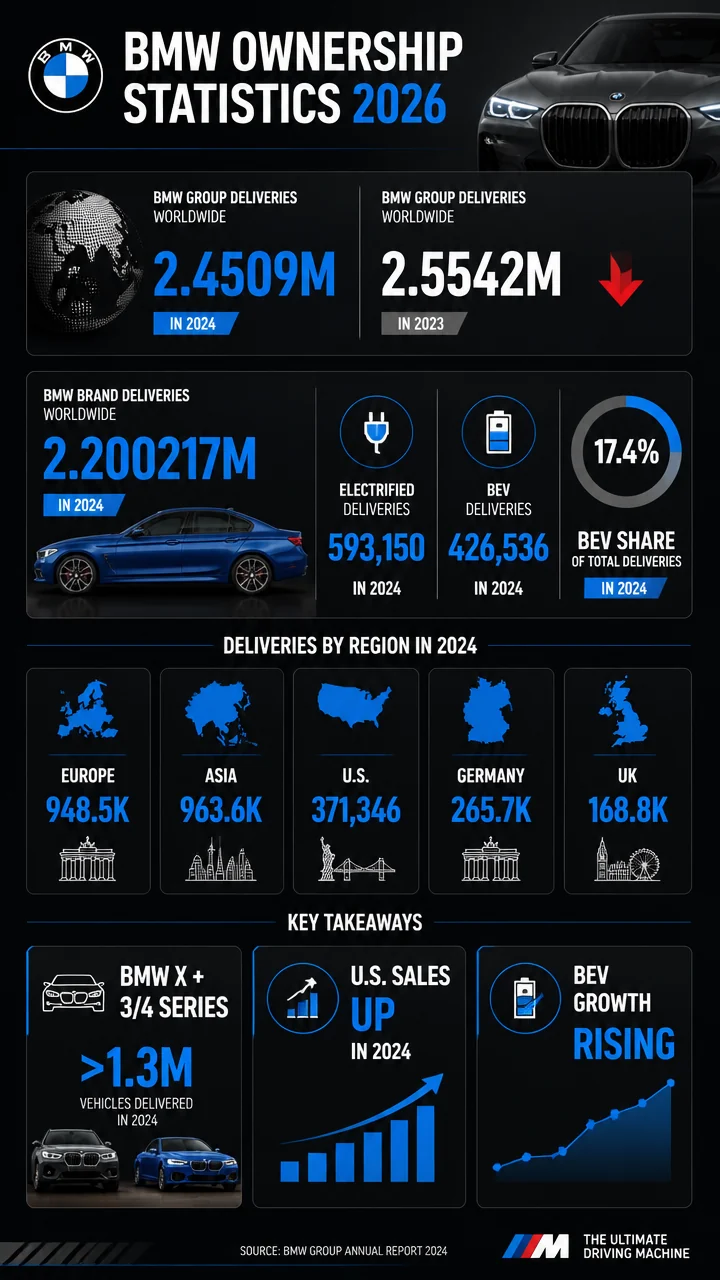
- BMW Group delivered 2.4509 million vehicles worldwide in 2024.
- BMW brand deliveries reached 2,200,217 units in 2024.
- BMW Group sold 426,536 BEVs in 2024, equal to a 17.4% BEV share.
- BMW electrified deliveries totaled 593,150 vehicles in 2024.
- In the U.S., BMW brand sales hit 371,346 vehicles in 2024.
BMW ownership statistics: key takeaways
- BMW Group deliveries were down modestly in 2024 versus 2023, but the brand remained above 2.4 million global vehicles.
- Europe remained BMW Group’s largest delivery region in 2024 with 948.5 thousand vehicles.
- Asia was still BMW’s second-largest region, though deliveries fell to 963.6 thousand in 2024 from 1,073.1 thousand in 2023.
- BMW’s U.S. sales grew in 2024, with both total brand sales and BEV volume rising year over year.
- The BMW X and 3/4 Series families continued to anchor volume, together accounting for more than 1.3 million vehicles in 2024.
BMW ownership statistics by global deliveries and market reach
BMW Group’s worldwide delivery base remains large enough to define the premium market.
In 2024, the company delivered 2,450.9 thousand vehicles worldwide, slightly below 2,554.2 thousand in 2023 but still comfortably above 2020 levels.
Big number: BMW Group has stayed in the 2.3 million to 2.6 million annual delivery range over the last five years, showing a stable global footprint even as markets shifted.
| Year | BMW Group worldwide deliveries |
|---|---|
| 2024 | 2,450.9 thousand |
| 2023 | 2,554.2 thousand |
| 2022 | 2,399.6 thousand |
| 2021 | 2,521.5 thousand |
| 2020 | 2,325.2 thousand |
That five-year pattern matters for ownership because it suggests BMW’s installed base is being refreshed at a huge scale.
When a brand sells this consistently, the pool of current owners, repeat buyers, and used-market shoppers stays deep.
BMW’s delivery volume gives the brand a broad ownership ecosystem: service, resale, financing, and loyalty all benefit when annual deliveries remain this high.
BMW ownership statistics by region: Europe, Asia, and the Americas
Regional delivery numbers show where BMW ownership is concentrated.
Europe is still the core engine, while Asia and the Americas provide major scale and strategic balance.
| Region | 2024 deliveries | 2023 deliveries | Trend |
|---|---|---|---|
| Europe | 948.5 thousand | 943.0 thousand | Flat to slightly up |
| Asia | 963.6 thousand | 1,073.1 thousand | Down |
| Americas | 482.7 thousand | 482.0 thousand | Essentially flat |
Pull-quote stat: BMW delivered more than 948 thousand vehicles in Europe in 2024, keeping the region as its largest single market block.
- Europe: 948.5 thousand in 2024, up from 943.0 thousand in 2023.
- Asia: 963.6 thousand in 2024, down from 1,073.1 thousand in 2023.
- Americas: 482.7 thousand in 2024, almost unchanged from 482.0 thousand in 2023.
Germany, the UK, the U.S., and China help define BMW ownership patterns within these regions.
That creates a mix of mature demand in Europe, enormous scale in Asia, and strong premium-brand loyalty in North America.
BMW ownership statistics in Germany, the UK, the U.S., and China
BMW’s most important country-level markets highlight just how differently the brand performs by geography.
Some markets are mature and stable; others are more cyclical but still massive.
| Country | 2024 deliveries | 2023 deliveries | 2022 deliveries | 2021 deliveries | 2020 deliveries |
|---|---|---|---|---|---|
| Germany | 265.7 thousand | 272.6 thousand | 254.3 thousand | 266.8 thousand | 285.0 thousand |
| UK | 168.8 thousand | 159.2 thousand | 157.3 thousand | 164.3 thousand | 163.2 thousand |
| USA | 399.3 thousand | 397.3 thousand | 363.5 thousand | 368.0 thousand | 307.9 thousand |
| China | 715.2 thousand | 826.3 thousand | 793.5 thousand | 847.9 thousand | 778.4 thousand |
- China is BMW’s largest single country market in the dataset, but 2024 deliveries fell to 715.2 thousand from 826.3 thousand in 2023.
- The U.S. is BMW’s strongest growth story among the big markets shown here, rising from 307.9 thousand in 2020 to 399.3 thousand in 2024.
- Germany stayed above 265 thousand in 2024, but remains below its 2020 level of 285.0 thousand.
- The UK showed steady improvement in 2024, reaching 168.8 thousand after several years near the mid-160-thousand range.
BMW ownership tends to be deepest where local brand awareness, dealer coverage, and premium-car demand are strongest.
These four markets help explain the brand’s global resilience.
BMW ownership statistics in the U.S.: sales, electrification, and retail footprint
The U.S. is one of the clearest places to see BMW ownership momentum in action.
BMW brand sales reached 371,346 vehicles in 2024, up from 362,244 in 2023.
Big number: BMW sold 70,379 electrified vehicles in the U.S. in 2024, equal to 19% of total sales.
| U.S. metric | 2024 | 2023 |
|---|---|---|
| BMW brand sales | 371,346 | 362,244 |
| BEV sales | 50,981 | 45,417 |
| Plug-in hybrid sales | 19,398 | N/A |
| Electrified vehicle sales | 70,379 | N/A |
- BMW BEV sales in the U.S. rose to 50,981 in 2024, up from 45,417 in 2023.
- Q4 2024 U.S.
BMW sales reached 117,506 vehicles
, compared with 107,881 in Q4 2023. - Q1 2024 U.S.
BMW sales were 90,844
including MINI and total BMW of North America volume. - Q2 2024 total BMW of North America volume hit 97,135 including MINI.
- Q3 2024 total BMW of North America volume was 83,412 including MINI.
- BMW had 4 fully electric BEV models in the U.S. at the start of 2024.
- BMW Group had 350 BMW retailers in the U.S. in 2024.
- BMW Group had 104 MINI dealers in the U.S. in 2024.
- BMW Group had 38 Rolls-Royce dealers in the U.S. in 2024.
- BMW Group had 147 BMW motorcycle retailers in the U.S. in 2024.
A wide retail and model footprint supports repeat ownership.
The U.S. network is not just selling cars; it is keeping the BMW ecosystem active across multiple brands and price points.
BMW ownership statistics by model mix: which series carry the brand
BMW’s model mix tells a lot about ownership behavior.
In 2024, volume concentrated heavily in the core sedan and SUV families, with a clear split between traditional series models and X vehicles.
| BMW model family | 2024 deliveries |
|---|---|
| 3 Series / 4 Series | 519,228 |
| X1 / X2 | 413,386 |
| X3 / X4 | 370,198 |
| X5 / X6 | 275,318 |
| 5 Series / 6 Series | 250,674 |
| 1 Series / 2 Series | 198,226 |
| X7 | 59,949 |
| 7 Series / 8 Series | 56,542 |
| X iX | 38,365 |
| Z4 | 10,482 |
| i3 / i8 | 36 |
Pull-quote stat: BMW delivered 519,228 units of the 3 Series / 4 Series family in 2024, making it the brand’s largest model group in the data.
- SUV ownership remains central: X1/X2, X3/X4, X5/X6, and X7 combined reached well over 1.1 million vehicles in 2024.
- The 3 Series/4 Series family still leads, showing the durability of BMW’s core sporty sedan identity.
- Upper-luxury series are smaller but meaningful, with the 7 Series/8 Series and X7 contributing premium halo volume.
- BMW’s electric specialty models remain niche in the dataset, especially the i3/i8 line at just 36 units.
BMW ownership is increasingly shaped by crossovers and SUVs, but the brand’s traditional sedan base is still the single biggest anchor for volume.
BMW ownership statistics and electrification growth
BMW’s electrification numbers show a brand that is scaling EVs without abandoning its broader portfolio.
In 2024, BMW Group delivered 426,536 BEVs and 593,150 electrified vehicles across BEV and PHEV.
| Electrification metric | 2024 | 2023 | Change |
|---|---|---|---|
| BMW Group BEVs | 426,536 | 375,716 | Up |
| BMW Group electrified vehicles | 593,150 | 565,875 | Up |
| BMW Group BEV share of total deliveries | 17.4% | N/A | N/A |
| BMW Group electrified share of total deliveries | 24.2% | N/A | N/A |
- BEVs accounted for 17.4% of BMW Group deliveries in 2024.
- Electrified vehicles made up 24.2% of BMW Group deliveries.
- BMW brand BEV deliveries reached 368,475 units in 2024, up from 330,197 in 2023.
- BMW brand PHEV deliveries reached 164,172 in 2024, down from 173,878 in 2023.
That mix suggests BMW’s electrification strategy is still broad-based.
BEVs are growing, PHEVs remain relevant, and the brand’s overall delivery profile still depends on a large set of combustion and electrified models.
BMW ownership statistics by brand portfolio: BMW, MINI, and Rolls-Royce
BMW Group is more than one brand, and that matters for understanding its ownership ecosystem.
MINI adds broad compact-car reach, while Rolls-Royce delivers ultra-luxury exclusivity.
- BMW brand deliveries: 2,200,217 in 2024.
- MINI deliveries: 244,925 in 2024.
- Rolls-Royce deliveries: 5,712 in 2024.
| Brand | 2024 deliveries | Notable model detail |
|---|---|---|
| BMW | 2,200,217 | 3 Series/4 Series led with 519,228 units |
| MINI | 244,925 | Hatch led with 128,635 units |
| Rolls-Royce | 5,712 | Cullinan led with 2,590 units |
MINI’s 2024 lineup shows a brand in transition: Hatch deliveries reached 128,635, Countryman hit 80,971, and the new Aceman posted 5,632 units.
Rolls-Royce stayed tiny by volume but powerful by positioning, with Cullinan at 2,590 units and Spectre at 1,890.
BMW Group ownership stats do not just measure BMW cars.
They map a premium ecosystem spanning volume luxury, compact urban mobility, motorcycles, and ultra-luxury prestige.
BMW ownership statistics by U.S. production and dealer network
BMW’s U.S. base is supported by serious manufacturing scale.
At Plant Spartanburg, BMW Group assembled more than 1,500 vehicles per day in 2024, with up to 450,000 annual vehicle capacity.
Plant Spartanburg has assembled nearly 7 million BMW vehicles in the U.S. since 1994.
- 350 BMW retailers give the brand broad national coverage.
- 147 BMW motorcycle retailers expand the BMW footprint beyond passenger cars.
- 104 MINI dealers support the compact premium segment.
- 38 Rolls-Royce dealers keep the ultra-luxury network selective and exclusive.
That infrastructure helps explain why BMW ownership in America is not only a sales story but also a service, resale, and loyalty story.
The network is large enough to support mainstream premium demand while still preserving the brand’s upmarket image.
BMW ownership statistics: what the numbers suggest about demand trends
The dataset points to a few clear demand themes.
BMW is not chasing growth everywhere at once; instead, it is balancing mature regional strength with electrification and model-mix optimization.
- China remains huge, but 2024 deliveries were meaningfully below 2023.
- The U.S. is a bright spot, with total sales, BEVs, and electrified vehicles all showing strong scale.
- Europe is steady, especially relative to BMW’s long-term presence there.
- SUVs are now a core ownership pattern, not a side story.
- Electrification is no longer niche, but it is still a minority share of total deliveries.
Pull-quote stat: BMW Group’s 24.2% electrified share in 2024 means roughly one in four deliveries had some form of electrification.
BMW ownership statistics compared with model and region benchmarks
Some of the most useful comparisons come from lining up the biggest delivery pools against the brand’s smaller but strategically important segments.
| Benchmark | 2024 figure | What it shows |
|---|---|---|
| Worldwide BMW Group deliveries | 2,450.9 thousand | The size of BMW’s global ownership base |
| BMW brand deliveries | 2,200,217 | BMW remains the core of the group |
| BMW BEV deliveries | 368,475 | EV adoption is scaling |
| BMW Group BEV deliveries | 426,536 | Group-wide EV volume is broader than BMW alone |
| BMW U.S. sales | 371,346 | The U.S. is a major ownership market |
| Rolls-Royce deliveries | 5,712 | Ultra-luxury remains highly exclusive |
Among the most interesting contrasts in the dataset is how BMW’s scale varies by segment.
A single model family like the 3 Series/4 Series can move more than half a million units, while a halo brand like Rolls-Royce moves only a few thousand by design.
Both play an important role in the wider BMW Group ownership picture.
BMW ownership statistics show a brand that is simultaneously mass-premium, electrifying, and still deeply tied to SUVs and core sedan families.
Across regions, models, and powertrains, the 2024 numbers paint a clear picture: BMW’s ownership base is large, diverse, and still evolving.
The strongest signals are steady global volume, durable U.S. demand, and a rapidly expanding electrified mix that is becoming central to the brand’s future.