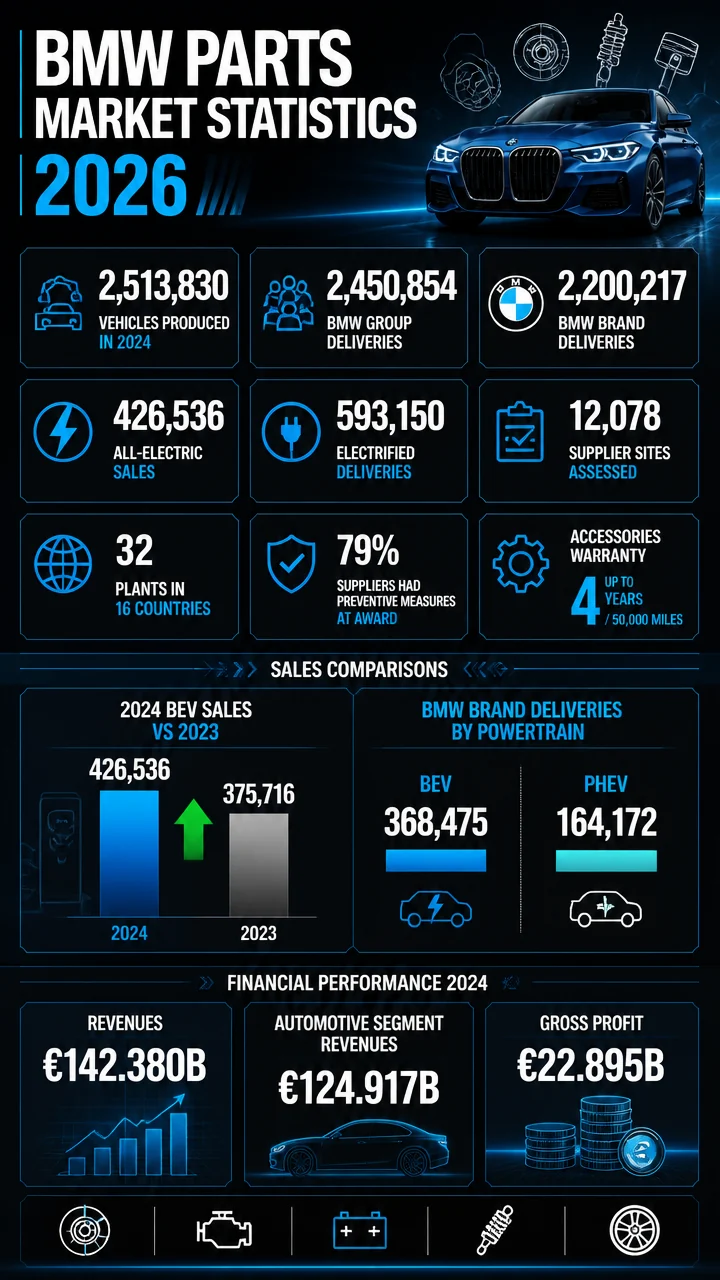
BMW parts market statistics are best understood through the company’s production scale, electrification mix, supplier base, and aftersales signals.
The latest figures show a market that is still enormous, but also being reshaped by EV growth, global manufacturing complexity, and a growing focus on reuse and remanufacturing.
Below, we break down the most relevant BMW market data for parts demand, sourcing, warranty coverage, and manufacturing footprint so you can quickly see where the pressure points and opportunities are.
At a glance: BMW parts market statistics
- 2,513,830 vehicles were produced by BMW Group in 2024, a huge base for OEM and aftermarket parts demand.
- 12,078 supplier sites were assessed with Drive Sustainability online in the reporting year.
- 32 production plants across 16 countries show how globally distributed BMW parts sourcing has become.
- 426,536 all-electric vehicles were sold in 2024, raising the importance of EV-specific parts and components.
- 79% of suppliers of production-related material had preventive measures implemented at award.
- BMW original accessories carry a limited warranty of up to 4 years/50,000 miles.
Table of contents
- BMW parts market size and production scale
- BMW sales trends that drive parts demand
- EV and electrification statistics shaping parts mix
- Supplier, sourcing, and production network data
- Aftersales, accessories, and warranty benchmarks
- Recycling, remanufacturing, and circular parts economy
- Regional and plant-level highlights
BMW parts market statistics by production scale
Big number: BMW Group produced 2,513,830 vehicles in 2024.
That scale matters because every vehicle built creates ongoing demand for original parts, replacement components, service items, accessories, logistics, and repair support.
The company’s industrial footprint also points to a broad and diversified parts network: BMW Group operates 32 production plants worldwide and production sites in 16 countries.
Fast facts on BMW’s manufacturing base
- 32 plants worldwide support the production network.
- 17 locations and two partner plants are used for drivetrain production.
- 8 named locations are cited as all-electric automobile production sites.
- €91.8 billion was BMW Group’s purchase volume in 2024.
For the parts market, purchase volume is especially important: a procurement figure of €91.8 billion signals enormous upstream demand for materials, assemblies, and supplier capacity.
In practical terms, this helps explain why BMW’s parts ecosystem is so large and so closely tied to industrial planning.
BMW parts market trends from sales and delivery data
Vehicle deliveries are one of the clearest indicators of future parts demand.
BMW Group delivered 2,450,854 vehicles in 2024, down from 2,554,183 in 2023.
Even with that decline, the brand still moved a massive installed base into service, warranty, and replacement cycles.
The BMW brand itself delivered 2,200,217 automobiles in 2024.
MINI delivered 244,925, while Rolls-Royce delivered 5,712.
Those figures show that BMW parts demand is not limited to one brand line; it spans mainstream luxury, premium compact, and ultra-luxury segments.
| Category | 2024 deliveries | 2023 deliveries | Trend |
|---|---|---|---|
| BMW Group total | 2,450,854 | 2,554,183 | Down |
| BMW brand | 2,200,217 | 2,252,793 | Down |
| MINI | 244,925 | 295,358 | Down |
| Rolls-Royce | 5,712 | 6,032 | Down |
| BMW Motorrad | 210,385 | Not provided | Reported up |
Why it matters
When deliveries remain above 2.4 million units, the parts opportunity stays substantial even if sales soften year over year.
Every delivered vehicle feeds future demand for:
- scheduled maintenance parts,
- collision and repair components,
- wear-and-tear consumables,
- electronic modules and software-linked parts,
- accessories and personalization items.
BMW parts market statistics and electrification growth
Key stat: BMW Group sold 426,536 all-electric vehicles in 2024, up from 375,716 in 2023.
That growth matters because EV adoption changes the parts mix, service content, and repair complexity.
BMW Group’s electrified deliveries, which include both BEVs and PHEVs, totaled 593,150 in 2024 versus 565,875 in 2023.
That means electrified vehicles made up an increasingly important slice of the company’s total delivery mix.
Electrification by the numbers
- 426,536 all-electric vehicle sales in 2024.
- 593,150 electrified vehicle deliveries in 2024.
- 368,475 BMW brand BEV deliveries in 2024.
- 164,172 BMW brand PHEV deliveries in 2024.
- 56,171 MINI BEV deliveries in 2024.
- 1,890 Rolls-Royce BEV deliveries in 2024.
| Electrified category | 2024 | 2023 | Change direction |
|---|---|---|---|
| All-electric vehicles | 426,536 | 375,716 | Up |
| Electrified vehicles (BEV + PHEV) | 593,150 | 565,875 | Up |
| BMW brand BEV | 368,475 | 330,197 | Up |
| BMW brand PHEV | 164,172 | 173,878 | Down |
| MINI BEV | 56,171 | 45,193 | Up |
| MINI PHEV | 2,442 | 16,281 | Down |
| Rolls-Royce BEV | 1,890 | 326 | Up sharply |
Pull quote: BMW’s electric shift is not just a sales story; it is a parts-market story.
More BEVs typically means different maintenance items, fewer engine-related components, and a growing need for batteries, power electronics, cooling systems, and software-enabled service workflows.
BMW parts market benchmarks from brand and segment splits
The brand breakdown shows how parts demand is spread across distinct usage patterns.
BMW’s core brand still dominates the volume mix, but MINI and Rolls-Royce add different service profiles, different parts SKUs, and different ownership expectations.
- BMW brand: 2,200,217 deliveries in 2024.
- MINI: 244,925 deliveries in 2024.
- Rolls-Royce: 5,712 deliveries in 2024.
- BMW Motorrad: 210,385 deliveries in 2024.
Interesting pattern: MINI’s 2024 deliveries fell from 295,358 to 244,925, while MINI BEV deliveries increased from 45,193 to 56,171.
That suggests a changing product mix even as total volume declined.
Another notable shift: Rolls-Royce BEV deliveries climbed from 326 to 1,890, a dramatic rise that points to a rapidly evolving luxury EV parts profile.
BMW supplier and sourcing data behind the parts market
Fast fact: BMW Group assessed 12,078 supplier sites with the Drive Sustainability online assessment in the reporting year.
That is a strong indicator of how deeply the company is monitoring its supply base for compliance, resilience, and sustainability.
The company also inspected 132 active and potential supplier sites and reported that 79% of suppliers of production-related material implemented the specified preventive measures at award.
Another 17% had agreed on those measures at award.
Supplier-side takeaways
- 12,078 supplier sites were assessed online.
- 132 supplier sites were inspected directly.
- 79% implemented preventive measures at award.
- 17% had agreed to preventive measures at award.
For the BMW parts ecosystem, these supplier metrics matter because parts availability depends not only on demand, but on how quickly suppliers can meet quality, sustainability, and operational expectations.
A large and active supplier base supports breadth of parts coverage, but it also increases the need for oversight.
BMW aftersales parts statistics: accessories, service, and warranty
The official BMW aftersales setup gives a strong signal that the parts market is not purely a factory-side story.
Owners are directed to shop BMW Parts & Accessories through My BMW Garage and shopbmwusa.com, which confirms the importance of owned retail and service channels.
Warranty benchmark: BMW original accessories come with a limited warranty of up to 4 years/50,000 miles.
If dealer installation happens after retail sale, the accessory carries the remainder of the New Vehicle/SAV Limited Warranty period or the limited parts warranty for 2 years from installation, whichever is greater.
Owner-resource signals
- BMW Parts & Accessories shopping is directed through official BMW channels.
- BMW Maintenance Programs are listed as an owner resource.
- BMW Service is listed as an owner resource.
- BMW Warranty Information is listed as an owner resource.
Why it matters: These resources help keep owners inside the BMW ecosystem for parts, service, and maintenance decisions, which can support stronger accessory sales and a more controlled repair pathway.
BMW circular economy and remanufactured parts statistics
Big number: BMW Group says thousands of vehicles are dismantled each year at its Lohhof recycling and dismantling center near Munich.
That gives the company a meaningful feedstock for parts recovery and material reuse.
BMW Group also says its remanufacturing process reconditions used parts and gives them a second life.
The company holds 50% ownership of Encory GmbH, its circular economy joint venture, since 2016.
- Encory GmbH: 50% BMW Group ownership.
- Lohhof center: thousands of vehicles dismantled each year.
- Remanufacturing: used parts are reconditioned for second-life use.
This part of the BMW parts market is especially relevant for cost-conscious repair, materials recovery, and sustainability-focused supply chains.
As EV and premium vehicle complexity rises, remanufacturing can play a larger role in keeping parts affordable and available.
BMW regional and plant-level statistics that affect parts supply
BMW’s plant geography has direct implications for parts logistics, export demand, and regional supplier networks.
The company listed vehicle plants across major production hubs including Araquari, Berlin, Chennai, Debrecen, Dingolfing, Goodwood, Leipzig, Manaus, Munich, Oxford, Rayong, Rosslyn, San Luis Potosi, Spartanburg, Steyr, and Tiexi.
BMW Group also produced all-electric automobiles at named locations including Dingolfing, Munich, Regensburg, Leipzig, Goodwood, Oxford, Chennai, Shenyang, and Zhangjiagang.
Spartanburg: the standout North American export hub
Nearly 225,000 BMW Sports Activity Vehicles and Coupes were exported from Plant Spartanburg in 2024, with an export value of more than $10 billion.
Over the 2014 to 2024 period, Spartanburg exported more than 2.7 million BMWs with an export value exceeding $104 billion.
BMW Manufacturing also assembled 396,117 Sports Activity Vehicles and Coupes in 2024, and more than 57,000 plug-in hybrid electric vehicles were assembled there.
Plug-in hybrids made up more than 14% of Spartanburg’s 2024 volume.
Notable detail: Nearly 50% of all BMWs sold in the U.S. were assembled at Plant Spartanburg in 2024.
| Spartanburg metric | 2024 figure |
|---|---|
| Exports | Nearly 225,000 vehicles |
| Export value | More than $10 billion |
| 2014–2024 exports | More than 2.7 million BMWs |
| 2014–2024 export value | More than $104 billion |
| Total 2024 assembly | 396,117 SAVs and Coupes |
| 2024 PHEV assembly | More than 57,000 units |
What BMW parts market statistics say about demand in 2026
Key takeaways
- The parts market is anchored by a production base of 2.5 million+ vehicles a year.
- Electrification is expanding quickly, with 426,536 BEVs sold in 2024.
- The supplier network is broad and heavily monitored, with 12,078 supplier sites assessed online.
- Aftersales is clearly structured around official channels, warranty coverage, and owner resources.
- Recycling and remanufacturing are increasingly relevant to parts recovery and second-life use.
- Regional plants like Spartanburg show how production and exports shape parts logistics well beyond Germany.
Pull-quote statistic: BMW’s parts ecosystem is being pulled in two directions at once: higher EV content on one side, and massive global scale on the other.
That combination is what makes BMW parts market statistics so useful for forecasting demand, sourcing, and service strategy.